
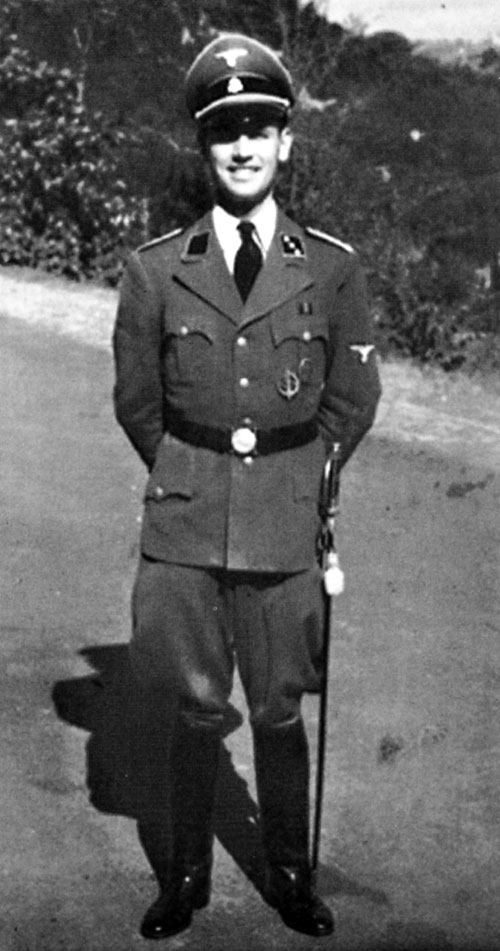
Erich Priebke is a name that resonates deeply in the annals of World War II history, synonymous with one of the most infamous massacres in Europe. Born on July 29, 1913, in Hennigsdorf, Germany, Priebke’s life trajectory took him from a young man who joined the Nazi Party at the age of 20 to a notorious SS captain involved in the atrocities of the Holocaust. His story, marked by war crimes, evasion of justice, and a belated trial, is a stark reminder of the horrors of war and the long arm of justice.
Early Life and Rise in the Nazi Party
Erich Priebke’s early life in Germany was unremarkable until his early twenties when he joined the National Socialist German Workers’ Party (Nazi Party). His zeal and dedication to the party’s ideologies caught the attention of Heinrich Himmler, one of the principal architects of the Holocaust and the head of the SS (Schutzstaffel). Priebke’s alignment with the Nazi regime’s most radical elements saw him rise through the ranks, eventually becoming an officer in the feared SS.
World War II and Involvement in the Fosse Ardeatine Massacre
During World War II, Priebke served in Italy, where he played a crucial role in executing the directives of the Nazi regime. By 1942, he had become the head of the Gestapo’s Brescia division, where his reputation for brutality and ruthlessness against the local population was well-established. However, his most notorious act came after his transfer to Rome in 1943.
On March 23, 1944, a partisan attack by the Gruppi di Azione Patriottica (GAP) on a German police battalion in Rome resulted in 33 German soldiers’ deaths. In retaliation, Hitler ordered the execution of ten Italians for every German killed. This led to the massacre at the Fosse Ardeatine, where 335 Italian civilians were executed in cold blood. Priebke, under the command of Herbert Kappler, was instrumental in organizing and carrying out these executions, personally shooting many of the victims.
Escape to Argentina and the “Ratline”
As the war ended and the Nazi regime crumbled, Priebke, like many other war criminals, sought to escape justice. With the help of the infamous “Ratline” network—a clandestine escape route for Nazis fleeing Europe—Priebke made his way to Argentina. The network, reportedly managed by Father Krunoslav Draganovic and with the assistance of certain elements within the Vatican, facilitated the relocation of numerous high-ranking Nazis to South America. Priebke settled in San Carlos de Bariloche, a picturesque town near the Andes, where he lived under the radar for decades.
Eluding Justice and the Pursuit by the Simon Wiesenthal Center
For many years, Erich Priebke lived quietly in Argentina, successfully avoiding the attention of international law enforcement and war crimes tribunals. The Nuremberg Trials, which sought to bring Nazi war criminals to justice, had ended without Priebke ever facing a courtroom. His existence was almost forgotten until the early 1990s when a member of the Simon Wiesenthal Center, an organization dedicated to tracking down Nazi war criminals, discovered him living openly in Bariloche.
This discovery reignited the international community’s interest in Priebke’s war crimes. In 1994, after nearly fifty years of evading justice, the Argentine government was compelled to act. Despite legal battles and appeals that initially blocked his extradition, Priebke was eventually sent back to Italy in 1995 to face trial.
The Trials and Legal Battles
Erich Priebke’s trial in Italy became a focal point of international attention, drawing criticism and protest from various quarters, especially from Jewish organizations and Holocaust survivors. The trial was complicated by issues such as the statute of limitations and legal technicalities, which initially led to a controversial ruling that acquitted him of some charges due to the expiration of the statute of limitations. This ruling sparked outrage and led to widespread protests.
However, the Italian judiciary was not finished with Priebke. The Court of Cassation, Italy’s highest court, overturned the initial ruling, leading to a retrial. In 1998, Priebke was sentenced to life imprisonment by the Military Court of Appeals, alongside Karl Haas, another former SS officer involved in the massacre. Due to his advanced age and poor health, Priebke’s life sentence was later reduced to house arrest, where he remained until his death.
Later Years and Death
Despite his convictions, Priebke remained unrepentant until the end of his life, often justifying his actions during the war as following orders. His lack of remorse further fueled public outrage and underscored the horrors of the Holocaust and the brutalities committed by the Nazi regime.
Erich Priebke lived to be 100 years old, dying in Rome on October 11, 2013. His death was met with mixed reactions; while some viewed it as the end of a painful chapter in history, others saw it as a reminder of the delayed justice that many Nazi war criminals evaded for decades.
Legacy and Historical Context
The life of Erich Priebke serves as a grim reminder of the atrocities committed during World War II and the Holocaust. His involvement in the Fosse Ardeatine massacre stands as a symbol of the extreme cruelty of the Nazi regime. The fact that he lived a comfortable life in Argentina for so many years highlights the challenges of bringing war criminals to justice, particularly those who managed to escape Europe in the post-war chaos.
Priebke’s trial also brought to the forefront the moral and legal complexities involved in prosecuting war crimes decades after they were committed. The debates over the statute of limitations, the responsibility of following orders, and the role of international law in such cases are all intricately tied to Priebke’s story. His life and trial continue to be studied in legal and historical contexts, offering insights into the challenges of transitional justice and the enduring impact of World War II on global politics and law.
Conclusion
Erich Priebke’s life is a stark illustration of the horrors of the Nazi era and the long journey toward justice for its victims. From his early days as a zealous Nazi party member to his involvement in one of Italy’s most heinous war crimes, Priebke’s story is one of brutality, evasion, and eventual accountability. His legacy serves as a cautionary tale about the dangers of extremism and the importance of remembering and addressing the atrocities of the past.
As history continues to judge figures like Priebke, it is crucial to remember the victims of his actions and the broader context in which these crimes occurred. The Fosse Ardeatine massacre, and Priebke’s role in it, remain a poignant reminder of the capacity for human cruelty and the necessity of vigilance in the face of such evil.


