
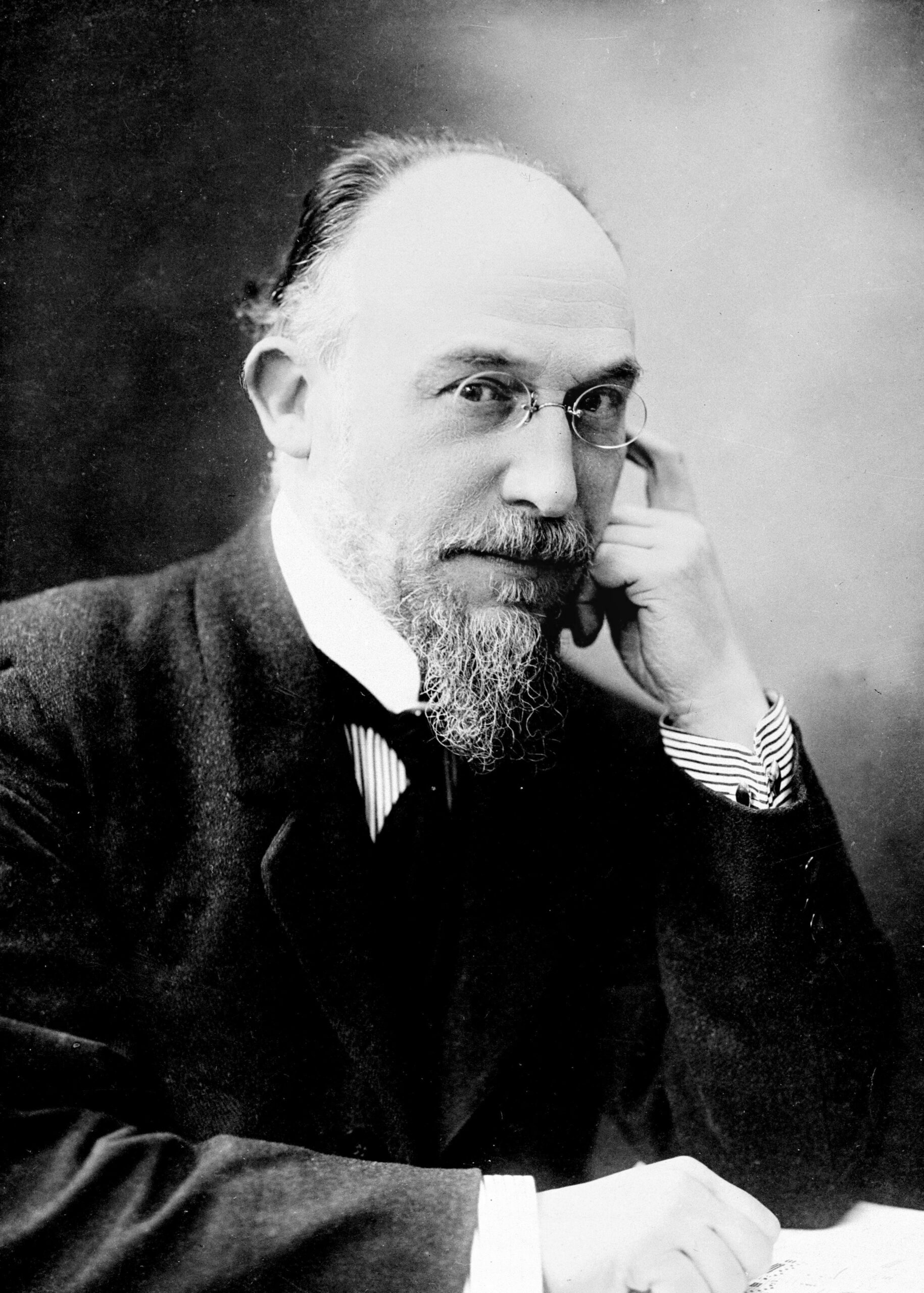
Erik Satie, born Alfred Éric Leslie Satie on May 17, 1866, in Honfleur, France, was a pioneering composer and pianist whose unconventional approach to music and composition has left a lasting impact on the world of music. Known for his eccentricity, wit, and disdain for the academic establishment, Satie’s work laid the groundwork for many modernist movements in the 20th century. His life was marked by a constant search for artistic authenticity, a challenge to norms, and an enduring influence that extended beyond music into literature, visual arts, and philosophy. This article explores Erik Satie’s life, his rise to fame, and the key highlights of his career, offering detailed insights into his contributions to music and culture.
Early Life and Musical Beginnings
Erik Satie was born into a family with a rich cultural background. His father, a Norman shipping broker, and his mother, of Scottish descent, exposed him to a diverse set of influences from an early age. The Satie family moved to Paris when Erik was just four years old, after his father secured a job as a translator. Paris, with its vibrant cultural scene, played a crucial role in shaping Satie’s artistic sensibilities.
However, tragedy struck early in his life. In 1872, when Satie was just six years old, his mother passed away. Following her death, Satie and his younger brother Conrad were sent back to Honfleur to live with their paternal grandparents. It was here that Satie began his first formal music lessons under the guidance of a local organist, who introduced him to the fundamentals of composition and the organ.
In 1878, Satie’s grandmother also passed away, and the brothers returned to Paris to live with their father, who had remarried a piano teacher. This new stepmother took charge of Satie’s musical education, further nurturing his burgeoning talent. Despite this, Satie’s early formal music education at the Paris Conservatoire was fraught with challenges. His instructors often criticized him for his lack of discipline and unconventional approach, leading to his dismissal in 1882. This rejection left a lasting impact on Satie, fueling his later disdain for the rigidity of academic music institutions.
The Early Compositions and Montmartre Years
After leaving the Conservatoire, Satie enlisted in the military in 1885, seeking a change of pace. However, military life was not suited to his temperament. To escape, he intentionally exposed himself to cold weather, resulting in a severe case of bronchitis that led to his discharge. This experience pushed Satie back into the world of music, and he moved to the Montmartre district of Paris in 1887, a hub for artists, writers, and musicians.
Montmartre was a melting pot of creative energy, and Satie quickly became a part of its bohemian scene. He developed a close friendship with the romantic poet Patrice Contamine, and his father published his first compositions. These early works, including Gymnopédies (1888) and Gnossiennes (1890), displayed Satie’s emerging style—simple, atmospheric pieces that broke away from the grandiose structures typical of the time.
In 1890, Satie moved to a small apartment at 6 Rue Cortot in Montmartre. Here, he immersed himself in the vibrant cultural life of the neighborhood, frequenting the cabaret Le Chat Noir, where he became acquainted with fellow composers and artists, including Claude Debussy. Satie’s compositions during this period, such as the Sarabandes and Pièces froides, were characterized by their subtle harmonies and unique rhythmic structures, which would later influence Debussy’s own work.
During this time, Satie also became involved with the esoteric and mystical movements that were popular in Paris. He joined the “Ordre Kabbalistique de la Rose-Croix,” a mystical order founded by Joséphin Péladan, and composed music for their rituals. His works from this period, including Sonneries de la Rose+Croix and Le Fils des étoiles, reflect his interest in mysticism and his attempt to merge music with spiritual experience.
The “Furniture Music” and Anti-Academic Stance
Satie’s disdain for the academic musical establishment deepened during the 1890s. He rejected the pretensions of the classical tradition and sought to create music that was accessible, functional, and devoid of unnecessary complexity. This period saw the creation of what Satie called musique d’ameublement or “furniture music”—a precursor to what we might now consider ambient music. These pieces were meant to be played in the background, blending into the environment rather than commanding attention. This concept was revolutionary, challenging the prevailing notion that music should always be the focal point of the listener’s experience.
Satie’s relationship with Debussy during this time was complex. While they were friends and mutual admirers, Satie often mocked Debussy’s more impressionistic style. Nevertheless, Satie’s minimalist approach and use of unusual scales and modes had a significant influence on Debussy, and the two remained close until Satie’s death.
Satie’s compositions from this era, such as the Trois morceaux en forme de poire (1903), were marked by humor, irony, and a deliberate flouting of musical conventions. His works often included eccentric titles and humorous, even absurd, performance instructions, which were reflective of his Dadaist inclinations. These pieces satirized the seriousness of the classical tradition, poking fun at the pretensions of the music establishment.
Later Years and the Birth of Modernism
In 1905, at the age of 39, Satie made a surprising decision to return to school, enrolling at the Schola Cantorum in Paris to study composition under Vincent d’Indy and Albert Roussel. This period of formal study was motivated by Satie’s desire to refine his technical skills, even though he continued to rebel against the rigid structures of academic music. His later works, such as Parade (1917), a ballet composed in collaboration with Jean Cocteau and Pablo Picasso, and Socrate (1918), an abstract, minimalist cantata, reflect this blend of academic discipline with avant-garde experimentation.
The ballet Parade was a landmark in Satie’s career and in the history of modernist music. It premiered in 1917 and was a collaboration with some of the leading figures of the avant-garde: Picasso, who designed the sets and costumes, Cocteau, who wrote the scenario, and Léonide Massine, who choreographed the dance. The work was revolutionary in its use of non-musical sounds—such as typewriters, sirens, and airplane propellers—integrated into the score. Parade was both a success and a scandal, provoking mixed reactions from audiences and critics alike, but it firmly established Satie as a key figure in the emerging modernist movement.
Satie’s association with Jean Cocteau and the young composers who would become known as “Les Six” (The Six), including Darius Milhaud, Arthur Honegger, and Francis Poulenc, further solidified his role as a mentor and pioneer of modern music. These composers, influenced by Satie’s rejection of Romanticism and his embrace of clarity, simplicity, and wit, sought to create a new, distinctly French style of music that was free from the emotional excesses of the past.
Final Years and Legacy
Erik Satie’s final years were marked by a continued dedication to his unique artistic vision, though his health began to deteriorate. Despite his financial struggles and relative isolation, Satie continued to compose and to be an influential figure in the Parisian avant-garde scene.
In 1925, Satie’s health took a severe turn for the worse, exacerbated by years of heavy drinking and poor living conditions. He was hospitalized in Paris and died on July 1, 1925, at the age of 59. His death marked the end of a career that had been as unconventional as the man himself. Satie left behind a legacy of innovation that would influence countless composers and artists in the decades to come.
Satie’s music, with its simplicity, repetitive structures, and humorous irreverence, laid the groundwork for many later developments in 20th-century music, including minimalism, avant-garde, and ambient music. His rejection of the grandiose and his embrace of the everyday, the functional, and the absurd resonated with the Dadaists and later with surrealists, making him a key figure in the broader cultural movements of his time.
Satie’s influence extended beyond music. His collaborations with artists like Picasso and Cocteau helped to blur the lines between different forms of art, paving the way for the interdisciplinary collaborations that would become a hallmark of modernism. His ideas about the role of music in society—particularly his concept of “furniture music”—anticipated the development of background music in commercial spaces, film scores, and the ambient music movement led by composers like Brian Eno.
Conclusion
Erik Satie was a composer ahead of his time, whose work challenged the conventions of the musical establishment and opened up new possibilities for the future of music. His life and career were marked by a relentless pursuit of artistic freedom, a rejection of pretension, and a deep commitment to the belief that music could—and should—be both serious and playful, both profound and accessible.
Satie’s legacy lives on in the continued relevance of his music, in the influence he had on generations of composers, and in the way his ideas have permeated into various aspects of culture and everyday life. Whether through the serene simplicity of the Gymnopédies or the bold experimentation of Parade, Satie’s work continues to inspire and challenge, reminding us of the power of music to provoke thought, evoke emotion, and transform the ordinary into the extraordinary.


