
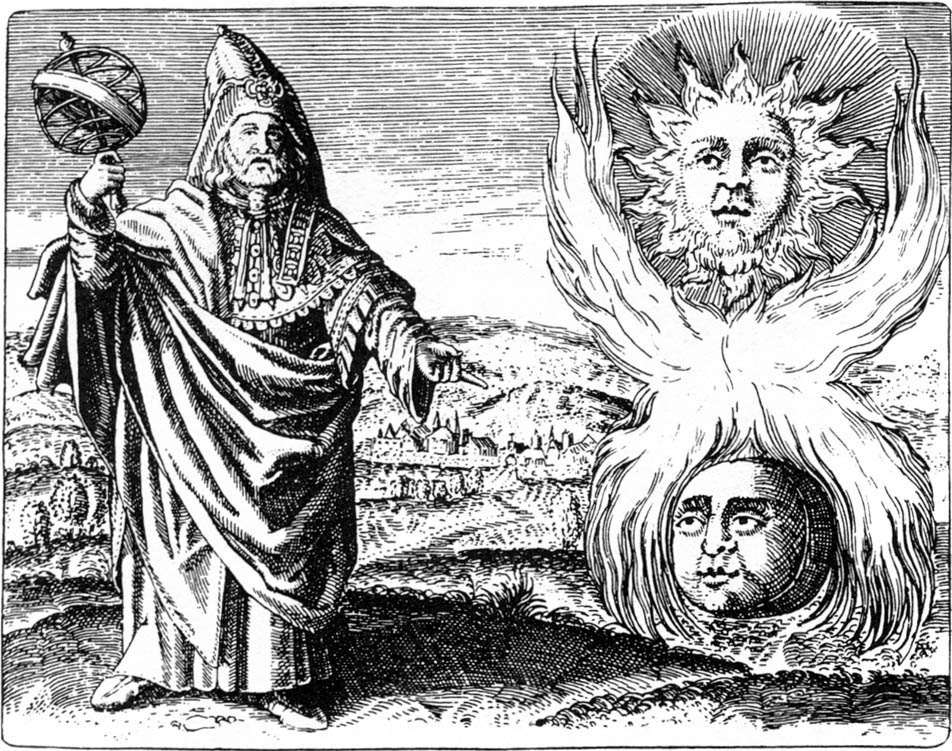
Ermete Trismegisto, also known as Hermes Trismegistus, is a figure shrouded in mystery and legend, revered throughout history as a fountain of wisdom and esoteric knowledge. His name, which translates to “Thrice Great Hermes,” reflects the immense respect he commanded, being considered the “Scribe of the Gods” by the ancient Egyptians. Ermete Trismegisto is associated with a vast body of philosophical, religious, and mystical writings that have influenced numerous spiritual traditions and philosophical movements over the centuries.
The Origins of Ermete Trismegisto
The origins of Ermete Trismegisto are as enigmatic as the figure himself. He is believed to have been of African descent, possibly born around 125 AD in Madaura, which is in modern-day Algeria. However, the historical existence of Ermete Trismegisto remains a subject of debate among scholars. Some propose that he was a real person who lived in antiquity, while others suggest that he is a syncretic figure, merging the attributes of the Greek god Hermes and the Egyptian god Thoth.
The combination of these two deities—Hermes, the messenger of the gods in Greek mythology, and Thoth, the god of wisdom, writing, and magic in Egyptian belief—created a powerful archetype that embodied the pursuit of knowledge, the mysteries of the universe, and the practice of the occult. This blending of Greek and Egyptian traditions occurred during the Hellenistic period, a time when cultures and religions across the Mediterranean were in close contact and often intertwined.
The Legend and Transformation Over Time
Ermete Trismegisto’s figure has evolved significantly over the centuries. Early depictions of him suggest that he was a wise sage or demigod, while later interpretations by Byzantine historians like Sincellus (circa 750-814 AD) proposed that he might have been two distinct individuals, one who lived before and another after the Great Flood. This idea of duality reflects the mysterious and timeless nature attributed to Trismegisto, further complicating efforts to define his true identity.
By the medieval period, Ermete Trismegisto had become a mythological figure whose teachings straddled the line between the human and the divine, embodying the convergence of Egyptian and Greek civilizations. His influence extended across various domains, from medicine and alchemy to philosophy and astrology.
The Corpus Hermeticum and Its Impact
One of the most significant contributions attributed to Ermete Trismegisto is the “Corpus Hermeticum,” a collection of writings that cover a wide range of topics, including philosophy, religion, and the occult sciences. These texts are considered foundational to Hermeticism, a philosophical and spiritual tradition that emphasizes the pursuit of gnosis, or direct knowledge of the divine.
The “Corpus Hermeticum” includes dialogues such as the “Asclepius,” where Trismegisto discusses topics like the nature of the divine, the cosmos, and the human soul. In one passage, he describes the art of “telestiké,” a ritual practice involving the invocation and entrapment of angels or demons within statues using herbs, gems, and perfumes. This fusion of philosophical inquiry with magical practices is a hallmark of Hermetic thought and has had a lasting impact on Western esotericism.
Another key text associated with Trismegisto is the “Emerald Tablet,” a short but profound work that encapsulates the essence of alchemy and Hermetic philosophy. The tablet’s famous maxim, “As above, so below,” succinctly expresses the Hermetic principle of correspondence, which posits that the macrocosm (the universe) and the microcosm (the individual) reflect each other. This idea has resonated through the ages, influencing various fields, from alchemy and astrology to modern science.
The Church Fathers and Hermetic Criticism
The influence of Ermete Trismegisto was not without its critics. Several early Christian theologians, known as the Church Fathers, weighed in on his writings and their implications for Christian doctrine. Tertullian and Lactantius, two prominent Church Fathers, saw in Hermeticism a precursor to Christianity, arguing that Trismegisto’s teachings hinted at truths later revealed in the Christian faith.
However, not all Church Fathers viewed him favorably. Saint Augustine, for example, placed Trismegisto in the same historical period as Moses and suggested that he was a descendant of the legendary astrologer Atlas. Augustine was skeptical of the Hermetic teachings, viewing them as a potential threat to orthodox Christian beliefs.
Despite these critiques, Hermeticism persisted and even thrived in certain intellectual circles, particularly during the Renaissance.
The Renaissance Revival of Hermeticism
The Renaissance marked a period of renewed interest in the writings and philosophy of Ermete Trismegisto. This revival was largely due to the efforts of scholars like Marsilio Ficino, who translated the “Corpus Hermeticum” into Latin under the patronage of Cosimo de’ Medici, the powerful ruler of Florence. Ficino’s translation made the Hermetic texts accessible to a wider European audience and sparked a wave of interest in esoteric and occult knowledge.
During the Renaissance, Hermeticism was closely associated with the broader cultural movement of Neoplatonism, which sought to reconcile ancient philosophical traditions with Christian theology. The rediscovery of ancient texts, including those attributed to Trismegisto, fueled a fascination with the mystical and magical aspects of the ancient world.
Renaissance thinkers like Giovanni Pico della Mirandola and Giordano Bruno embraced Hermeticism as a means of exploring the divine mysteries and achieving spiritual enlightenment. The influence of Hermeticism extended beyond philosophy and religion, leaving its mark on art, literature, and the emerging scientific revolution.
Hermeticism’s Influence in the Middle Ages and Beyond
Hermeticism’s impact was not confined to the Renaissance. During the Middle Ages, the teachings of Ermete Trismegisto were revered by alchemists, who saw him as a master of the occult sciences. His writings provided a theoretical framework for the practice of alchemy, which sought to transform base metals into gold and achieve spiritual purification.
The association of Trismegisto with alchemy and magic continued into the modern era. His name became synonymous with the pursuit of hidden knowledge and the exploration of the esoteric. In the 18th century, figures like the Count of Cagliostro, an infamous occultist, exploited the Hermetic tradition for personal gain, using it to lend credibility to his own mystical practices.
Hermeticism also found its way into secret societies like the Freemasons, who incorporated elements of Trismegisto’s teachings into their rituals and symbols. The Hermetic tradition provided a rich source of symbolism and esoteric knowledge that resonated with the Masonic emphasis on wisdom, initiation, and spiritual growth.
The Enduring Mystery of Ermete Trismegisto
Despite centuries of study and speculation, the true identity of Ermete Trismegisto remains a mystery. Was he a historical figure who lived and died in Carthage around 180 AD, as some sources suggest? Or was he a divine or semi-divine being, a symbolic representation of the union between human and cosmic wisdom?
The allure of Ermete Trismegisto lies in this very ambiguity. His writings and the legends surrounding him continue to captivate scholars, mystics, and seekers of wisdom. The mystery of Trismegisto is not merely a historical puzzle to be solved; it is an invitation to explore the deeper questions of existence, knowledge, and the divine.
The fascination with Ermete Trismegisto endures because his teachings offer timeless insights into the nature of reality and the human quest for understanding. Whether viewed as a sage, a magician, or a myth, Trismegisto’s legacy is a testament to the enduring power of wisdom and the search for truth.
Conclusion
Ermete Trismegisto is a figure whose life and works have transcended time, influencing countless generations of thinkers, mystics, and spiritual seekers. His teachings, encapsulated in the “Corpus Hermeticum” and the “Emerald Tablet,” continue to inspire those who seek to understand the mysteries of the universe and the human soul.
The story of Ermete Trismegisto is a reminder that the pursuit of knowledge is not confined to any one time or place. It is a journey that spans the ages, connecting us to the wisdom of the past and guiding us toward the mysteries of the future. As we continue to explore the depths of his teachings, Ermete Trismegisto remains a beacon of light in the ever-expanding universe of human knowledge.


