
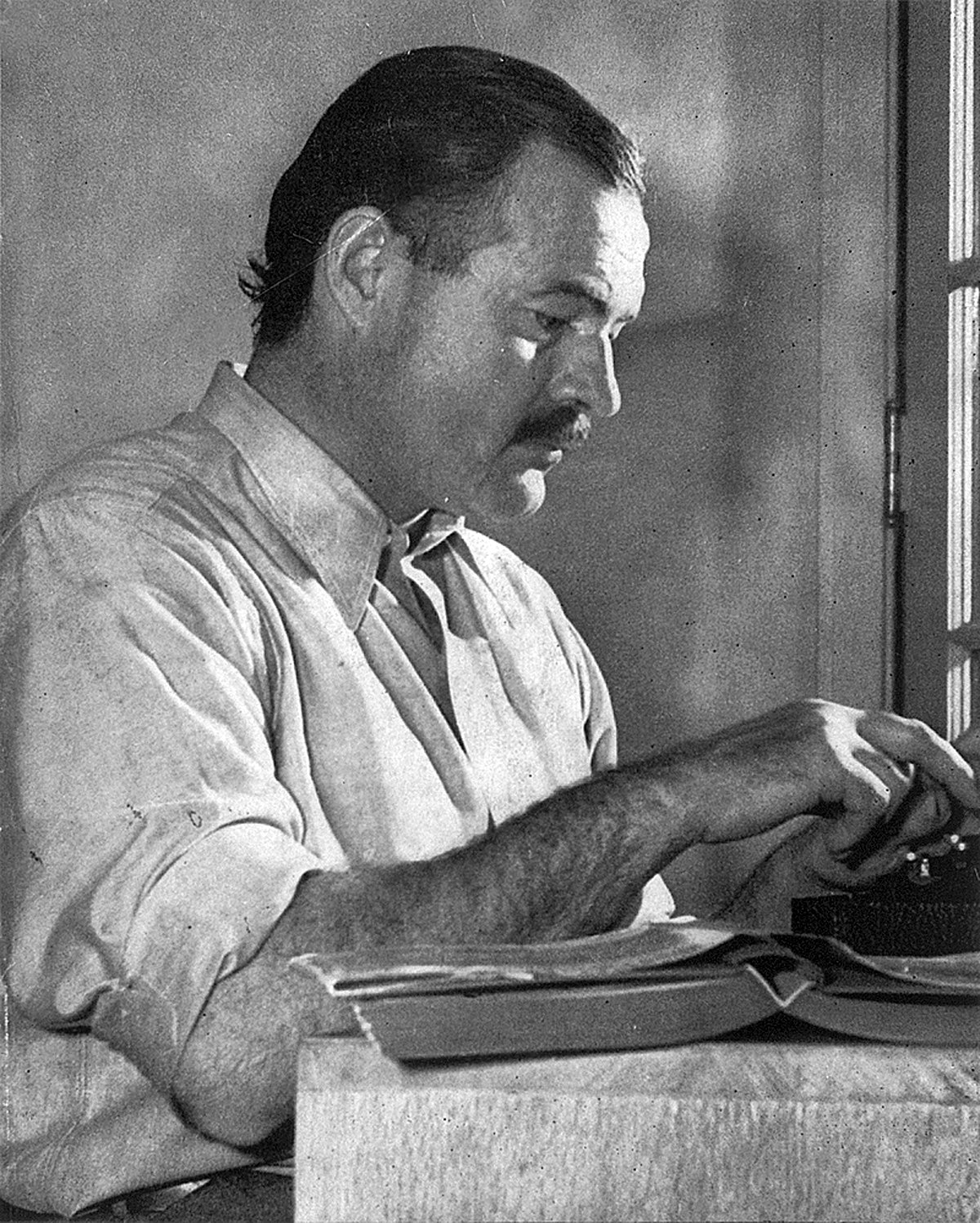
Ernest Hemingway, born on July 21, 1899, in Oak Park, Illinois, stands as a towering figure in 20th-century American literature. Renowned for his distinctive writing style and adventurous life, Hemingway is often regarded as one of the most influential writers of his time. His works, characterized by their concise prose and exploration of themes like courage, loss, and masculinity, have left an indelible mark on literature and continue to inspire readers and writers alike. This article delves into Hemingway’s life, his rise to fame, and the key moments that defined his illustrious career.
Early Life and Influences
Ernest Miller Hemingway was born into a well-to-do family in the affluent suburb of Oak Park, Illinois. His father, Clarence Edmonds Hemingway, was a physician, and his mother, Grace Hall Hemingway, was a music teacher. Hemingway’s early years were marked by a strong connection to nature, fostered by his father, who taught him to hunt, fish, and appreciate the outdoors. These early experiences in the wilderness of Michigan would later profoundly influence Hemingway’s writing, infusing his works with a deep sense of adventure and a keen awareness of the natural world.
Hemingway’s introduction to literature came early, with his mother encouraging him to read and write. However, it was his time at Oak Park and River Forest High School that further developed his literary talents. He excelled in English and contributed to the school newspaper, showing early signs of the talent that would later make him famous.
The Formative Years: World War I and Journalism
In 1917, after graduating from high school, Hemingway began his writing career as a reporter for The Kansas City Star. The brief stint in journalism was pivotal, as it instilled in him the value of concise, straightforward prose—qualities that would become hallmarks of his writing style. The Star’s style guide, which emphasized short sentences and vigorous English, left a lasting impression on Hemingway.
World War I interrupted Hemingway’s budding career. Eager to serve, he attempted to enlist in the U.S. Army but was rejected due to poor eyesight. Undeterred, Hemingway volunteered as an ambulance driver for the Red Cross and was sent to the Italian front. His experiences in the war, including being severely wounded by mortar fire in 1918, had a profound impact on him. The war’s horrors and the sense of disillusionment it fostered became central themes in much of his later work.
Hemingway’s time in Italy also introduced him to the complexities of love and loss. During his recovery in a Milan hospital, he fell in love with Agnes von Kurowsky, a nurse seven years his senior. The relationship, although brief, deeply affected Hemingway, and echoes of it can be found in his later works, particularly in his novel A Farewell to Arms.
Early Literary Success in Paris
After returning to the United States in 1919, Hemingway struggled to find his place. He continued writing but was frustrated by his inability to break into the literary scene. His personal life was also turbulent; after a strained relationship with his mother, he moved to Chicago, where he worked as a freelance writer for the Toronto Star and other publications.
In 1921, Hemingway married Elizabeth Hadley Richardson, and the couple moved to Paris, a city that was, at the time, the epicenter of the expatriate literary community. Paris in the 1920s was a hotbed of creativity and innovation, and Hemingway quickly became a part of the “Lost Generation”—a term coined by Gertrude Stein to describe the disillusioned post-World War I generation of writers and artists.
In Paris, Hemingway was mentored by Stein and formed friendships with other influential writers, including F. Scott Fitzgerald, James Joyce, and Ezra Pound. This period was crucial in shaping Hemingway’s literary voice. Under Pound’s guidance, Hemingway began to refine his writing, stripping it of unnecessary ornamentation and focusing on economy of language—a style that would become his trademark.
In 1923, Hemingway’s first book, Three Stories and Ten Poems, was published, followed by In Our Time in 1925, a collection of short stories that showcased his emerging style and thematic concerns. The critical success of these works established Hemingway as a rising star in the literary world.
The Rise to Fame: Major Works of the 1920s and 1930s
Hemingway’s breakthrough came in 1926 with the publication of The Sun Also Rises. The novel, which depicts the aimless lives of expatriates in Europe after World War I, captured the disillusionment of the “Lost Generation.” Its spare, unadorned prose and emphasis on the characters’ internal struggles resonated with readers and critics alike, establishing Hemingway as one of the leading voices of his generation.
Following the success of The Sun Also Rises, Hemingway continued to write prolifically. In 1929, he published A Farewell to Arms, a novel based on his experiences during World War I. The story of an American ambulance driver’s tragic love affair with a British nurse against the backdrop of the war was both a critical and commercial success. The novel’s exploration of themes like love, war, and the inevitability of loss struck a chord with readers and further cemented Hemingway’s reputation as a major literary figure.
During this period, Hemingway’s personal life was as eventful as his professional one. In 1927, he divorced Hadley Richardson and married Pauline Pfeiffer, a fashion reporter. The couple moved to Key West, Florida, where Hemingway wrote some of his most famous works, including Death in the Afternoon (1932), a non-fiction book about bullfighting, and Green Hills of Africa (1935), a semi-autobiographical account of a safari in East Africa.
The Spanish Civil War and Later Works
The 1930s were a tumultuous time for Hemingway, both personally and professionally. He became deeply involved in the Spanish Civil War, supporting the Republican side against Franco’s Nationalists. His experiences in Spain inspired some of his most powerful work, including the novel For Whom the Bell Tolls (1940). The book, which tells the story of an American dynamiter fighting with the Republicans, is widely regarded as one of Hemingway’s finest novels and was nominated for the Pulitzer Prize.
During this time, Hemingway’s marriage to Pauline Pfeiffer began to unravel, largely due to his affair with journalist Martha Gellhorn. In 1940, he divorced Pauline and married Gellhorn, with whom he shared a passion for adventure and a commitment to covering war. Together, they traveled to China and Europe, reporting on the conflicts of the time.
World War II marked another significant chapter in Hemingway’s life. Although he was no longer young, he participated in the war as a journalist and even took part in the D-Day landings and the liberation of Paris. Hemingway’s wartime experiences were intense and, at times, controversial—he was accused of violating the Geneva Conventions by taking on a combatant role, though he was later exonerated.
Post-War Life and the Nobel Prize
The years following World War II were difficult for Hemingway. His marriage to Martha Gellhorn ended in 1945, and in 1946, he married his fourth and final wife, Mary Welsh. The couple lived in Cuba, at Hemingway’s beloved Finca Vigía, where he continued to write but struggled with health problems, including depression, alcoholism, and injuries sustained during a plane crash in Africa in 1954.
Despite these challenges, Hemingway produced some of his most enduring work during this period. In 1952, he published The Old Man and the Sea, a novella about an aging Cuban fisherman’s struggle to catch a giant marlin. The book was a critical and commercial success, earning Hemingway the Pulitzer Prize in 1953. The following year, he was awarded the Nobel Prize in Literature, recognized for his “mastery of the art of narrative” and his influence on contemporary style.
Decline and Tragic End
The final years of Hemingway’s life were marked by a steady decline in both his physical and mental health. He suffered from severe depression, exacerbated by the effects of multiple concussions and other injuries. Hemingway’s once-prolific writing slowed, and he became increasingly despondent over his inability to work.
In 1960, Hemingway moved to Ketchum, Idaho, seeking privacy and tranquility. However, his mental state continued to deteriorate, and he was hospitalized several times for psychiatric treatment, including electroconvulsive therapy. Despite these efforts, Hemingway remained deeply troubled and unable to overcome his depression.
On July 2, 1961, Hemingway took his own life with a shotgun at his home in Ketchum. His death was a tragic end to the life of one of America’s greatest literary figures, a man whose work had captured the complexities of the human experience with unparalleled clarity and power.
Legacy and Influence
Ernest Hemingway’s legacy is vast and enduring. His distinctive writing style, characterized by its brevity, clarity, and intensity, has influenced countless writers and continues to be studied and admired today. Hemingway’s ability to convey deep emotion and complex themes through simple, direct language set a new standard in literary style, one that has been emulated by generations of authors.
Hemingway’s themes—war, love, courage, loss, and the struggle against nature—remain relevant, resonating with readers across different cultures and eras. His portrayal of the “Hemingway hero”—a stoic, masculine figure who faces life’s challenges with grace under pressure—has become an iconic representation of a particular kind of American ideal.
Beyond his literary achievements, Hemingway’s adventurous life, his love of travel, and his passion for outdoor pursuits have also left a lasting cultural imprint. From his safaris in Africa to his deep-sea fishing in the Gulf Stream, Hemingway’s life was as bold and uncompromising as the characters he created. His work continues to inspire not only writers but also adventurers, journalists, and anyone who seeks to live life fully.
In the end, Ernest Hemingway’s life and work embody the spirit of the 20th century, capturing its triumphs and tragedies with unparalleled insight. His contributions to literature are immeasurable, and his influence is felt far beyond the pages of his books. Hemingway remains a giant in the world of letters, a writer whose work continues to challenge, inspire, and move readers around the world.


