
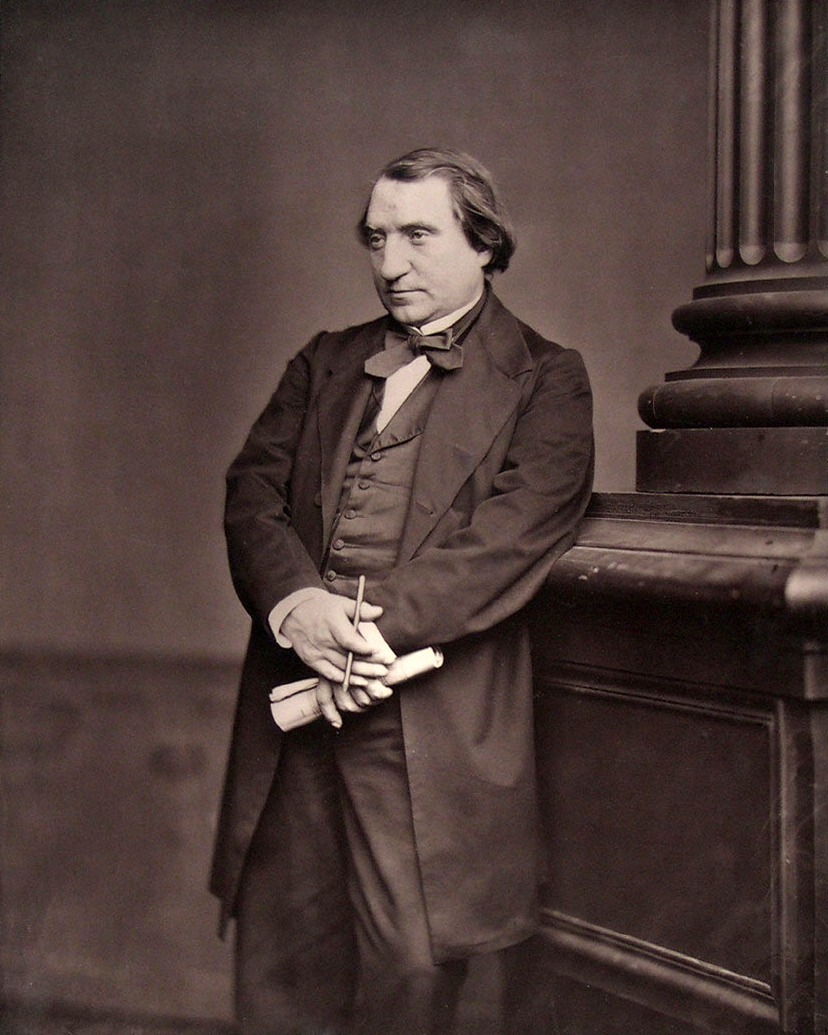
Ernest Renan was a towering intellectual figure of the 19th century, whose work bridged the realms of religion, philosophy, history, and philology. Born on February 28, 1823, in Tréguier, Brittany, France, Renan’s contributions to European thought remain significant, especially for his critical approach to religious texts and his pioneering studies in Semitic languages. His life and work reflect the complex interplay between faith and reason during a time of significant intellectual upheaval in Europe.
Early Life and Education
Joseph Ernest Renan was born into a devoutly Catholic family in the small town of Tréguier. His early education was shaped by his religious upbringing, which eventually led him to enter the seminary of Saint-Sulpice in Paris. It was here that Renan began to distinguish himself as a brilliant student, particularly in the fields of theology and ancient languages. However, his time at the seminary also marked the beginning of a profound spiritual and intellectual crisis.
By 1845, Renan had abandoned his religious studies, disillusioned by what he perceived as the dogmatic rigidity of the Church. Instead, he turned his attention to the study of philology and philosophy, focusing on the ancient Semitic languages and civilizations. This shift would lay the foundation for his later works, which often grappled with the tensions between religious faith and scientific inquiry.
Academic Career and Major Works
Renan’s academic career was marked by both brilliance and controversy. In 1852, he earned his doctorate with a thesis titled “Averroès et l’averroisme” (“Averroes and Averroism”), which explored the influence of the medieval Muslim philosopher Averroes on Western thought. This work exemplified Renan’s approach to intellectual history, which sought to trace the development of ideas across cultures and epochs.
In 1862, Renan was appointed professor of Hebrew at the Collège de France, a position that placed him at the center of the French intellectual establishment. However, his tenure was short-lived. Renan’s inaugural lecture, in which he questioned the historical accuracy of the Bible, provoked outrage, leading to his suspension from the post. Undeterred, Renan continued to pursue his scholarly interests, which culminated in the publication of his most famous work, Vie de Jésus (Life of Jesus) in 1863.
Vie de Jésus was the first volume of Renan’s Histoire des origines du christianisme (History of the Origins of Christianity), a series that sought to place the figure of Jesus within a historical and cultural context, devoid of the supernatural elements traditionally ascribed to him. Renan portrayed Jesus as an “incomparable man,” a visionary whose ethical teachings were nonetheless shaped by the cultural milieu of his time. This work was groundbreaking in its historical-critical approach to the New Testament, but it also attracted significant criticism, particularly from Catholic circles, for its perceived irreverence.
Renan’s scholarship extended beyond Christianity to the history of the Jewish people. His Histoire du peuple d’Israël (History of the People of Israel), published between 1887 and 1893, was an ambitious attempt to trace the development of Jewish religious thought from its earliest origins. Although the work was not without its flaws—Renan’s historical method was often criticized for its lack of rigor—it remains an important contribution to the study of ancient Judaism and the evolution of monotheistic religions.
Philosophical and Ethical Writings
In addition to his historical and philological works, Renan was also a prolific writer on philosophical and ethical issues. His Essais de morale et de critique (Essays on Morality and Criticism, 1859) and Questions contemporaines (Contemporary Questions, 1868) reflect his deep engagement with the moral and political questions of his time. Renan was a staunch advocate of scientific progress and human reason, yet he was also acutely aware of the moral dilemmas posed by modernity.
One of Renan’s most significant contributions to ethical thought was his notion of “independent piety.” In his later works, such as Feuilles détachées (Scattered Leaves, 1891), Renan argued for a form of religious sentiment that was independent of dogmatic belief. This idea was revolutionary in its time, as it suggested that one could maintain a sense of spiritual reverence without adhering to traditional religious doctrines.
Influence and Legacy
Ernest Renan’s influence on European thought was profound and far-reaching. His works inspired both admiration and controversy, particularly among his contemporaries in the French intellectual and political elite. Renan’s skeptical and often ironic tone, coupled with his incisive critiques of religious orthodoxy, made him a polarizing figure. Yet, it was precisely this willingness to challenge established norms that ensured his lasting impact on fields as diverse as theology, history, and literary criticism.
Renan’s legacy is perhaps best understood in the context of the broader intellectual currents of the 19th century. He was a key figure in the movement known as “positivism,” which emphasized the importance of scientific knowledge and rational inquiry. However, unlike some of his contemporaries, Renan did not see science and religion as wholly incompatible. Instead, he sought to reconcile the two, arguing that the progress of human reason could lead to a deeper understanding of spiritual truths.
This attempt to bridge the gap between faith and reason is evident in Renan’s later works, such as Souvenirs d’enfance et de jeunesse (Recollections of Childhood and Youth, 1883), where he reflects on his own spiritual journey. In these autobiographical writings, Renan offers a poignant meditation on the tensions between his early religious fervor and his later commitment to critical scholarship.
Honors and Final Years
Despite the controversies that surrounded his career, Renan received numerous honors in his later years. He was made an administrator of the Collège de France and was awarded the title of Grand Officer of the Legion of Honor, one of France’s highest civilian distinctions. These accolades reflect the high regard in which Renan was held by his peers, even as his ideas continued to provoke debate.
In his final years, Renan continued to write and publish, contributing to the intellectual life of France until his death on October 2, 1892, in Paris. He was buried in the Montmartre Cemetery, a fitting resting place for a man whose life was dedicated to the pursuit of knowledge and the exploration of the human spirit.
Conclusion: Ernest Renan’s Enduring Relevance
Ernest Renan remains a figure of enduring relevance in the fields of history, theology, and philosophy. His works continue to be studied for their innovative approaches to religious texts and their insights into the cultural and intellectual history of the 19th century. Renan’s life is a testament to the power of critical inquiry and the importance of challenging established truths in the pursuit of deeper understanding.
In the contemporary context, Renan’s ideas resonate with ongoing debates about the role of religion in public life and the relationship between science and faith. His call for an “independent piety” that transcends dogma speaks to a modern audience that increasingly seeks spirituality outside the confines of organized religion. Similarly, his historical-critical approach to religious texts has influenced generations of scholars, shaping the way we understand the origins of religious traditions.
Ernest Renan was not just a scholar; he was a thinker who dared to question the fundamental assumptions of his time. His work invites us to do the same, encouraging a spirit of inquiry that is as relevant today as it was in his own time. Through his writings, Renan challenges us to consider the complexities of faith, the limits of reason, and the possibilities of human progress.


