
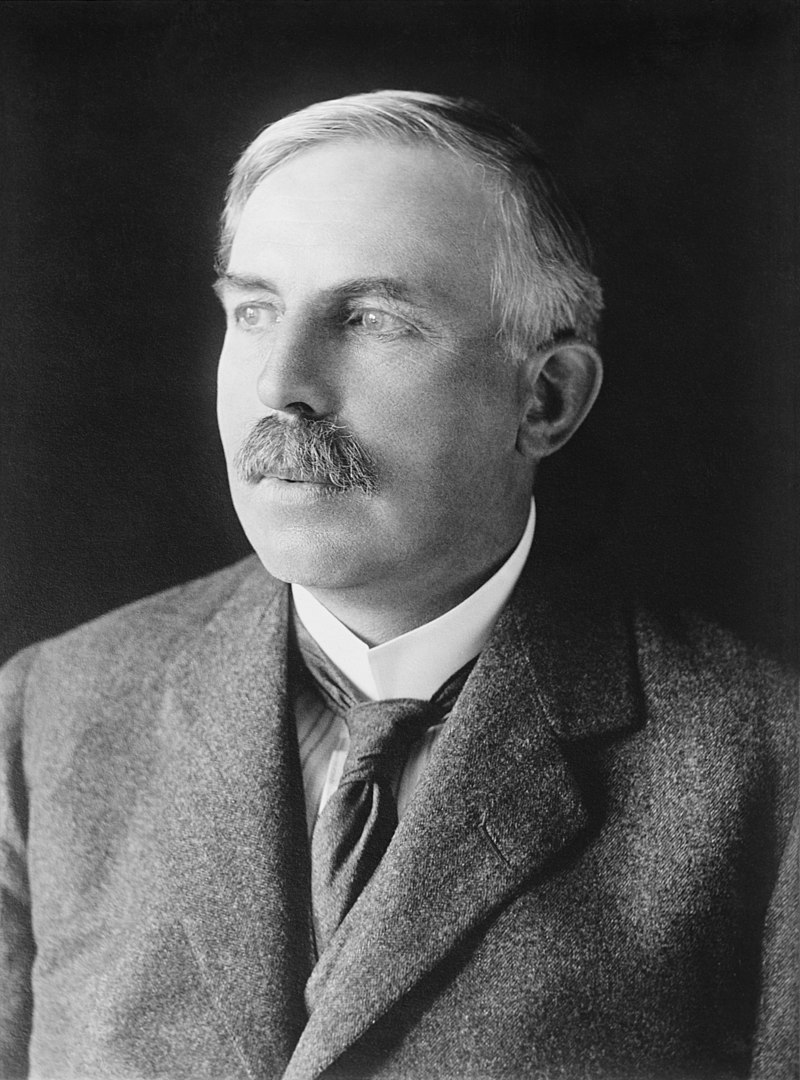
Ernest Rutherford, born on August 30, 1871, in Brightwater, near Nelson, New Zealand, is often referred to as the father of nuclear physics. His groundbreaking work in the field of atomic structure and radioactivity laid the foundation for much of modern science. Throughout his life, Rutherford made numerous contributions to the scientific community, earning him the Nobel Prize in Chemistry in 1908. This article delves into the life, achievements, and legacy of Ernest Rutherford, providing a comprehensive overview of his contributions to science.
Early Life and Education
Ernest Rutherford was born into a large family in rural New Zealand. His early life was marked by curiosity and a keen interest in the natural world, traits that would later define his scientific career. He attended the Nelson College and later enrolled at Canterbury College, where he excelled in mathematics and physical sciences. Rutherford earned three degrees from Canterbury, demonstrating his academic prowess and laying the groundwork for his future endeavors in science.
Journey to Britain and Early Research
In 1895, at the age of 24, Rutherford moved to Britain to further his studies at the University of Cambridge’s Cavendish Laboratory. At the time, the Cavendish Laboratory was a hub of scientific innovation, and it was here that Rutherford began to make his mark. His early work focused on the detection of electromagnetic waves, a field that was still in its infancy. Rutherford’s research in this area earned him a scholarship and recognition among his peers.
It was during this time that Rutherford coined the terms “alpha” and “beta” rays to describe the two types of radiation emitted by uranium and thorium. This work marked the beginning of his lifelong exploration of radioactivity, a field that would dominate his scientific career.
The Move to Canada and Nobel Prize
In 1898, at the age of 27, Rutherford accepted a position as a professor of physics at McGill University in Montreal, Canada. It was here that he conducted some of his most important work on radioactivity. Rutherford’s experiments demonstrated that radioactivity was the result of the spontaneous disintegration of atoms, a revolutionary idea at the time. This discovery challenged the prevailing notion that atoms were indivisible and unchangeable, fundamentally altering the scientific understanding of matter.
Rutherford’s work at McGill earned him international acclaim and, in 1908, he was awarded the Nobel Prize in Chemistry for his investigations into the disintegration of elements and the chemistry of radioactive substances. Although the award was in chemistry, Rutherford often considered himself a physicist, reflecting his deep commitment to understanding the fundamental principles of the natural world.
Discovering the Atomic Nucleus
In 1907, Rutherford moved to the Victoria University of Manchester, where he continued his research into the structure of the atom. It was here that he conducted his famous gold foil experiment, which led to the discovery of the atomic nucleus. In this experiment, Rutherford and his colleagues, Hans Geiger and Ernest Marsden, bombarded a thin sheet of gold foil with alpha particles. They observed that while most of the particles passed through the foil, a small fraction was deflected at large angles.
This unexpected result led Rutherford to propose a new model of the atom, one that consisted of a dense, positively charged nucleus surrounded by orbiting electrons. This nuclear model of the atom was a significant departure from earlier models, such as J.J. Thomson’s “plum pudding” model, and it laid the foundation for modern atomic theory.
Transmutation and Nuclear Reactions
Rutherford’s discovery of the atomic nucleus was just the beginning of his contributions to nuclear physics. In 1919, he became the first person to deliberately transmute one element into another. By bombarding nitrogen gas with alpha particles, Rutherford succeeded in converting nitrogen atoms into oxygen atoms, demonstrating that it was possible to change one element into another through nuclear reactions. This experiment marked the first artificial transmutation of an element, a significant milestone in the field of nuclear physics.
Rutherford’s work on nuclear reactions also led to the discovery of the proton, a subatomic particle with a positive charge that is found in the nucleus of every atom. His identification of the proton furthered the understanding of atomic structure and paved the way for future discoveries in particle physics.
Collaboration with Niels Bohr and the Development of Atomic Theory
During his time at Manchester, Rutherford worked closely with Niels Bohr, a Danish physicist who would go on to develop the Bohr model of the atom. Bohr’s model, which built on Rutherford’s nuclear model, introduced the idea that electrons orbit the nucleus in discrete energy levels, or shells. This concept was crucial in explaining the spectral lines of hydrogen and provided a more accurate representation of atomic structure.
Rutherford’s collaboration with Bohr was a fruitful one, and together they laid the groundwork for much of 20th-century physics. Their work not only advanced the understanding of atomic structure but also influenced the development of quantum mechanics, a field that would revolutionize science in the years to come.
Return to Cambridge and Leadership at Cavendish Laboratory
In 1919, Rutherford returned to Cambridge, where he succeeded J.J. Thomson as the director of the Cavendish Laboratory. Under Rutherford’s leadership, the laboratory became a center for cutting-edge research in nuclear physics. Rutherford was a mentor to many young scientists, including James Chadwick, who discovered the neutron, and John Cockcroft and Ernest Walton, who were the first to split the atom using a particle accelerator.
Rutherford’s ability to inspire and guide the next generation of scientists was one of his greatest strengths. He fostered an environment of collaboration and innovation at the Cavendish Laboratory, leading to numerous breakthroughs in the field of nuclear physics. The laboratory’s success during Rutherford’s tenure is a testament to his vision and leadership.
Later Years and Legacy
In the later years of his career, Rutherford continued to make significant contributions to science. He published several important works, including “The Electrical Structure of Matter” in 1926 and “The Artificial Transmutation of the Elements” in 1933. These publications further cemented his reputation as one of the leading scientists of his time.
Rutherford’s achievements were widely recognized, and in 1931, he was elevated to the peerage as Baron Rutherford of Nelson of Cambridge. This honor reflected not only his scientific accomplishments but also his contributions to the advancement of knowledge and education.
Rutherford passed away on October 19, 1937, at the age of 66. His death marked the end of an era in science, but his legacy lives on. Rutherford’s work laid the foundation for many of the discoveries that followed, and his influence can be seen in the work of countless scientists who have built on his ideas.
The Impact of Rutherford’s Discoveries on Modern Science
Ernest Rutherford’s discoveries have had a profound impact on modern science. His work on the structure of the atom and radioactivity revolutionized the understanding of matter and paved the way for the development of nuclear energy and atomic weapons. The nuclear model of the atom that Rutherford proposed is still the basis for modern atomic theory, and his discovery of the proton remains a cornerstone of particle physics.
Rutherford’s contributions to science extend beyond his own discoveries. As a mentor and leader, he influenced a generation of scientists who went on to make significant contributions of their own. The work done at the Cavendish Laboratory under Rutherford’s leadership led to the discovery of the neutron, the development of the first particle accelerators, and the advancement of quantum mechanics.
The techniques and principles that Rutherford developed continue to be used in scientific research today. His work on radioactivity, in particular, has applications in fields as diverse as medicine, archaeology, and environmental science. The ability to measure the age of objects using radioactive decay, a technique that Rutherford helped pioneer, has become an essential tool in fields like geology and paleontology.
Historical Context and Broader Influence
Rutherford’s work must be understood within the broader context of the scientific developments of the late 19th and early 20th centuries. During this period, science was undergoing a revolution, with new discoveries challenging long-held beliefs about the nature of matter and the universe. Rutherford was at the forefront of this revolution, and his work played a key role in shaping the course of modern science.
The discovery of the atomic nucleus and the subsequent development of nuclear physics had far-reaching implications, both scientifically and socially. The ability to harness nuclear energy, which emerged from the principles that Rutherford helped establish, has had a profound impact on the world, providing a new source of energy but also raising ethical and environmental concerns.
Rutherford’s legacy is also reflected in the institutions that continue to carry on his work. The Cavendish Laboratory remains a leading center for scientific research, and the techniques that Rutherford developed are still used by scientists around the world. His influence extends beyond the laboratory, as his discoveries continue to shape the way we understand the universe.
Conclusion
Ernest Rutherford’s life and work have left an indelible mark on the history of science. From his early experiments with radioactivity to his discovery of the atomic nucleus, Rutherford’s contributions have shaped the way we understand the fundamental nature of matter. His legacy as the father of nuclear physics is well deserved, and his influence continues to be felt in the scientific community.
As we reflect on Rutherford’s achievements, it is clear that his work was not just about making discoveries but about advancing knowledge and inspiring future generations of scientists. His ability to combine rigorous experimentation with creative thinking set him apart as one of the great minds of his time.
Rutherford’s story is a testament to the power of curiosity, perseverance, and the pursuit of knowledge. His life and work continue to inspire scientists today, reminding us of the importance of pushing the boundaries of what we know and exploring the unknown.


