
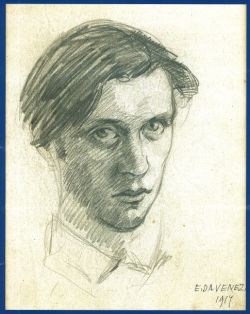
Eugenio Da Venezia, born on November 9, 1900, in Venice, Italy, is celebrated as a central figure in 20th-century Italian painting. Renowned for his dedication to figurative art, Da Venezia’s work is distinguished by its blend of Italian traditions and French Impressionism, capturing the delicate interplay of light and form. His contributions to the art world have earned him a place among the most respected painters of his time, making his life and work a fascinating study in the evolution of modern art.
Early Life and Artistic Training
Eugenio Da Venezia was born into a city synonymous with art and culture. Venice, with its rich history of Renaissance art and its unique light, profoundly influenced his early development as an artist. Da Venezia’s passion for art was evident from a young age, and he pursued formal training at the Istituto Statale d’Arte and later at the prestigious Accademia di Belle Arti di Venezia. Under the guidance of esteemed instructors such as Vittorio Bressanin, Emilio Paggiaro, and Ettore Tito, Da Venezia honed his skills in drawing, painting, and anatomy.
His education was not confined to the classroom. Da Venezia also studied anatomy at the Ospedale Civile di Venezia, often alongside his close friend and fellow painter, Marco Novati. This rigorous study of the human form would become a hallmark of his work, allowing him to master the complexities of figurative art with precision and sensitivity.
The Influence of French Impressionism
Eugenio Da Venezia’s artistic journey was deeply influenced by the French Impressionists, particularly Pierre Bonnard. Bonnard, who encountered Da Venezia’s work at the Venice Biennale in the early 1930s, offered the young artist crucial advice: to deepen his understanding of form so that he could both master and, at times, seemingly deconstruct it. This counsel became a guiding principle in Da Venezia’s work, as he sought to balance the immediacy of impressionistic color with a solid grasp of form and structure.
Da Venezia’s paintings are characterized by a lightness of touch and a sensitivity to color that reflects the influence of the Impressionists. However, his work also demonstrates a commitment to the figurative tradition, grounding his explorations of light and color in the disciplined study of the human form and the natural world. This combination of influences allowed Da Venezia to develop a unique style that was both modern and deeply rooted in tradition.
The “Giovani di Palazzo Carminati” and the Burano School
In the early 20th century, Venice was home to a vibrant artistic community, and Eugenio Da Venezia was at the heart of it. Along with contemporaries such as Fioravante Seibezzi, Mario Varagnolo, Neno Mori, and Giuseppe Santomaso, Da Venezia formed a group of artists known as the “Giovani di Palazzo Carminati.” This group was committed to exploring new directions in Italian art while maintaining a connection to the country’s rich figurative tradition.
Da Venezia’s work during this period often focused on the landscapes of the Venetian lagoon, the hills, and the mountains, as well as still lifes and portraits. His use of light, his palette of clear, luminous colors, and his sensitive rendering of form placed him in the tradition of the Burano School, a movement associated with a second generation of Venetian artists who were influenced by Impressionism.
National and International Recognition
Eugenio Da Venezia’s talent was recognized early in his career, and he quickly became a prominent figure in the Italian art scene. He began exhibiting at the prestigious Cà Pesaro in Venice in 1925, and his work was shown there continuously until 1956. These exhibitions established him as a leading painter in Venice, and his reputation soon spread beyond the city.
In 1932, Da Venezia was invited to participate in the Venice Biennale, one of the most important international art exhibitions. His work was featured in the Biennale for several years, and it was during the 1934 edition that he met the Duc de Trèvise, Edouard Napoléon César Edmond Mortier de Trévise. The Duc, impressed by Da Venezia’s work, invited him to hold a solo exhibition in Paris in 1935. This opportunity marked the beginning of Da Venezia’s international career, and he spent several years living and working in Paris, immersing himself in the vibrant artistic community there.
Despite the outbreak of World War II, which disrupted his time in Paris, Da Venezia continued to exhibit his work both in Italy and abroad. His participation in international exhibitions, including shows in Vienna, Warsaw, Budapest, and Berlin, further solidified his reputation as a leading figure in European art. Da Venezia’s work was celebrated for its technical mastery and its ability to capture the essence of the Italian landscape and the human form.
Teaching and Influence
In addition to his work as a painter, Eugenio Da Venezia made significant contributions to the education of future generations of artists. In 1940, following a solo exhibition at the Venice Biennale, he was appointed as a professor of Decorative Painting at the Istituto Statale d’Arte di Venezia by the Italian Ministry of Public Education. In 1947, he began teaching at the Accademia di Belle Arti di Venezia, where he held the chair of Designated Figure.
As a teacher, Da Venezia was deeply committed to the education of young artists. He encouraged his students to study the human form rigorously and to develop a deep understanding of both traditional techniques and modern innovations. His influence as a teacher extended beyond the classroom, as he continued to exhibit his work and engage with the broader artistic community throughout his career.
Later Years and Legacy
Eugenio Da Venezia’s career spanned more than six decades, during which he remained an active and influential figure in the Italian art world. His work was exhibited widely in Italy, including at major venues in Rome, Milan, and Florence, as well as in international exhibitions across Europe. He also continued to participate in group exhibitions with his peers, including the “Tredici” group of Venetian artists and the “Pittori di Bardonecchia.”
In 1968, Da Venezia was honored with a retrospective exhibition at the Bevilacqua La Masa Foundation in Venice, showcasing his work from 1930 to 1968. This exhibition was a testament to his enduring influence and the high regard in which he was held by the Italian art community.
Da Venezia’s work is now part of the permanent collections of several major museums, including the Galleria Internazionale d’Arte Moderna di Venezia, the Galleria d’Arte Moderna di Roma, and the Museo Civico di Rovereto. His paintings are also held by numerous foundations and private collections, ensuring that his legacy will continue to be appreciated by future generations.
Eugenio Da Venezia passed away in Venice on September 8, 1992, just shy of his 92nd birthday. His death marked the end of an era in Italian art, but his influence remains strong. As a painter, teacher, and member of the Venetian artistic community, Da Venezia played a crucial role in shaping the direction of 20th-century Italian art. His work continues to be celebrated for its technical excellence, its sensitivity to color and light, and its deep connection to the traditions of Italian painting.
Historical Context and Artistic Impact
Eugenio Da Venezia’s life and work must be understood within the broader context of 20th-century European art. The early 1900s were a time of significant change in the art world, as artists began to break away from the constraints of academic painting and explore new styles and techniques. In Italy, this period was marked by the rise of the Novecento movement, which sought to create a modern Italian art that was both innovative and rooted in tradition.
Da Venezia’s work reflects the tensions and contradictions of this period. On one hand, he was deeply influenced by the innovations of French Impressionism, which emphasized the effects of light and color over strict adherence to form. On the other hand, he remained committed to the figurative tradition, believing that a deep understanding of form was essential to creating truly great art. This balance between tradition and innovation is one of the defining characteristics of Da Venezia’s work and helps to explain its enduring appeal.
Moreover, Da Venezia’s career coincided with a period of intense political and social upheaval in Europe. The rise of Fascism in Italy, the outbreak of World War II, and the post-war reconstruction all had a profound impact on the lives of artists and the art world. Despite these challenges, Da Venezia remained dedicated to his craft, continuing to paint, exhibit, and teach throughout these turbulent times. His work serves as a reminder of the resilience of the human spirit and the enduring power of art to capture and express the beauty of the world.
Conclusion
Eugenio Da Venezia’s life and work are a testament to the power of art to transcend time and place. Born in the heart of Venice, a city steeped in artistic tradition, Da Venezia carried the torch of Italian painting into the 20th century, blending the lessons of the past with the innovations of the modern era. His commitment to figurative art, his mastery of form, and his sensitivity to color and light have left a lasting legacy that continues to inspire artists and art lovers alike.
As we look back on the life of Eugenio Da Venezia, we see not only the story of an individual artist but also a reflection of the broader currents of European art in the 20th century. His work captures the beauty of the Italian landscape, the complexity of the human form, and the richness of Venetian culture, offering a window into a world that is both timeless and ever-changing. For those who seek to understand the history of modern art, the life and work of Eugenio Da Venezia provide a compelling and invaluable perspective.


