
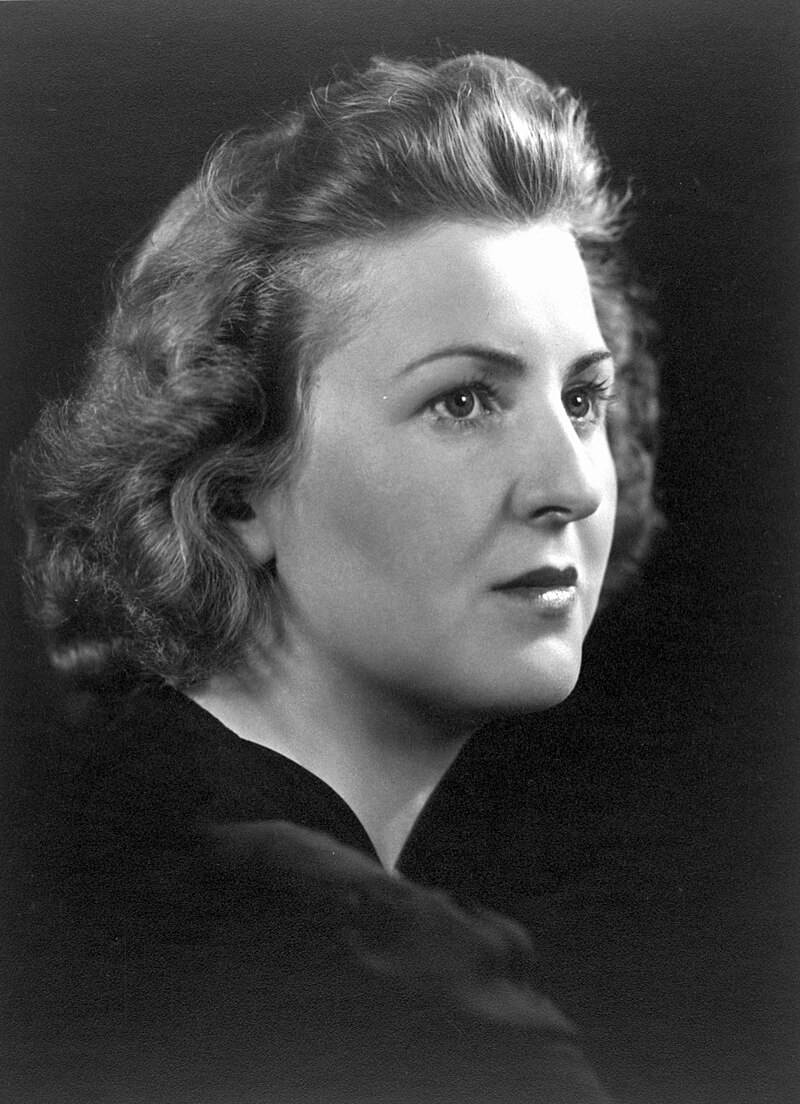
Eva Braun, a name that resonates through the pages of history as the woman who stood beside one of the most infamous figures of the 20th century—Adolf Hitler. Born on February 6, 1912, in Simbach, Bavaria, Germany, Eva Braun’s life is a complex tapestry woven with the threads of simplicity, ambition, and the dark shadows of a relationship that forever tied her to one of history’s darkest chapters.
Early Life and Background
Eva Braun was born into a middle-class family. Her father, Fritz Braun, was a school teacher, and her mother, Franziska, was a devout Catholic who instilled in her children the values of discipline and tradition. Eva was the second of three daughters, and from an early age, she exhibited a rebellious streak that set her apart from her more conventional family.
Despite her father’s aspirations for her to become an artist and her mother’s hope for her to pursue a career as a seamstress, Eva was more interested in the pursuits of fashion, beauty, and the social scenes of her time. Her childhood was marked by a lack of interest in the traditional roles her family envisioned for her, leading her to drop out of a strict Catholic school where she had been enrolled in an attempt to curb her rebellious nature.
Meeting Adolf Hitler
Eva’s life took a dramatic turn when she secured a job as an assistant and model for Heinrich Hoffmann, a photographer who was closely associated with the National Socialist German Workers’ Party (NSDAP). It was through Hoffmann that Eva Braun first met Adolf Hitler in 1929, though at the time, she had no idea who he was or the role he would soon play in both her life and world history.
Hitler, who was 23 years her senior, was instantly taken by Eva’s youthful beauty and vivacious spirit. Their relationship, however, was anything but public. Hitler, who carefully crafted his public image, kept Eva in the shadows, away from the public eye and the political sphere. Despite this, Eva was deeply infatuated with Hitler, a feeling that would ultimately define the rest of her life.
Life in the Shadows
Eva Braun’s relationship with Hitler was marked by periods of intense loneliness and despair. Hitler’s attention to her was sporadic, often leaving Eva feeling neglected and despondent. This emotional turmoil led her to two suicide attempts, both of which she survived. These attempts were a cry for attention from a man who was more concerned with his political ambitions than with her emotional well-being.
After her second suicide attempt, Hitler made more significant efforts to include Eva in his life, albeit still away from the public eye. He moved her to his mountain retreat, the Berghof, where she lived in relative luxury. At the Berghof, Eva enjoyed the privileges that came with being Hitler’s companion—expensive clothes, a private chauffeur, and the freedom to indulge in her hobbies. However, she remained isolated from the broader political activities of the Third Reich, living a life of seclusion and superficial pleasures.
The Role of Eva Braun in Hitler’s Life
While Eva Braun may have been isolated from the political machinations of the Nazi regime, her presence in Hitler’s life was significant in other ways. She provided him with a semblance of normalcy, a private life that he could retreat to amid the chaos of his public and political life. Despite this, Eva’s influence on Hitler’s decisions and policies was virtually non-existent. She was, in many respects, a passive observer of the events unfolding around her.
Eva Braun’s life with Hitler was marked by a paradoxical mix of luxury and insignificance. While she enjoyed material comforts, she had little to no influence over the man who was responsible for some of the most heinous acts in human history. Her life was a reflection of the superficiality that often accompanied the inner circle of the Nazi elite—privilege without power, presence without purpose.
The Final Days
As World War II drew to a close, the relationship between Eva Braun and Adolf Hitler took its final, fatal turn. In April 1945, as Allied forces closed in on Berlin, Eva joined Hitler in his underground bunker. Despite the dire circumstances, she remained loyal to him, demonstrating a commitment that culminated in their marriage on April 29, 1945.
This marriage, which took place less than 40 hours before their joint suicide, was a final act of devotion on Eva’s part. On April 30, 1945, Adolf Hitler and Eva Braun took their own lives—Hitler by a gunshot to the head and Eva by ingesting cyanide. Their bodies were found side by side, a tragic end to a relationship that had been shrouded in secrecy and marked by emotional turmoil.
Historical Context and Legacy
Understanding Eva Braun’s life requires a deep dive into the historical context of the era in which she lived. The early 20th century in Germany was a period of significant social, political, and economic upheaval. The aftermath of World War I, the Treaty of Versailles, and the economic depression of the 1920s created a fertile ground for the rise of extremist ideologies, including the brand of nationalism that Adolf Hitler espoused.
Eva Braun, like many Germans of her time, was swept up in the tide of history that brought Hitler to power. However, unlike others, her proximity to Hitler placed her in a unique and dangerous position. Despite this, she remained largely apolitical, focusing instead on her personal life and her relationship with Hitler. This detachment from the broader political context of her time is one of the most puzzling aspects of her character.
Eva Braun’s legacy is a complex one. She is often portrayed as a tragic figure—an ordinary woman who was drawn into the orbit of one of history’s most malevolent figures. However, her role in history is also controversial. Some view her as a willing accomplice, someone who chose to ignore the atrocities committed by the man she loved. Others see her as a victim of circumstance, a woman who was emotionally manipulated and ultimately destroyed by her relationship with Hitler.
The Nuances of Eva Braun’s Story
The story of Eva Braun is not just about her relationship with Adolf Hitler; it is also a reflection of the times in which she lived. Her life highlights the role of women in Nazi Germany, a regime that relegated women to the roles of wives and mothers, excluding them from the political and public spheres. Eva’s life, therefore, can be seen as a microcosm of the broader societal norms and expectations placed on women during this period.
Moreover, Eva Braun’s story also raises questions about the nature of power and influence. Despite her close relationship with Hitler, Eva had little to no impact on his political decisions. This lack of influence challenges the notion that proximity to power equates to actual power. Eva’s life serves as a reminder that being close to someone powerful does not necessarily translate into having agency or control.
Conclusion
Eva Braun’s life is a testament to the complexities of human relationships, especially those that unfold in the shadow of historical events. Her story is one of love, loyalty, and tragedy, set against the backdrop of one of the darkest periods in human history. While her life was marked by privilege, it was also defined by isolation and emotional turmoil. In the end, Eva Braun remains an enigmatic figure—a woman whose life and choices continue to intrigue historians and the public alike.
Her legacy, much like the period in which she lived, is fraught with contradictions. She was both a victim and a participant, a bystander and a companion, a figure of love and a symbol of tragedy. Understanding Eva Braun requires an exploration of these contradictions and a recognition of the complex interplay between personal choices and historical forces.


