
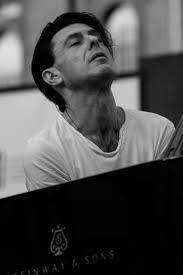
Ezio Bosso, born on September 13, 1971, in Turin, Italy, was an extraordinary figure in the world of classical music. Known for his profound talent as a composer, conductor, and pianist, Bosso’s life and career were marked by remarkable achievements and profound challenges. This article delves into the life, fame, and significant highlights of Ezio Bosso’s journey.
Early Life and Musical Beginnings
Ezio Bosso showed an inclination towards music from a very young age. At just four years old, he began exploring music with the help of his brother, a musician, and a great-aunt who played the piano. By the age of twelve, he had already started composing music. In 1985, at fourteen, Bosso joined the band Statuto, where he played for three years before deciding to focus on classical music, setting aside his involvement in the ska-mod revival genre.
Rise to Fame in the 1990s
Bosso’s classical music career took off while he was still a teenager. He debuted as a soloist in France and quickly gained recognition across Europe, performing with prestigious orchestras. Throughout the 1990s, Bosso graced some of the world’s most renowned stages, including the Royal Festival Hall in London, the Sydney Opera House, the Southbank Centre, the Palacio de Bellas Artes in Mexico City, Carnegie Hall in New York, the Teatro Colón in Buenos Aires, and the Auditorium Parco della Musica in Rome.
His work extended to the theater, where he composed music for numerous productions. These included “La stanza di Emily,” “Cuori,” “A score for Amleth,” “Sogno di una notte di mezza estate,” and “Studio su Amleto” with Valter Malosti. Between 1998 and 2001, he contributed to “La confessione biologica” with Antonio Catania, “Qoeleth e il cantico dei cantici” with David Riondino, “Moi je s’addresse,” and “Aspettiamo quello simpatico” with Rocco Papaleo.
Breakthrough in the 2000s
The 2000s were a period of significant milestones for Ezio Bosso. In 2001, he composed the soundtrack for the film “Ribelli per caso.” Two years later, he created the score for “Io non ho paura,” directed by Gabriele Salvatores and starring Diego Abatantuono. This work earned him a nomination for the David di Donatello award.
Bosso continued his success in film scoring with works like “Rosso come il cielo” and “Quo Vadis Baby” between 2004 and 2005, followed by “The Moon on the Lake” and “Il dolce e l’amaro” in 2006 and 2007, respectively.
Health Challenges and Resilience in the 2010s
In 2011, Bosso faced a life-changing diagnosis of a neurodegenerative disease similar to amyotrophic lateral sclerosis (ALS). The disease gradually affected his mobility and speech. Shortly thereafter, he was also diagnosed with a brain tumor, a severe blow that led him to contemplate ending his life. However, encouraged by his doctor, Bosso chose to confront his health challenges with courage and resilience.
Despite the toll of his illness and the demanding treatments that caused significant weight loss, Bosso continued to pursue his passion for music. In 2013, he formed a notable collaboration with renowned cellist Mario Brunello, leading to the creation of a cello-piano duo.
Major Accomplishments and Legacy
Bosso’s career reached new heights in 2014 when he debuted with the London Symphony Orchestra, conducting his piece “Fantasia per Violino e Orchestra.” The following year, his performance at the Ikon Gallery, part of the “3 Drawing Rooms” installation by his close friend David Tremlett, was hailed as the artistic event of the year in Britain by Penelope Curtis, director of Tate Britain, and The Arts News Paper.
In 2015, Bosso was again nominated for a David di Donatello for the music of “Il ragazzo invisibile,” another collaboration with Gabriele Salvatores. That same year, the University of Bologna invited him to compose and conduct a piece inspired by the university’s Magna Charta.
Bosso’s first official solo album, “The 12th Room,” was released on October 30, 2015, by Egea Music. The album, which received critical acclaim, showcased his profound musical talent and emotional depth.
Impact and Influence
Ezio Bosso’s influence extended beyond his musical achievements. In February 2016, he appeared as a guest of honor at the Sanremo Music Festival, where his performance and heartfelt interview with host Carlo Conti moved the audience deeply. Bosso’s humility and sense of humor were evident when he humorously responded to a controversial satirical tweet about his appearance, demonstrating his ability to find light even in challenging situations.
Bosso continued to inspire audiences and fellow musicians until his passing on May 15, 2020, at the age of 48. His life, marked by extraordinary musical contributions and a courageous battle against illness, left an indelible mark on the world of classical music.
Conclusion
Ezio Bosso’s life was a testament to the power of resilience, passion, and creativity. From his early beginnings in Turin to his international acclaim as a composer and conductor, Bosso’s journey was one of relentless pursuit of artistic excellence. Despite the immense challenges posed by his health, he continued to inspire and move audiences with his music and his indomitable spirit.
Bosso’s legacy lives on through his compositions, recordings, and the countless lives he touched with his music. His story is not just one of artistic achievement but also of human triumph, a reminder that the beauty of music can transcend even the most profound adversities.


