
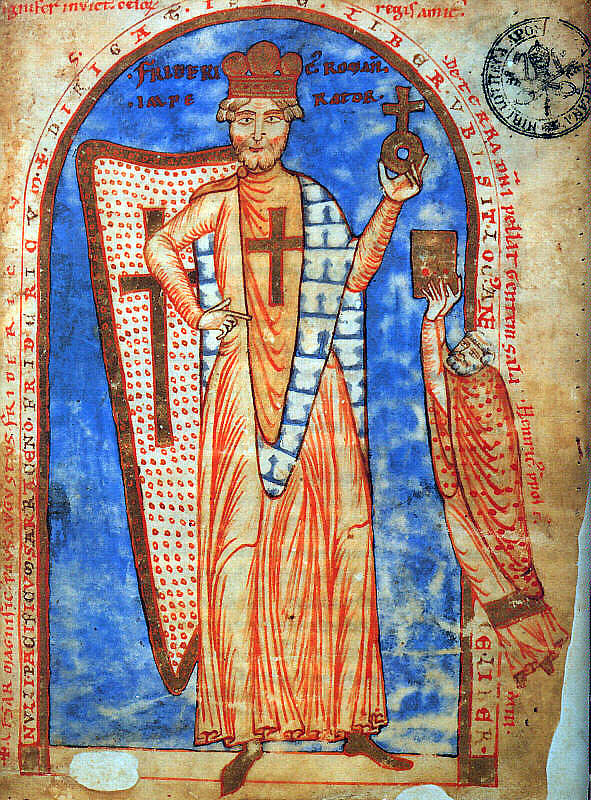
Federico I Hohenstaufen, known as Federico Barbarossa, was a significant historical figure whose impact on the medieval European landscape remains profound. Born in 1122 in Waiblingen, Germany, Barbarossa rose to prominence as the Holy Roman Emperor, a title he held from 1155 until his death in 1190. His quest to establish a universal empire, his military campaigns, and his complex relationship with the Papacy shaped the political and cultural fabric of his time. This article delves into the life, achievements, and lasting legacy of Federico Barbarossa.
Early Life and Ascension
Federico Barbarossa was born to Frederick II, Duke of Swabia, and Judith of Bavaria. His early life was steeped in the noble traditions of his family, and he quickly rose through the ranks. In 1147, upon the death of his father, Barbarossa inherited the Duchy of Swabia, becoming Frederick III. His first notable political action was joining his uncle, Emperor Conrad III, on the Second Crusade, which, despite its ultimate failure, solidified his reputation as a competent and brave leader.
Coronation as King of Germany
On March 9, 1152, Federico Barbarossa was crowned King of Germany in Aachen. This event marked the beginning of his ambitious plans to restore the glory and influence of the Holy Roman Empire. His vision was to create a powerful and unified empire that would surpass the influence of the Papacy and rival the ancient Roman Empire.
The Diet of Constance and Italian Campaigns
In March 1153, Barbarossa convened the Diet of Constance, a significant political assembly that included representatives from various German duchies and Italian communes. Here, he sought to assert his rights over the election of German bishops and to secure the Church’s support in exchange for his protection and endorsement.
The Diet of Constance also provided Barbarossa with an opportunity to address the appeals of several Italian cities, including Lodi, Pavia, and Como, which sought his intervention against the rising power of Milan. Seeing this as an opportunity to extend his influence in Italy, Barbarossa launched several military campaigns to subdue rebellious cities and assert his authority. His actions included the destruction of Tortona and the significant confrontation with Milan, which eventually led to its surrender in 1162.
Coronation as Holy Roman Emperor
Barbarossa’s Italian campaigns culminated in his coronation as Holy Roman Emperor by Pope Adrian IV on June 18, 1155. This ceremony, held in Rome, was a significant milestone in Barbarossa’s quest for imperial authority. However, the relationship between the Emperor and the Papacy remained fraught with tension, as both sides vied for supremacy.
Conflict with the Papacy and the Lombard League
The power struggle between Barbarossa and the Papacy intensified with the election of Pope Alexander III, who opposed Barbarossa’s attempts to consolidate imperial control over Italy. This conflict led to the formation of the Lombard League in 1167, an alliance of northern Italian cities, including Milan, Venice, and Bologna, which sought to resist Barbarossa’s authority.
The ensuing conflict saw several significant battles, including the famous Battle of Legnano in 1176, where Barbarossa’s forces were decisively defeated by the Lombard League. This defeat forced Barbarossa to negotiate peace, leading to the Treaty of Venice in 1177, which recognized the autonomy of the Lombard cities and marked a temporary truce with Pope Alexander III.
Later Years and the Third Crusade
Despite setbacks in Italy, Barbarossa’s ambition and influence continued to shape European politics. In 1183, the Peace of Constance formally recognized the independence of the Lombard League cities while allowing Barbarossa to retain nominal control over them.
In his later years, Barbarossa turned his attention to the Holy Land. Following the fall of Jerusalem to Saladin in 1187, Barbarossa took the cross and led the German contingent of the Third Crusade. His participation in the crusade was driven by a desire to secure Christian control over Jerusalem and to reaffirm his status as a leader of Christendom.
Death and Legacy
Tragically, Federico Barbarossa’s life ended during the Third Crusade. On June 10, 1190, while crossing the Saleph River (now Göksu River) in Anatolia, Barbarossa drowned. His death marked the end of an era, and his army, leaderless and demoralized, struggled to continue the crusade effectively.
Barbarossa’s legacy is multifaceted. He is remembered as a powerful and determined ruler who sought to restore the glory of the Holy Roman Empire. His military campaigns, political maneuvers, and efforts to assert imperial authority had a lasting impact on the structure of European politics. The cities and regions he influenced or controlled bore the marks of his reign for centuries.
Historical Context and Impact
Federico Barbarossa’s reign occurred during a period of significant transformation in medieval Europe. The struggle between secular and ecclesiastical powers, exemplified by Barbarossa’s conflicts with the Papacy, was a defining feature of the era. His efforts to establish a universal empire were part of a broader trend among European monarchs to centralize authority and expand their influence.
Barbarossa’s campaigns in Italy, although ultimately unsuccessful in achieving complete domination, played a crucial role in shaping the political landscape of the region. The resistance of the Lombard League and the eventual recognition of their autonomy under the Peace of Constance highlighted the growing power and influence of urban communes in medieval Italy.
The Symbolism of Barbarossa
Federico Barbarossa’s legacy extends beyond his immediate political and military achievements. In German folklore and nationalist sentiment, he became a symbol of imperial ambition and German unity. Legends of his return, such as the story that he sleeps in the Kyffhäuser mountain awaiting a call to restore Germany to greatness, underscore his enduring symbolic importance.
Conclusion: A Complex Legacy
Federico Barbarossa’s life and reign were marked by ambition, conflict, and a relentless pursuit of power. His efforts to establish a universal empire were shaped by the broader dynamics of medieval Europe, where the interplay between secular and ecclesiastical authorities defined the political landscape.
Barbarossa’s legacy is complex. He was a ruler who sought to centralize authority and expand his influence, yet his actions also spurred the development of political resistance and the assertion of local autonomy. His reign had a lasting impact on the Holy Roman Empire and the Italian communes, and his participation in the Third Crusade underscored his commitment to the broader Christian cause.
As a historical figure, Federico Barbarossa embodies the complexities and contradictions of medieval kingship. His life and achievements continue to be studied and debated by historians, and his legacy remains a significant chapter in the history of medieval Europe.


