
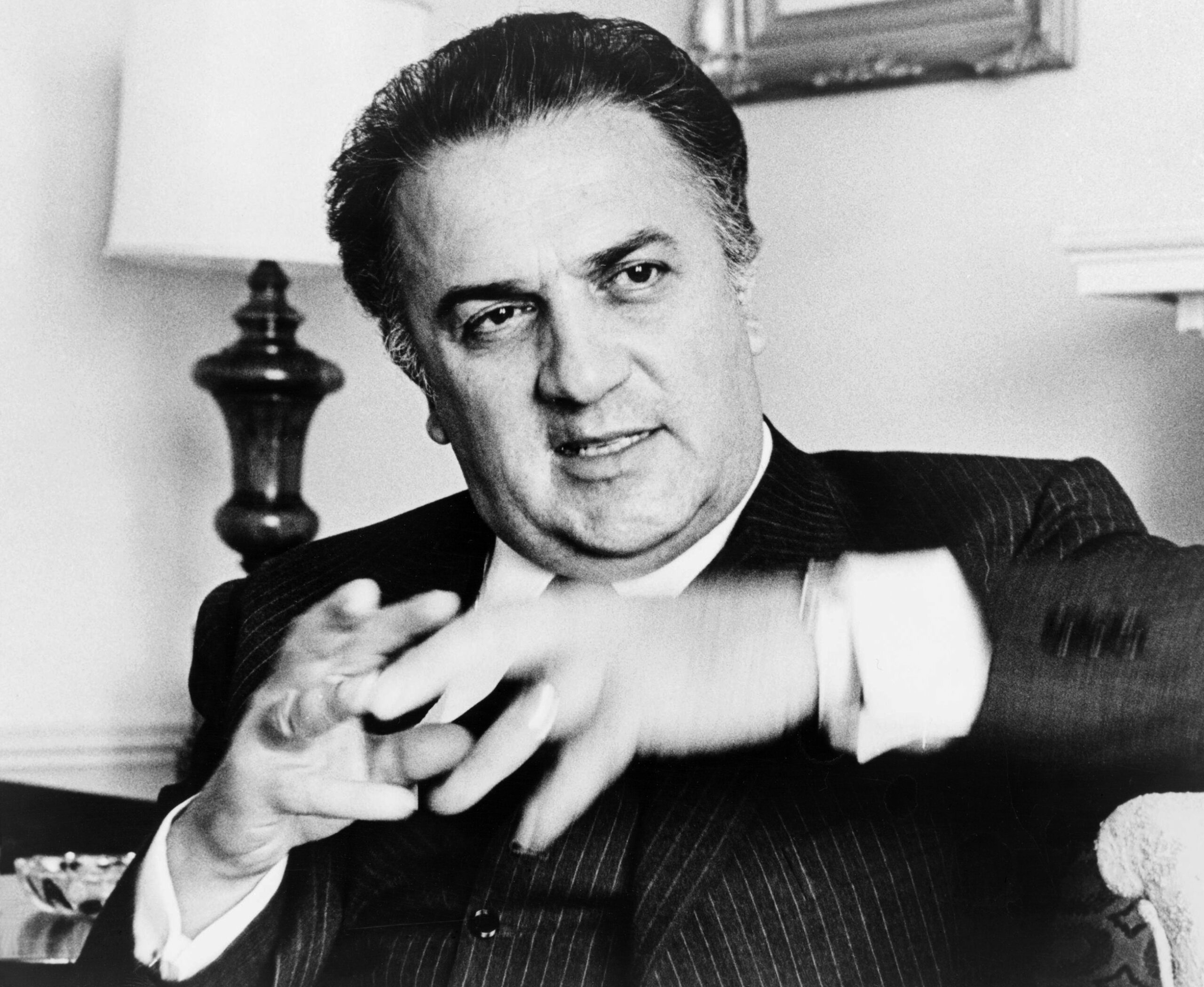
Federico Fellini, a name that echoes through the annals of cinematic history, is one of the most influential filmmakers of the 20th century. Born on January 20, 1920, in Rimini, Italy, Fellini’s life was a tapestry of creativity, innovation, and a deep exploration of the human condition. This article delves into the life and career of Federico Fellini, examining his journey from a young caricaturist to a world-renowned director, his unique style, and the indelible mark he left on the world of cinema.
Early Life and Artistic Beginnings
Federico Fellini was born into a modest, small-town family in Rimini, a coastal city in Italy. His father, originally from Gambettola, was a traveling salesman dealing in food products, while his mother was a housewife. Fellini’s early life in Rimini, surrounded by the vibrant yet provincial atmosphere of the town, would later serve as a profound influence on his cinematic work.
Fellini’s disinterest in formal education became apparent during his years at the local classical high school. Instead of focusing on his studies, he found solace in drawing and caricature, honing his artistic skills. At the tender age of 17, he began earning money by creating caricatures, a talent that foreshadowed his future in the arts. He was commissioned by the local cinema, the Fulgor, to create portraits of famous actors, which were displayed to attract moviegoers.
In 1937, alongside his friend and painter Demos Bonini, Fellini founded a caricature shop called “Febo.” Here, they offered caricatures to vacationers, an endeavor that further solidified Fellini’s passion for the arts and storytelling. His early work in caricature not only demonstrated his artistic talent but also his ability to observe and exaggerate human features and behaviors—a skill that would become a hallmark of his later films.
Move to Rome and Early Career
In January 1939, at the age of 19, Fellini moved to Rome, ostensibly to study law. However, it quickly became clear that his true interests lay elsewhere. Rome, with its bustling streets, ancient monuments, and thriving arts scene, captivated Fellini. He immersed himself in the world of entertainment, frequenting the avant-garde theater scene and the radio industry, where he began writing scripts and gags.
Fellini’s early collaborations in Rome were with some of Italy’s most prominent entertainers of the time, including Aldo Fabrizi, Erminio Macario, and Marcello Marchesi. These experiences allowed him to refine his storytelling abilities and develop a unique voice that blended humor with a deep understanding of human nature.
In 1943, Fellini’s life took a significant turn when he met Giulietta Masina, a talented actress who was performing on a radio show he had written. The two married in October of that year, forming a partnership that would not only endure for the rest of Fellini’s life but also play a crucial role in many of his films. Masina would go on to star in some of Fellini’s most acclaimed works, becoming a muse and collaborator who brought his characters to life with depth and sensitivity.
Transition to Cinema and Early Successes
Fellini’s transition from radio and theater to cinema began in the late 1930s and early 1940s. He initially worked as a “gagman,” writing jokes and scenes for other directors, including the popular comedian Macario. His early involvement in the film industry was marked by a series of collaborations on screenplays for other directors, such as Mario Bonnard’s “Avanti c’è posto” and Goffredo Alessandrini’s “Chi l’ha visto?”
It was during this period that Fellini became associated with the Italian neorealist movement, a cinematic trend that sought to depict the everyday lives of ordinary people in post-war Italy. Fellini’s contributions to the screenplays of Roberto Rossellini’s “Rome, Open City” (1945) and “Paisà” (1946) were instrumental in defining the neorealist aesthetic, which emphasized naturalistic performances, location shooting, and a focus on social issues.
Fellini’s work with Rossellini, in particular, was a turning point in his career. The success of “Rome, Open City,” a film that depicted the struggles of the Italian Resistance during World War II, brought international acclaim and established Fellini as a significant voice in Italian cinema. This collaboration also marked the beginning of Fellini’s exploration of the blurred lines between reality and fantasy, a theme that would become central to his later work.
Directorial Debut and Early Films
In the early 1950s, Fellini made his directorial debut with “Luci del varietà” (Variety Lights, 1951), a film co-directed with Alberto Lattuada. The film, which centered on the lives of struggling variety performers, hinted at the autobiographical elements that would become a hallmark of Fellini’s work. It also showcased his fascination with the world of entertainment, a recurring theme in his films.
Following “Luci del varietà,” Fellini directed “Lo sceicco bianco” (The White Sheik, 1952), his first solo feature film. The film was a satirical comedy that explored the fantasies of a newlywed woman who becomes infatuated with a popular photo-romance actor. While not a commercial success, “Lo sceicco bianco” demonstrated Fellini’s unique ability to blend humor with a poignant exploration of human desires and delusions.
Fellini’s breakthrough came with his third film, “I vitelloni” (1953). The film, which was based on his memories of youth in Rimini, told the story of five young men who are reluctant to leave their small-town lives. “I vitelloni” resonated with audiences both in Italy and abroad, earning critical acclaim and establishing Fellini as a major director. The film’s success also marked the beginning of Fellini’s exploration of autobiographical themes, as he drew on his own experiences to create stories that were both personal and universal.
International Acclaim and the Golden Age of Fellini
Fellini’s international acclaim was solidified with the release of “La strada” (1954), a film that would become one of his most celebrated works. Starring Giulietta Masina as Gelsomina, a simple-minded woman sold to a traveling strongman, played by Anthony Quinn, “La strada” was a poignant exploration of loneliness, cruelty, and redemption. The film’s poetic imagery and emotional depth resonated with audiences worldwide, earning Fellini his first Academy Award for Best Foreign Language Film.
“La strada” was followed by “Il bidone” (1955) and “Le notti di Cabiria” (1957), the latter of which also starred Giulietta Masina and earned Fellini his second Academy Award for Best Foreign Language Film. In “Le notti di Cabiria,” Masina played the role of a naive, optimistic prostitute who dreams of finding love and happiness but faces a series of heartbreaking disappointments. The film’s blend of comedy and tragedy, along with Masina’s remarkable performance, further cemented Fellini’s reputation as a master storyteller.
However, it was with “La dolce vita” (1960) that Fellini reached the pinnacle of his career. The film, which depicted the decadent lifestyle of a journalist in Rome, was both a critical and commercial success. “La dolce vita” won the Palme d’Or at the Cannes Film Festival and became a cultural phenomenon, with its title becoming synonymous with the hedonistic excesses of modern life. The film’s portrayal of a society in moral decline sparked controversy, particularly with the Vatican, but it also marked a turning point in Fellini’s career as he moved away from the neorealist style and embraced a more personal, surrealistic approach to filmmaking.
“8½” and the Exploration of the Psyche
In 1963, Fellini released what is often considered his magnum opus, “8½.” The film, which starred Marcello Mastroianni as a director struggling with creative block and personal crises, was a deeply introspective work that blurred the lines between reality and fantasy. “8½” was a reflection on the creative process, as well as a meditation on memory, identity, and the passage of time.
The film’s innovative narrative structure, which interwove dream sequences with reality, was groundbreaking and influenced countless filmmakers. “8½” won the Academy Award for Best Foreign Language Film and the Oscar for Best Costume Design, and it remains one of the most studied and celebrated films in cinematic history.
Following “8½,” Fellini continued to explore themes of memory, fantasy, and the subconscious in his films. “Giulietta degli spiriti” (1965), Fellini’s first color film, delved into the inner life of a woman (played by Giulietta Masina) who discovers her husband’s infidelity. The film used vibrant colors and surreal imagery to depict the protagonist’s emotional journey, marking another milestone in Fellini’s career.
Later Works and Continued Innovation
The late 1960s and 1970s saw Fellini continuing to push the boundaries of cinema with films that were increasingly surreal and experimental. “Fellini Satyricon” (1969) was a visually stunning adaptation of Petronius’s ancient Roman text, reimagined as a psychedelic exploration of decadence and decay. The film’s fragmented narrative and bold imagery reflected Fellini’s fascination with the decline of civilizations and the timelessness of human desires.
In 1973, Fellini returned to his roots with “Amarcord,” a semi-autobiographical film set in a small town in 1930s Italy. “Amarcord,” which means “I remember” in the Rimini dialect, was a nostalgic and humorous portrayal of life in Fascist Italy, filled with colorful characters and whimsical episodes. The film was a critical and commercial success, earning Fellini his fourth Academy Award for Best Foreign Language Film.
Fellini’s later works, including “Il Casanova di Federico Fellini” (1976), “Prova d’orchestra” (1979), and “La città delle donne” (1980), continued to explore complex themes of identity, memory, and the passage of time. His final film, “La voce della Luna” (1990), was a melancholic reflection on the loss of innocence and the fading of dreams, marking a poignant end to his illustrious career.
Legacy and Influence
Federico Fellini passed away on October 31, 1993, at the age of 73, leaving behind a legacy that continues to influence filmmakers, artists, and writers around the world. His ability to blend reality with fantasy, his deep understanding of human psychology, and his innovative use of narrative and visual style have made him one of the most revered directors in the history of cinema.
Fellini’s films are celebrated for their exploration of the human condition, their rich visual imagery, and their unique blend of humor and tragedy. His work has inspired generations of filmmakers, from Martin Scorsese to David Lynch, and his influence can be seen in countless films that explore the boundaries between reality and the imagination.
In the end, Federico Fellini was more than just a filmmaker; he was a visionary artist who used cinema to explore the complexities of life, love, and the human soul. His films continue to resonate with audiences today, reminding us of the power of storytelling and the enduring magic of the movies.


