
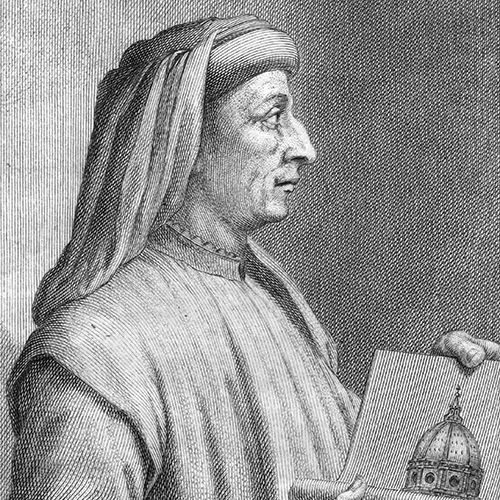
Filippo Brunelleschi, born in 1377 in Florence, Italy, stands as one of the most innovative and influential figures in the history of architecture. His work not only defined the Renaissance in Florence but also laid the groundwork for modern architectural principles. As the man behind the iconic dome of Florence’s Santa Maria del Fiore, Brunelleschi’s contributions to the world of art, engineering, and architecture have left an indelible mark on history.
Early Life and Training
Filippo di ser Brunellesco Lapi, better known as Filippo Brunelleschi, was born into a well-established Florentine family. His father, a notary, likely expected his son to follow in his professional footsteps, but Brunelleschi’s interests lay elsewhere. Early in his life, he trained as a goldsmith and sculptor, working in a bottega (workshop), where he honed his skills in metalwork, a discipline that required both precision and creativity.
Brunelleschi’s early works included contributions to the silver altar of San Jacopo in Pistoia, which highlighted his talents in goldsmithing. Despite his initial success in this field, Brunelleschi’s passion soon shifted towards architecture, driven by his desire to explore the spatial and mathematical aspects of building design.
The Baptistery Competition: A Turning Point
In 1401, Brunelleschi entered a competition to design the bronze doors for the Florence Baptistery, one of the city’s most prestigious artistic commissions. The competition, sponsored by the Arte di Calimala (the wool merchants’ guild), sought a new set of doors to complement those created by Andrea Pisano in the 14th century. Brunelleschi’s submission, a panel depicting the Sacrifice of Isaac, was a powerful display of his sculptural prowess, characterized by its dramatic intensity and detailed realism.
However, the competition ended ambiguously. Some accounts suggest that Brunelleschi tied for first place with Lorenzo Ghiberti, while others claim he came in second. Disappointed by the outcome, Brunelleschi withdrew from the project, leaving Ghiberti to complete the doors, which are now famous as the “Gates of Paradise.”
This setback proved to be a pivotal moment in Brunelleschi’s career. Disillusioned with sculpture, he decided to focus entirely on architecture. This decision would soon lead to one of the most extraordinary architectural achievements in history.
Study in Rome and the Birth of Renaissance Architecture
Following the Baptistery competition, Brunelleschi traveled to Rome, accompanied by his close friend, the sculptor Donatello. In Rome, Brunelleschi immersed himself in the study of ancient Roman architecture. He meticulously measured and analyzed the ruins, particularly the Pantheon, with its vast dome, which would later influence his own work.
This period of study was crucial for Brunelleschi, as it solidified his understanding of classical architecture’s principles, particularly its use of geometry and proportion. He became one of the first architects to grasp and apply the concept of linear perspective, a mathematical system that allows for the depiction of three-dimensional space on a two-dimensional plane. Brunelleschi’s experiments with perspective would later revolutionize Renaissance art and architecture, providing a scientific approach to design that had been lost since antiquity.
The Dome of Santa Maria del Fiore: A Masterpiece
Brunelleschi’s most famous achievement is undoubtedly the dome of Florence’s Cathedral of Santa Maria del Fiore, commonly known as the Duomo. By the early 15th century, the cathedral had been under construction for over a century, but the original plans had left an enormous challenge: how to span the vast space above the central nave with a dome, especially since no one knew how to build such a large structure without it collapsing under its own weight.
In 1418, the Opera del Duomo, the committee overseeing the cathedral’s construction, announced a competition to design a dome for the cathedral. Brunelleschi’s proposal was nothing short of revolutionary. He suggested constructing the dome without the traditional wooden centering used to support such structures during construction. Instead, he proposed an innovative method of building a double-shell dome, with interlocking bricks arranged in a herringbone pattern to provide additional support.
Despite skepticism from his peers and the sheer audacity of his design, Brunelleschi’s plan was accepted. Work on the dome began in 1420, with Brunelleschi overseeing the project. His solution involved a series of ingenious devices and techniques, including hoists and cranes he designed specifically for the project, which allowed for the precise placement of the massive stones needed to build the dome.
The dome, completed in 1436, remains one of the largest masonry domes in the world and is considered a masterpiece of Renaissance architecture. Its construction was a triumph of engineering, blending classical principles with groundbreaking innovation. The success of the dome established Brunelleschi as the foremost architect of his time, and it remains a symbol of Florence’s cultural and artistic heritage.
Other Architectural Achievements
While the dome of Santa Maria del Fiore is Brunelleschi’s most famous work, it is by no means his only contribution to the field of architecture. Throughout his career, Brunelleschi designed numerous other buildings that exemplify the principles of Renaissance architecture, characterized by clarity, harmony, and proportion.
One of his earliest projects was the Ospedale degli Innocenti (1419), a children’s orphanage in Florence. The building’s design, with its elegant loggia supported by slender columns and round arches, set the standard for Renaissance architecture. The Ospedale is often cited as one of the first buildings to embody the new architectural language of the Renaissance, combining functional design with classical aesthetics.
Brunelleschi also designed the Old Sacristy of San Lorenzo (1421-1440), a chapel that served as a model for later Renaissance churches. The design of the sacristy is notable for its geometric clarity and harmonious proportions, which reflect Brunelleschi’s deep understanding of classical architecture.
Another significant project was the Pazzi Chapel at the Basilica of Santa Croce in Florence, begun around 1441. The chapel is a masterpiece of proportion and symmetry, with a central dome, Corinthian columns, and pilasters that exemplify the ideals of Renaissance architecture. The Pazzi Chapel is often considered one of the most perfect examples of Brunelleschi’s architectural style.
Innovations in Perspective and Engineering
Brunelleschi’s contributions to the Renaissance extended beyond architecture. He was also a pioneering engineer and inventor, developing new techniques and machinery that would have a lasting impact on the field of construction. His work on the dome of Santa Maria del Fiore required the creation of advanced hoisting machines, which allowed workers to lift and position heavy stones with unprecedented precision.
Moreover, Brunelleschi’s experiments with linear perspective had a profound influence on the visual arts. By demonstrating how to create the illusion of depth on a flat surface, Brunelleschi provided artists like Masaccio and Leonardo da Vinci with the tools they needed to develop the realistic, three-dimensional style that became a hallmark of Renaissance painting.
Legacy and Influence
Filippo Brunelleschi’s impact on architecture and engineering cannot be overstated. His work represents a bridge between the medieval world and the modern era, bringing the principles of classical architecture into the Renaissance and laying the foundation for centuries of architectural innovation.
Brunelleschi’s approach to architecture was groundbreaking in that it combined practical engineering with theoretical knowledge. He was not just a builder but a thinker, someone who understood that architecture could be both a science and an art. His use of geometry and mathematics to solve complex architectural problems set new standards for design, influencing generations of architects who followed in his footsteps.
The dome of Santa Maria del Fiore remains one of the most iconic structures in the world, a testament to Brunelleschi’s genius and vision. It continues to inspire architects, engineers, and artists, serving as a symbol of what can be achieved when innovation and creativity come together.
Brunelleschi passed away on April 15, 1446, in Florence, leaving behind a legacy that would endure for centuries. He was buried in the cathedral he helped complete, a fitting tribute to a man whose work defined the skyline of Florence and the spirit of the Renaissance.
Conclusion
Filippo Brunelleschi was more than just an architect; he was a visionary whose innovations helped shape the course of Western architecture. His ability to blend ancient principles with modern techniques resulted in some of the most enduring and beautiful structures in the world. From the majestic dome of Santa Maria del Fiore to the harmonious proportions of the Pazzi Chapel, Brunelleschi’s work embodies the ideals of the Renaissance, reflecting a deep understanding of geometry, perspective, and classical design.
Today, Brunelleschi is remembered as one of the founding fathers of Renaissance architecture, a man whose contributions continue to influence the field more than five centuries after his death. His legacy is one of innovation, artistry, and a relentless pursuit of perfection, qualities that make him one of history’s greatest architects.


