
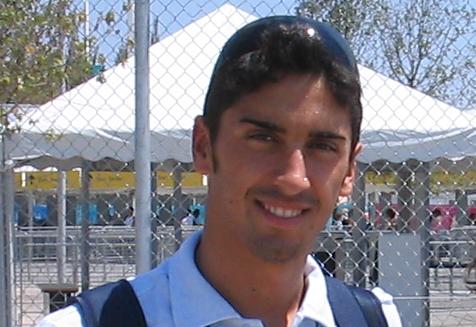
Filippo Magnini, born on February 2, 1982, in Pesaro, Italy, is a renowned swimmer who has left an indelible mark on the world of competitive swimming. Known for his powerful strokes and tenacious spirit, Magnini has earned the nickname “Superpippo” and “Re Magno” (King Magnini) for his extraordinary achievements in the pool. His journey from a young, enthusiastic athlete to a world champion is a tale of dedication, resilience, and unwavering commitment to excellence.
Early Life and Introduction to Sports
Filippo Magnini’s early life was characterized by an innate curiosity and a vibrant personality. At the tender age of four, he began roller skating alongside his sister Laura, a testament to his early interest in physical activities. Growing up in Pesaro, a city where basketball is the predominant sport, Magnini initially dabbled in basketball, tennis, and soccer. Despite his enthusiasm for these sports, his slender physique prompted his parents to encourage him to take up swimming to build strength and endurance.
Magnini’s first foray into competitive swimming was with the local club Vis Sauro Nuoto, where he quickly began to make a name for himself. By the age of ten, he had already experienced the thrill of standing on the podium, winning his first trophies. His passion for swimming deepened, and despite his initial desire to pursue soccer, he decided to focus solely on swimming, a decision that would set the course for his future career.
Transition to Competitive Swimming
During his teenage years, Filippo Magnini specialized in breaststroke, a discipline that he excelled in due to his impeccable technique and determination. At sixteen, his hard work began to pay off as he won his first Italian national titles in the junior category. These victories led to his selection for the Italian national junior team, where he gained valuable international experience and added to his growing collection of medals.
At eighteen, Magnini made a pivotal decision that would change the trajectory of his career. Recognizing his potential in freestyle, he transitioned from breaststroke to freestyle, a move that proved to be incredibly successful. His coaches, impressed by his natural speed and agility, fully supported this transition. This decision marked the beginning of his rise to the top of the swimming world.
Rise to Prominence: Early 2000s
In 2001, Filippo Magnini graduated from high school with a diploma in geometry. With his family’s encouragement, he moved to Turin, where he joined the prestigious Rari Nantes Torino swimming club. Under the guidance of coach Claudio Rossetto, Magnini dedicated himself entirely to freestyle swimming. His partnership with Rossetto was crucial in developing his technique and mental fortitude, qualities that would become his trademarks in the years to come.
By 2004, Magnini had established himself as one of Italy’s premier swimmers. He dominated national competitions, winning multiple Italian titles and earning his place on the Italian national team. His breakthrough on the international stage came at the 2004 Athens Olympics, where he played a pivotal role in the Italian 4×200-meter freestyle relay team that won a bronze medal. This achievement not only brought him international recognition but also earned him the title of Cavaliere della Repubblica (Knight of the Republic) from the President of Italy, Carlo Azeglio Ciampi.
World Champion: The Pinnacle of Success
The year 2005 marked a historic moment in Filippo Magnini’s career. Competing at the World Championships in Montreal, Canada, Magnini took part in the 100-meter freestyle, often referred to as the “blue riband” event of swimming, comparable to the 100-meter sprint in track and field. Despite being fourth at the halfway turn, Magnini unleashed a remarkable burst of speed in the final 50 meters, overtaking his rivals to claim the gold medal with a time of 48.12 seconds. This victory was not only a personal triumph but also a milestone for Italian swimming, as he became the first Italian to win a world title in the 100-meter freestyle.
Magnini’s victory resonated throughout the swimming community, earning him widespread acclaim. His time of 48.12 seconds was the second-fastest in history at that point, only behind the legendary Pieter van den Hoogenband. The significance of this achievement cannot be overstated, as it elevated Magnini to the status of a national hero and an international swimming icon.
Continued Dominance and Challenges
Following his success in Montreal, Filippo Magnini continued to dominate the swimming scene. At the 2006 European Championships in Budapest, he once again claimed the gold medal in the 100-meter freestyle, reinforcing his position as the swimmer to beat. That same year, at the World Championships in Melbourne, he shared the gold medal with Canadian swimmer Brent Hayden in a dramatic race that ended in a tie.
Despite these successes, Magnini faced challenges as well. The 2008 Beijing Olympics were a disappointment for the Italian team, with Magnini unable to replicate his previous successes. However, his resilience shone through as he rebounded to win the 100-meter freestyle at the 2012 European Championships in Debrecen, Hungary, just weeks before the London Olympics. This victory, achieved with a near-perfect race, was a testament to his enduring skill and competitive spirit.
Personal Life and Media Presence
Outside the pool, Filippo Magnini has been a prominent figure in Italian media, partly due to his high-profile relationship with fellow swimming champion Federica Pellegrini. The couple’s relationship, which was widely covered by the press, captivated the public’s imagination, making them one of Italy’s most famous sports couples.
In 2008, following the Beijing Olympics, Magnini ventured into the world of television, serving as a correspondent from Honduras for the popular Italian reality show “L’isola dei famosi” (The Island of the Famous). This experience further solidified his status as a media personality, beyond his achievements in sports.
In 2017, at the age of 35, Magnini announced his retirement from competitive swimming. The following year, his relationship with television presenter Giorgia Palmas became public, and the couple has since been a fixture in Italian celebrity culture. Their relationship reached a new milestone in 2020 with the birth of their daughter, Mia.
Controversy and Redemption
Magnini’s career was not without controversy. In November 2018, he was handed a four-year ban from swimming by the Italian Anti-Doping Agency (NADO) for alleged doping violations. The accusations were a severe blow to his reputation and career, casting a shadow over his achievements. However, Magnini vehemently denied any wrongdoing and fought to clear his name.
In February 2020, after a long legal battle, Filippo Magnini was acquitted of all charges and his ban was lifted. The court’s decision was a vindication for Magnini, who had always maintained his innocence. This acquittal allowed him to restore his reputation and return to public life with renewed vigor.
Legacy and Impact
Filippo Magnini’s legacy in the world of swimming is marked by his incredible achievements and the obstacles he overcame. He is widely regarded as one of Italy’s greatest swimmers, and his victories have inspired countless young athletes in Italy and around the world.
Magnini’s success in the 100-meter freestyle—a discipline often dominated by swimmers from the United States and Australia—was particularly significant. It demonstrated that European swimmers could compete at the highest levels in sprint events, and it paved the way for future generations of Italian swimmers to aspire to greatness.
Beyond his athletic accomplishments, Magnini has also made a lasting impact through his public persona. His resilience in the face of adversity, his contributions to Italian sports culture, and his commitment to maintaining the integrity of his sport have earned him respect both within and outside the swimming community.
Conclusion
Filippo Magnini’s journey from a young boy in Pesaro to a world champion swimmer is a story of dedication, resilience, and an unwavering pursuit of excellence. His achievements in the pool have made him a national hero in Italy, and his legacy continues to inspire new generations of athletes. Despite the challenges he faced, both in his career and personal life, Magnini’s story is ultimately one of triumph and redemption. His contributions to the sport of swimming, both in terms of his records and his example of sportsmanship, will be remembered for years to come.
As Filippo Magnini moves forward in his post-swimming career, he remains a symbol of what can be achieved through hard work, determination, and a refusal to give up in the face of adversity. His story is a testament to the power of perseverance and the enduring spirit of a true champion.


