
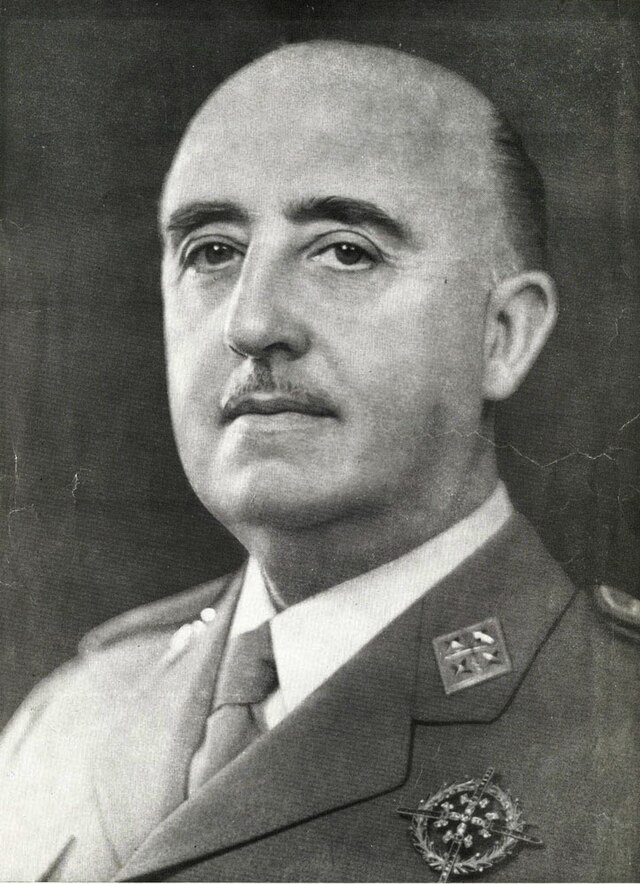
Francisco Franco Bahamonde, one of the most controversial figures in 20th-century European history, was born on December 4, 1892, in El Ferrol, a port city in northwestern Spain. His life and legacy are intertwined with Spain’s tumultuous political landscape, particularly during the Spanish Civil War and the subsequent dictatorship that lasted until his death in 1975. This article delves into Franco’s life, exploring his rise to power, the factors that contributed to his fame, and the lasting impact of his rule on Spain and the world.
Early Life and Military Beginnings
Born into a middle-class family with strong ties to the Spanish Navy, Franco’s early life was marked by familial discord, with his parents separating during his childhood. Despite the challenges, Franco displayed a strong sense of discipline and determination from a young age. At just 14, he enrolled in the Spanish Military Academy in Toledo, where he stood out not only for his youth and short stature but also for his commitment and resolve.
Franco’s military career began in earnest in 1912 when he was assigned to the Spanish Army in Africa. This period was crucial in shaping his character and military prowess. He distinguished himself as a brave and capable officer, often taking part in dangerous missions that earned him both recognition and respect among his peers. By 1920, he had joined the Spanish Foreign Legion, an elite military unit where he quickly rose through the ranks due to his leadership qualities and strict adherence to military discipline.
Rise to Power: The Spanish Civil War
The early 20th century in Spain was marked by political instability, with the monarchy giving way to the Second Spanish Republic in 1931. Franco, although not initially a prominent political figure, was deeply affected by the Republic’s policies, particularly those that targeted the military establishment. His conservative and nationalist views began to crystallize during this period, laying the groundwork for his eventual leadership role.
In 1936, Spain was plunged into a brutal civil war that pitted the Republican government against a coalition of Nationalists, including monarchists, fascists, and conservatives. Franco, who had been stationed in Morocco, emerged as a key figure in the Nationalist movement. His leadership was solidified after a series of military victories, and by 1939, he had succeeded in defeating the Republican forces, establishing himself as the undisputed ruler of Spain.
Dictatorship and Fame
Franco’s dictatorship, which lasted from 1939 until his death in 1975, was characterized by its authoritarian nature, suppression of political opposition, and strong emphasis on traditional Spanish values, including Catholicism and nationalism. Unlike other contemporary dictators such as Adolf Hitler and Benito Mussolini, Franco maintained a relatively low profile on the international stage. However, his regime was no less repressive, with widespread censorship, political purges, and a secret police force that kept dissent in check.
One of Franco’s most significant accomplishments, in his view, was keeping Spain neutral during World War II. Despite pressure from Nazi Germany and Fascist Italy, Franco managed to avoid direct involvement in the conflict, a decision that likely spared Spain from the devastation experienced by much of Europe. This neutrality, combined with his ability to maintain a tight grip on power, contributed to his enduring fame and the longevity of his regime.
Franco’s fame was not limited to his military and political achievements. He cultivated a carefully crafted image as the savior of Spain, portraying himself as a man of the people, committed to restoring order and preserving the nation’s unity. This self-styled image was reinforced through propaganda, which depicted him as a pious and humble leader, often referred to as “El Caudillo” (The Leader). His public persona was further bolstered by his marriage to Carmen Polo, an aristocratic woman who was often seen alongside Franco in public ceremonies, where she was accorded the status of a queen.
Historical Context and Ideological Influence
To fully understand Franco’s impact on Spain and his place in history, it’s essential to explore the broader ideological and historical context in which he operated. Franco’s worldview was shaped by a combination of traditional Spanish conservatism, anti-communism, and a deep-seated belief in the moral and spiritual superiority of the Spanish nation. His regime was marked by a relentless opposition to liberalism, socialism, and any form of political pluralism, which he viewed as threats to the nation’s stability and unity.
Franco’s ideological stance was heavily influenced by the experiences of the Spanish Civil War, which he saw as a struggle between the forces of order and chaos, tradition and modernity, religion and secularism. This binary worldview led him to align with the Catholic Church, which became one of the pillars of his regime. In return, the Church provided Franco with moral legitimacy and support, reinforcing his image as the defender of Spain’s Catholic heritage.
Franco’s disdain for political parties and democratic institutions was evident in his approach to governance. He established a one-party state under the Falange Española Tradicionalista y de las JONS, a fascist-inspired political organization that served as the regime’s official ideology. However, Franco’s brand of fascism was distinct from that of Hitler or Mussolini. While he adopted some elements of fascist rhetoric and symbolism, his regime was more conservative and traditionalist, emphasizing the preservation of Spain’s historical identity and social hierarchy rather than the revolutionary aspects of fascism.
The Legacy of Franco’s Rule
Francisco Franco’s legacy is a complex and contentious one. On the one hand, he is credited with stabilizing Spain after years of civil war and political turmoil, laying the groundwork for the country’s eventual economic recovery in the 1950s and 1960s. Under Franco’s rule, Spain experienced significant industrial growth, infrastructural development, and improvements in living standards for many Spaniards. However, these economic gains came at a high cost, as the regime’s authoritarian policies stifled political freedom, suppressed cultural diversity, and perpetuated social inequalities.
Franco’s impact on Spanish society extended beyond the political and economic realms. His regime’s emphasis on traditional gender roles, Catholic values, and national unity had a lasting influence on Spanish culture and identity. The regime’s censorship and propaganda shaped public discourse and created a monolithic narrative of Spanish history that excluded alternative perspectives and marginalized minority groups, such as Basques and Catalans, who sought greater autonomy and recognition.
Despite Franco’s efforts to secure his regime’s longevity, his death in 1975 marked the beginning of a dramatic transformation in Spain. The country transitioned to democracy in the years following his death, a process that involved dismantling the institutions and structures that had supported Franco’s dictatorship. The transition was remarkably peaceful, given Spain’s history of political violence, and is often cited as a model of democratic consolidation.
However, the legacy of Francoism continues to be a source of debate and division in Spain. While some view Franco as a hero who saved Spain from communism and preserved its unity, others see him as a tyrant whose repressive policies inflicted deep wounds on the nation’s social fabric. The debate over Franco’s legacy was reignited in recent years with the decision to exhume his remains from the Valley of the Fallen, a controversial monument built during his regime to honor the victims of the Civil War. The exhumation, which took place in 2019, was part of a broader effort to reckon with Spain’s past and address the lingering effects of Francoism on Spanish society.
Conclusion
Francisco Franco’s life and legacy are emblematic of the broader struggles and contradictions that have shaped modern Spain. His rise to power, his role in the Spanish Civil War, and his subsequent dictatorship left an indelible mark on the country, influencing its political trajectory, social structures, and cultural identity for decades. While Franco’s regime is often remembered for its authoritarianism and repression, it also played a significant role in shaping the Spain we know today.
As Spain continues to grapple with the legacy of Francoism, it is essential to approach this complex history with nuance and a deep understanding of the historical context. By doing so, we can gain a more comprehensive view of Franco’s impact on Spain and the world, and better understand the ongoing challenges of reconciling with a difficult past.


