
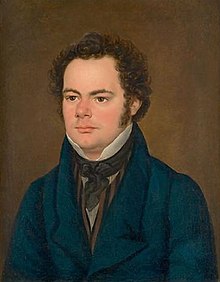
Franz Schubert, an Austrian composer, is a towering figure in the world of classical music. Born on January 31, 1797, in Lichtental, a suburb of Vienna, Schubert’s life and work have left an indelible mark on the world of music. Despite his short life—he died at the age of 31—Schubert’s prolific output and unique compositional voice have secured his place among the greatest composers of all time. This article explores the life, achievements, and legacy of Franz Schubert, offering a comprehensive view of his journey from a child prodigy to a revered composer, alongside an exploration of the historical context and nuances that shaped his music.
Early Life and Musical Beginnings
Franz Peter Schubert was born into a family where music was deeply valued. His father, a schoolteacher and amateur cellist, was Schubert’s first music teacher, introducing him to the fundamentals of music. Schubert’s early exposure to music was further enriched by formal training under Michael Holzer, an organist and choirmaster in his hometown. By the age of 11, Schubert’s exceptional talent had earned him a position as a choirboy in the Imperial Chapel in Vienna, a prestigious role that included a scholarship to the imperial and royal city college, known as the Stadtkonvikt.
During his time at the Stadtkonvikt, Schubert’s musical education flourished. He studied under Wenzel Ruczicka, the court organist, and Antonio Salieri, a renowned composer who recognized the young Schubert’s extraordinary potential. Salieri’s mentorship played a crucial role in shaping Schubert’s compositional style, particularly in the realms of vocal and choral music.
The Early Compositions: A Prodigy Emerges
Franz Schubert’s compositional career began at a remarkably young age. By 1811, when he was just 14 years old, Schubert had already composed his first string quartets, which were performed in private family gatherings. These early works, though simple, demonstrated his innate understanding of musical structure and his ability to convey deep emotion through music.
In 1813, at the age of 16, Schubert left the Stadtkonvikt to assist his father as a schoolteacher. However, his passion for music never waned. It was during this period that Schubert discovered the poetry of Johann Wolfgang von Goethe, which would become a significant source of inspiration for his compositions. Schubert’s first major success came in 1814 with the composition of his Gretchen am Spinnrade (Gretchen at the Spinning Wheel), a song based on Goethe’s Faust. This work, marked by its dramatic intensity and innovative piano accompaniment, signaled the arrival of a major new voice in music.
The Birth of the Lied: Schubert’s Contribution to Vocal Music
One of Franz Schubert’s most significant contributions to the world of music is the development of the German Lied, a genre of song that combines voice and piano in a way that enhances the emotional content of the text. Between 1814 and 1815, Schubert composed over 140 Lieder, including the famous Erlkönig (The Elf King), which is still considered one of the greatest masterpieces of the genre. The Lied became a vehicle for Schubert’s lyrical genius, allowing him to explore a wide range of emotions and psychological states.
By the end of 1816, Schubert had composed more than 500 Lieder. His ability to set poetry to music was unparalleled, and his songs became highly sought after among the Viennese musical elite. Despite his growing reputation, Schubert continued to live in relative obscurity, supported financially by a small circle of friends and admirers who recognized his genius.
Independence and Struggles
In 1816, Schubert made a significant decision that would shape the rest of his life: he left his position as a schoolteacher to pursue a full-time career in music. This choice was made possible by the support of friends like Franz von Schober, a poet and librettist, who provided Schubert with the financial assistance he needed to focus on composing.
Schubert’s social circle, often referred to as the “Schubertiad,” included a group of artists, poets, and musicians who shared his passion for the arts. Among them were the lawyer Joseph von Spaun, poet Johann Mayrhofer, and baritone Johann Michael Vogl, who became a key interpreter of Schubert’s Lieder. These gatherings were crucial for Schubert’s development as a composer, providing him with a supportive environment where his music could be performed and appreciated.
Despite this support, Schubert’s life was marked by financial difficulties and health challenges. He never held a permanent position and relied on the generosity of his friends to make ends meet. This period of financial instability was exacerbated by Schubert’s health problems. In 1822, he contracted syphilis, a disease that would plague him for the rest of his life and contribute to his early death.
Mature Works and Artistic Legacy
Even as his health deteriorated, Schubert continued to compose at a feverish pace. The final years of his life were marked by the creation of some of his most profound and enduring works. In 1827, he composed the song cycle Winterreise (Winter Journey), a dark and introspective work that explores themes of loss, despair, and isolation. This cycle, along with his earlier work Die schöne Müllerin (The Fair Maid of the Mill), stands as one of the pinnacles of the Lied genre.
Schubert’s instrumental music from this period also reflects a deepening of his artistic vision. His final symphony, the “Great” C Major Symphony, completed in 1828, is a monumental work that combines Beethovenian grandeur with Schubert’s lyrical sensibility. Similarly, his late piano sonatas and the String Quintet in C major reveal a composer at the height of his powers, pushing the boundaries of form and expression.
The Untimely Death of a Genius
Tragically, Franz Schubert’s life was cut short on November 19, 1828, when he succumbed to typhoid fever, exacerbated by his weakened state from syphilis. He was only 31 years old. Schubert was buried next to Beethoven, his idol, in the Währing Cemetery in Vienna, a gesture that symbolized his place among the great composers of his time.
Despite his early death, Schubert’s legacy has only grown with time. His music, characterized by its lyrical beauty, emotional depth, and innovative use of harmony, has influenced generations of composers and continues to be celebrated worldwide. Schubert’s works are now staples of the classical repertoire, and his Lieder, in particular, have set the standard for vocal music.
The Historical Context of Schubert’s Music
Understanding Franz Schubert’s music requires an appreciation of the historical context in which he lived and worked. The early 19th century was a time of great political and social upheaval in Europe, with the Napoleonic Wars, the Congress of Vienna, and the rise of Romanticism profoundly affecting the cultural landscape.
Schubert’s music is often seen as a bridge between the Classical and Romantic eras. While his early works show the influence of classical composers like Haydn and Mozart, his later compositions are infused with the emotional intensity and individualism that characterize Romantic music. Schubert’s ability to convey complex emotions through simple, yet powerful, musical means has made him a quintessentially Romantic composer.
The Schubert Myth: Fame and Recognition
During his lifetime, Franz Schubert was not widely recognized outside of Vienna. His music was appreciated by a small circle of connoisseurs, but he did not achieve the fame enjoyed by some of his contemporaries. It was only after his death that Schubert’s true genius began to be recognized. The “Schubert Myth,” as it is sometimes called, refers to the posthumous discovery and celebration of his music.
In the decades following Schubert’s death, his works were championed by composers like Robert Schumann, Johannes Brahms, and Felix Mendelssohn, who recognized his unique contributions to music. By the late 19th century, Schubert’s reputation had grown considerably, and he was celebrated as one of the great masters of Western music.
Schubert’s Influence on Future Generations
The impact of Franz Schubert’s music on subsequent generations of composers cannot be overstated. His Lieder, in particular, set a new standard for vocal composition, influencing composers like Hugo Wolf, Gustav Mahler, and Richard Strauss. Schubert’s instrumental music also paved the way for later developments in the symphony, chamber music, and solo piano repertoire.
In the 20th century, Schubert’s music continued to inspire composers and musicians. His use of harmony, melody, and form has been studied and emulated by countless artists, and his works remain central to the concert repertoire. Today, Schubert is regarded as one of the most important and influential composers in the history of Western music.
Conclusion
Franz Schubert’s life, though tragically short, was marked by an extraordinary creative output that has left an enduring legacy in the world of music. His ability to blend lyrical beauty with profound emotional depth has made his music timeless, resonating with audiences across generations. As we continue to explore and perform Schubert’s works, we gain a deeper appreciation of his genius and his contributions to the rich tapestry of classical music.


