
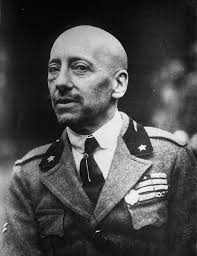
Gabriele D’Annunzio, born on March 12, 1863, in Pescara, Italy, was a prolific writer, poet, dramatist, and soldier whose influence on Italian culture and politics was profound. His life, marked by artistic brilliance, military heroism, and personal scandal, made him one of the most controversial and celebrated figures in Italy during the late 19th and early 20th centuries. This article explores the life, fame, and enduring legacy of Gabriele D’Annunzio, providing detailed insights into his achievements and the historical context in which he lived.
Early Life and Education
Gabriele D’Annunzio was the third of five children born to Francesco D’Annunzio and Luisa de Benedictis. From a young age, he exhibited extraordinary intelligence and a precocious talent for writing. His early education took place at the Reale Collegio Cicognini in Prato, a prestigious and strict boarding school known for its rigorous academic standards. D’Annunzio’s rebellious nature often clashed with the school’s rigid discipline, but his intellectual brilliance was undeniable.
In 1879, at just 16 years old, D’Annunzio published his first collection of poems, Primo Vere, with financial support from his father. The collection, marked by its sensual and provocative themes, was favorably reviewed by prominent critics, including one in the Fanfulla della Domenica, which helped establish his reputation as a promising young poet.
D’Annunzio’s early work caught the attention of the Italian literary establishment, and he quickly became a prominent figure in Rome’s cultural circles. In 1881, he moved to Rome to study literature and philosophy at the university. However, his academic pursuits were soon overshadowed by his burgeoning literary career and his involvement in the city’s vibrant literary and journalistic scene.
The Rise to Fame: Literary Achievements and Personal Scandals
By the early 1880s, Gabriele D’Annunzio had become a well-known name in Italian literature. His early works, including Canto Novo (1882) and Terra Vergine (1882), displayed his mastery of language and his ability to evoke the beauty and sensuality of the natural world. These works, characterized by their lyrical intensity and vivid imagery, solidified D’Annunzio’s status as one of Italy’s leading poets.
In 1883, D’Annunzio married Maria Hardouin di Gallese, a young duchess from a prominent Roman family. The marriage, however, was troubled from the start, partly due to D’Annunzio’s extravagant lifestyle and frequent affairs. Despite his tumultuous personal life, D’Annunzio continued to produce significant literary works, including the novel Il Piacere (1889), which is considered one of his masterpieces. Il Piacere, translated as The Child of Pleasure, tells the story of Andrea Sperelli, a young Roman aristocrat who embodies the decadent and hedonistic values that D’Annunzio himself often espoused.
D’Annunzio’s literary success was accompanied by growing personal notoriety. His passionate affair with the actress Elvira Natalia Fraternali, known as Barbara Leoni, became the subject of public gossip and scandal. The relationship, which inspired much of D’Annunzio’s work during this period, ultimately led to a trial for adultery in 1893, further fueling his controversial reputation.
The 1890s: A Decade of Artistic and Personal Turmoil
The 1890s were a period of intense creativity and personal upheaval for Gabriele D’Annunzio. His relationship with Barbara Leoni ended, and he soon began an affair with the famous Italian actress Eleonora Duse. D’Annunzio and Duse became one of Italy’s most celebrated and scandalous couples, and their tumultuous relationship inspired some of D’Annunzio’s most famous works, including the novel Il Trionfo della Morte (1894) and the play La Figlia di Iorio (1904).
During this decade, D’Annunzio’s financial troubles worsened. His extravagant lifestyle, characterized by luxurious living and constant spending, led to mounting debts. Despite his prolific output as a writer, D’Annunzio struggled to manage his finances, a problem that would plague him throughout his life.
Nevertheless, D’Annunzio’s artistic achievements during the 1890s were remarkable. His novel Le Vergini delle Rocce (1895) and the poetry collection Alcyone (1904), part of the Laudi del Cielo, del Mare, della Terra e degli Eroi series, are considered among his finest works. Alcyone, in particular, is celebrated for its lyrical beauty and its evocation of the natural world, reflecting D’Annunzio’s deep connection to the Italian landscape.
The Early 20th Century: From Literary Icon to Political Figure
As the 20th century dawned, Gabriele D’Annunzio’s focus began to shift from literature to politics. His nationalistic sentiments, which had been present in his work since the 1890s, became more pronounced as he embraced the ideals of Italian nationalism and irredentism. These beliefs would eventually lead him to take an active role in Italian politics and military affairs.
In 1910, facing overwhelming debt and hounded by creditors, D’Annunzio fled to France, where he continued to write and cultivate his image as a cosmopolitan artist. During his time in France, he engaged in relationships with several notable women, including the dancer Isadora Duncan and the painter Romaine Brooks. He also collaborated with composer Claude Debussy on the play Le Martyre de Saint Sébastien (1911), which showcased his ability to blend literature with other art forms.
With the outbreak of World War I in 1914, D’Annunzio returned to Italy, driven by a desire to actively participate in the conflict. He became a fervent supporter of Italy’s entry into the war on the side of the Allies and used his oratory skills to rally support for the cause. D’Annunzio’s speeches, filled with passionate nationalism and heroic rhetoric, made him a prominent figure in the pro-war movement.
D’Annunzio’s military career during the war was marked by daring and audacious actions. He served as a pilot in the Italian Air Force and participated in several high-profile missions, including the famous “Flight over Vienna” in 1918, where he dropped propaganda leaflets over the Austrian capital. For his bravery, he was awarded numerous military honors, including the Medaglia d’Oro al Valore Militare.
The Post-War Period: The Fiume Adventure and the Rise of Fascism
After the war, Gabriele D’Annunzio became disillusioned with the Italian government’s handling of the post-war settlement, particularly its failure to annex the city of Fiume (now Rijeka, Croatia), which he and many other nationalists believed rightfully belonged to Italy. In September 1919, D’Annunzio took matters into his own hands by leading a group of nationalist volunteers, known as the Arditi, in the occupation of Fiume. He declared the city an independent state, known as the Italian Regency of Carnaro, and ruled it as a self-proclaimed “Commander” until December 1920.
The Fiume episode, while ultimately unsuccessful, solidified D’Annunzio’s reputation as a nationalist hero and a charismatic leader. His governance of Fiume was marked by flamboyant ceremonies, theatrical pageantry, and the promulgation of a constitution that blended elements of socialism, corporatism, and anarchism. The Fiume adventure is often seen as a precursor to the rise of fascism in Italy, as it exemplified many of the themes and tactics that would later be adopted by Benito Mussolini and the Fascist Party.
Despite his initial opposition to Mussolini, D’Annunzio eventually aligned himself with the Fascist regime, largely for reasons of personal convenience and financial necessity. In 1924, Mussolini appointed D’Annunzio as Prince of Montenevoso, a title that came with substantial financial rewards. The Fascist government also provided funding for the construction of the Vittoriale degli Italiani, D’Annunzio’s lavish estate on Lake Garda, which he envisioned as a monument to his life and work.
The Later Years: The Vittoriale and Literary Legacy
In his later years, Gabriele D’Annunzio withdrew from active political life and focused on writing and overseeing the construction of the Vittoriale. The estate, which included a museum, a theater, and various monuments, became a symbol of D’Annunzio’s unique blend of art, politics, and personal mythology. He lived there in seclusion, surrounded by artifacts from his military and literary career, and continued to write until his death.
One of D’Annunzio’s final works, Il Libro Segreto (The Secret Book), published posthumously, reflects his introspective and reflective state in his later years. The work is a collection of personal thoughts, memories, and philosophical musings, offering a glimpse into the mind of a man who had lived a life filled with triumphs, scandals, and contradictions.
D’Annunzio died on March 1, 1938, at the Vittoriale. His death was met with national mourning, and he was buried at the estate in a grandiose tomb befitting his larger-than-life persona. The Vittoriale remains a popular tourist destination and a testament to D’Annunzio’s enduring legacy in Italian culture.
Conclusion: The Enduring Influence of Gabriele D’Annunzio
Gabriele D’Annunzio’s life and work continue to captivate and inspire. His contributions to literature, his impact on Italian politics, and his complex personality make him a figure of enduring fascination. D’Annunzio’s writings, particularly his poetry and novels, remain essential reading for those interested in Italian literature and the cultural history of the early 20th century.
While D’Annunzio’s association with nationalism and his ties to the Fascist regime have sparked controversy, his artistic achievements and his influence on modernist literature cannot be denied. His ability to blend the personal with the political, the aesthetic with the ideological, has left a lasting mark on Italian culture.
As Italy and the world continue to grapple with the legacies of nationalism, war, and artistic innovation, Gabriele D’Annunzio’s life serves as both a cautionary tale and a source of inspiration. His work challenges us to consider the power of art and the responsibilities that come with wielding such influence.


