
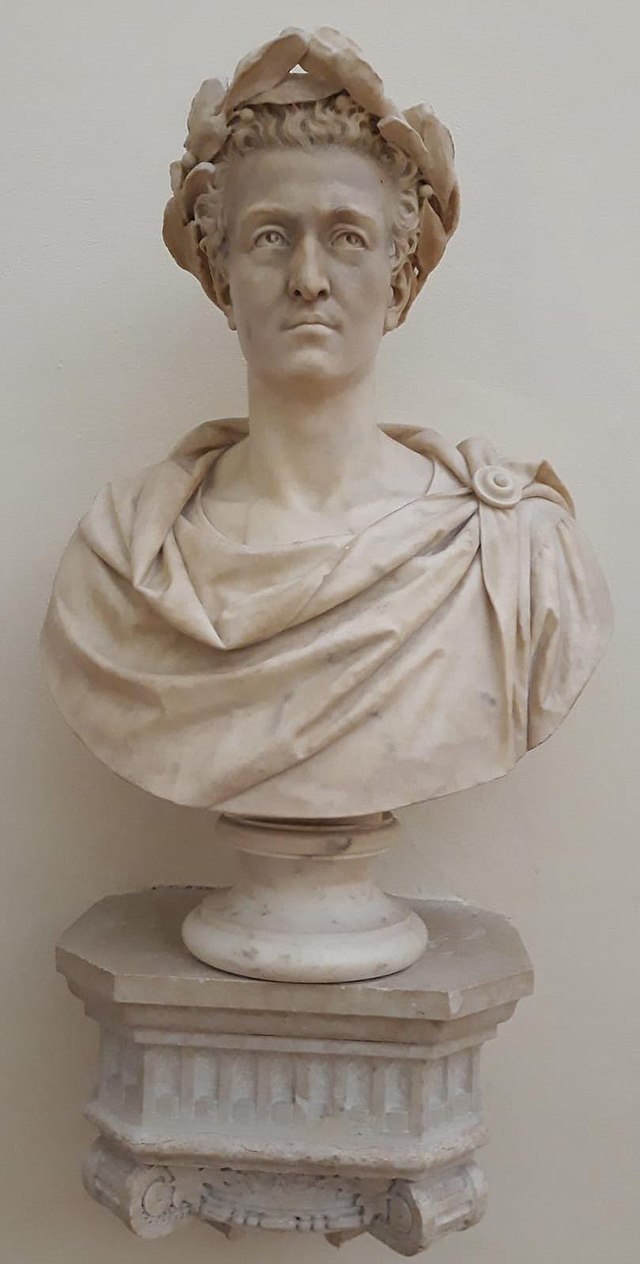
Gaio Valerio Catullo, also known as Gaius Valerius Catullus, was a Roman poet born in 84 B.C. in Verona, a city that was part of the Gallia Cisalpina region of the Roman Empire. His life, though short, was marked by profound literary contributions, especially in the form of poetry that has been celebrated for its emotional depth and stylistic innovation. Catullus’s work primarily revolves around themes of love, passion, betrayal, and the intricacies of human relationships, making him one of the most enduring and influential figures in Roman literature.
Early Life and Education
Catullus was born into a wealthy and prominent family in Verona. The family owned a villa in Sirmione, on the shores of Lake Garda, a location that would later be immortalized in some of Catullus’s most evocative verses. The villa was a place of luxury and refinement, reportedly visited by none other than Julius Caesar himself, which speaks to the social standing of Catullus’s family.
Growing up in such an environment, Catullus received a comprehensive education, typical of young men of his social class. This education was rigorous and classical, steeped in the works of earlier Greek and Roman poets. As was customary for the Roman elite, Catullus moved to Rome around 60 B.C. to further his studies and to immerse himself in the political and cultural life of the city. His time in Rome coincided with the decline of the Roman Republic, a period fraught with political unrest, which inevitably influenced his work.
Literary Circle and the Neoterics
Upon arriving in Rome, Catullus became associated with a group of young, avant-garde poets known as the Neoterics (or “Poetae Novi” in Latin). This group, inspired by the Hellenistic poets like Callimachus, sought to revolutionize Roman poetry by focusing on personal expression, refined diction, and a departure from the traditional epic and didactic forms that dominated Roman literature. The Neoterics emphasized brevity, wit, and a polished style, all of which became hallmarks of Catullus’s work.
In Rome, Catullus developed close friendships with several influential figures, including the famous orator Cornelius Nepos and the esteemed advocate Quintus Hortensius Hortalus. These relationships not only provided Catullus with intellectual camaraderie but also placed him in the midst of Rome’s vibrant literary and political circles.
The Love and Torment of Lesbia
One of the most significant and enduring aspects of Catullus’s poetry is his portrayal of his intense and tumultuous love affair with a woman he refers to as Lesbia. This pseudonym was likely inspired by the ancient Greek poet Sappho, who hailed from the island of Lesbos and whose work Catullus greatly admired. Lesbia is widely believed to be Clodia, a woman of noble birth, sister to the infamous politician Publius Clodius Pulcher, and wife of the proconsul Metellus Celer.
The relationship between Catullus and Clodia/Lesbia was complicated and filled with passion, infidelity, and heartache. Catullus’s poems about Lesbia range from ecstatic celebrations of love to bitter recriminations of betrayal, capturing the full spectrum of emotions that characterized their affair. Clodia, who was about ten years older than Catullus, was known for her beauty, wit, and intelligence, but also for her promiscuity and manipulative tendencies. These qualities made her both the object of Catullus’s deepest affections and the source of his greatest anguish.
Catullus’s poems dedicated to Lesbia are some of the most personal and emotionally charged works in all of Roman literature. They include some of his most famous lines, such as the plea for “a thousand kisses” in the poem “Vivamus, mea Lesbia, atque amemus,” and the haunting expression of grief in “Odi et amo.” These poems are not just love letters but are also explorations of the human condition, dealing with themes of desire, loyalty, jealousy, and the pain of unrequited love.
The Death of a Brother and a Journey to Bithynia
Another pivotal moment in Catullus’s life was the death of his brother, an event that deeply affected him and is poignantly reflected in his poetry. The loss led Catullus to leave Rome and return to Verona, where he spent several months grieving. His brother’s death is commemorated in one of Catullus’s most famous poems, Carmen 101, a touching elegy that Catullus wrote after visiting his brother’s grave in the Troad, near Troy.
In 57 B.C., seeking both to escape the turmoil of his personal life and to restore his depleted finances, Catullus joined the retinue of the Roman governor Gaius Memmius on a journey to Bithynia, in Asia Minor. This trip exposed Catullus to the rich intellectual culture of the East, and it was during this time that he composed some of his most polished and sophisticated poems. Although his time in Bithynia did not result in the financial gain he had hoped for, it did contribute significantly to his literary development.
The “Liber” and Poetic Legacy
Throughout his life, Catullus wrote approximately 116 poems, collectively referred to as the “Liber,” or “The Book,” which has been preserved through the centuries. These poems vary in length and subject matter, and they are traditionally categorized into three groups: the “nugae” (trifles), the “carmina docta” (learned poems), and the “epigrams.”
-
Nugae (Carmina 1-60): These are shorter poems, often light-hearted and written in various meters, with a preference for hendecasyllabic verse. They cover a wide range of topics, from love and friendship to satirical and invective pieces.
-
Carmina Docta (Carmina 61-68): These are more elaborate and scholarly compositions, including epithalamia (wedding songs) and mythological narratives. These poems demonstrate Catullus’s mastery of Greek and Roman literary traditions and his ability to adapt them to his unique style.
-
Epigrams (Carmina 69-116): These poems are composed in elegiac couplets and often resemble the nugae in tone and content. They include some of Catullus’s most scathing critiques of his contemporaries, as well as more reflective and personal pieces.
Catullus’s poetry, particularly the “carmina docta,” shows a profound engagement with the works of earlier poets, both Greek and Roman. His style is marked by its conciseness, its precision of language, and its emotional intensity. He was a master of the Latin language, using it to express complex emotions with remarkable clarity and impact.
Later Years and Death
After his return from Bithynia, Catullus sought solace in the peace and tranquility of his family’s villa in Sirmione. However, the last years of his life were overshadowed by illness, which some sources suggest may have been tuberculosis. This “mal sottile,” or “wasting disease,” consumed him both physically and mentally, leading to his untimely death in 54 B.C., at the age of just thirty. The exact circumstances of his death remain unclear, but it is widely believed that he died in Rome.
Despite his short life, Catullus’s impact on Roman literature was profound. His work influenced not only his contemporaries but also generations of poets who followed. The themes of love, loss, and human frailty that he explored with such depth and sincerity have ensured that his poetry remains relevant and admired to this day.
Historical and Cultural Context
Catullus’s life and work must be understood within the broader context of the late Roman Republic, a period marked by political upheaval, social change, and the eventual transition to the Roman Empire. The old values of the Republic were being challenged by new ideas and ways of life, and this tension is reflected in the literature of the time.
Catullus, with his focus on personal experience and emotional expression, represented a departure from the traditional Roman values of duty, honor, and public service. His poetry was intensely personal, concerned more with individual feelings and relationships than with the grand themes of statecraft and military conquest that had dominated earlier Roman literature.
At the same time, Catullus’s work is deeply rooted in the classical traditions of Greek literature, particularly the Hellenistic poets like Callimachus and Theocritus. His ability to blend these influences with his own voice created a new kind of Roman poetry that was both sophisticated and accessible, appealing to readers across the centuries.
Conclusion
Gaio Valerio Catullo’s poetry has left an indelible mark on the literary world. His works, characterized by their emotional depth, stylistic precision, and personal sincerity, continue to resonate with readers today. Whether he is expressing the joy of love, the pain of betrayal, or the sorrow of loss, Catullus’s voice remains as powerful and relevant as it was over two millennia ago.
His life, though brief, was rich in experiences and emotions, all of which he poured into his poetry. From the passionate love affair with Lesbia to the grief of his brother’s death, Catullus’s work offers a window into the soul of a man who lived intensely and wrote with unmatched eloquence. His legacy is that of a poet who captured the complexities of the human heart with unparalleled skill, ensuring that his work would be remembered and cherished long after his death.


