
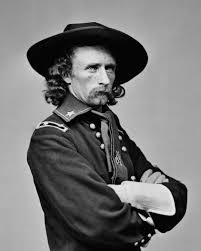
George Armstrong Custer, born on December 5, 1839, in New Rumley, Ohio, is one of the most controversial and fascinating figures in American history. Known for his audacity and ambition, Custer’s life was marked by his rapid rise in the military ranks during the American Civil War and his infamous last stand at the Battle of Little Bighorn. His legacy is a complex blend of heroism, hubris, and tragedy, making him a subject of enduring interest.
Early Life and Education
Custer was born into a modest family in rural Ohio. His father, Emanuel Custer, was a blacksmith, and his mother, Maria Ward Kirkpatrick, was of Irish descent. Despite his humble beginnings, Custer was destined for a life far removed from the quiet life of his hometown. At the age of ten, Custer was sent to live with his sister Lydia in Monroe, Michigan. This move played a significant role in shaping his character and ambitions. Lydia, who was deeply involved in his upbringing, influenced Custer’s early education and development.
Custer attended the Young Men’s Academy in Monroe, where he quickly displayed the characteristics that would define his life: a generous nature, a competitive spirit in sports, and a passion for military history. These traits foreshadowed his future career, where his boldness and love for the military would take center stage.
In 1857, at the age of 17, Custer entered the United States Military Academy at West Point. His time at West Point was marked by a blend of brilliance and recklessness. Custer was an excellent horseman and a sociable cadet, but his disdain for discipline and order frequently got him into trouble. He graduated in 1861, ranking last in his class—a reflection of both his academic struggles and his rebellious nature.
Civil War and Rapid Rise to Fame
Custer’s military career took off with the outbreak of the American Civil War in 1861. Despite his unremarkable academic record at West Point, Custer’s practical skills and audacity made him a valuable asset to the Union Army. The war created an urgent demand for officers, and Custer’s talents quickly became evident on the battlefield.
In 1862, Custer was assigned to the 5th Cavalry Regiment of the Army of the Potomac. He soon distinguished himself with a daring reconnaissance mission across the Chickahominy River, where he demonstrated the fordability of the river under enemy fire. This bold action caught the attention of General George McClellan, who appointed Custer as his aide-de-camp, promoting him to the rank of captain.
Custer’s most significant rise came in June 1863, just before the pivotal Battle of Gettysburg. At the young age of 23, Custer was promoted to brigadier general of volunteers, making him the youngest general in the Union Army. His appointment came just two days before Gettysburg, where Custer played a crucial role in the Union’s victory.
At Gettysburg, Custer led the Michigan Cavalry Brigade in a series of aggressive charges against the forces of Confederate General J.E.B. Stuart. Custer’s leadership and the ferocity of his men helped to prevent Stuart’s cavalry from flanking the Union Army, contributing to the overall Union victory in what is often considered the turning point of the Civil War.
Post-War Years and the Indian Campaigns
After the Civil War, Custer’s life took a different turn as he transitioned from a national hero to a key figure in the Indian Wars of the American West. In the post-war period, Custer was involved in various military operations aimed at subduing Native American tribes in the Great Plains, a task that was both controversial and fraught with danger.
In 1866, Custer was mustered out of the volunteer service and returned to the regular army as a lieutenant colonel. He was assigned to the newly formed 7th Cavalry Regiment, a unit that would become synonymous with his name. Custer’s role in the Indian Wars began in earnest in 1867 when he was tasked with leading an expedition to protect settlers and suppress Native American resistance.
Custer’s approach to the Indian Wars was marked by the same boldness that had characterized his Civil War service, but it also revealed a darker side to his ambition. His campaigns were often brutal, reflecting the harsh realities of frontier warfare. One of the most infamous episodes in Custer’s career occurred in 1868 during the Battle of Washita River. Custer led a surprise attack on a Cheyenne village led by Chief Black Kettle, resulting in the deaths of over 100 Native Americans, including women and children. While Custer saw the attack as a military success, it sparked widespread criticism and debate about the ethics of his actions.
The Black Hills Expedition and Rising Tensions
In 1874, Custer was tasked with leading an expedition into the Black Hills of South Dakota, a region that had been promised to the Sioux in the Treaty of Fort Laramie. The discovery of gold in the Black Hills by Custer’s expedition set off a rush of miners and settlers into the area, violating the treaty and escalating tensions between the U.S. government and the Sioux Nation.
Custer’s actions in the Black Hills further inflamed the already volatile situation. The U.S. government’s inability or unwillingness to stop the influx of miners led to the breakdown of negotiations with the Sioux, who saw their sacred lands being overrun by outsiders. The situation was rapidly spiraling towards open conflict, and Custer would find himself at the center of this growing storm.
The Battle of Little Bighorn: Custer’s Last Stand
The culmination of Custer’s career—and his life—came on June 25, 1876, at the Battle of Little Bighorn. This battle, also known as “Custer’s Last Stand,” has become one of the most famous and controversial episodes in American history. It was here that Custer, leading the 7th Cavalry, met his fate against a coalition of Lakota Sioux, Northern Cheyenne, and Arapaho warriors.
The battle was part of the Great Sioux War of 1876, a conflict driven by the U.S. government’s attempts to force the Sioux onto reservations and seize their lands. Underestimating the strength and determination of the Native American forces, Custer divided his regiment into three battalions and launched an attack on what he believed to be a small encampment along the Little Bighorn River.
In reality, Custer had stumbled upon a large and well-prepared force, led by iconic leaders such as Sitting Bull and Crazy Horse. Custer’s detachment, numbering around 210 men, was quickly surrounded and overwhelmed. By the end of the day, Custer and all of his men were dead, marking one of the most decisive and humiliating defeats in U.S. military history.
Legacy: Hero, Villain, or Both?
The news of Custer’s death and the annihilation of his command shocked the nation. Initially, Custer was lionized as a heroic martyr, a brave soldier who had fallen in the line of duty. The press and public, largely unaware of the complexities of the battle, portrayed Custer as a symbol of American courage and resilience.
However, as more details of the battle emerged, Custer’s legacy became increasingly controversial. Critics argued that his reckless disregard for the capabilities of his enemies and his refusal to wait for reinforcements had led to the unnecessary deaths of his men. President Ulysses S. Grant, who had a strained relationship with Custer, publicly criticized him for what he deemed an avoidable disaster.
Custer’s image has continued to evolve over the years. For some, he remains a symbol of the tragic and often brutal expansion of the American frontier. For others, he is seen as a reckless and arrogant officer whose ambition led to his downfall. The Battle of Little Bighorn has been the subject of countless books, movies, and debates, with each generation reassessing Custer’s actions and motivations.
Archaeological Insights and Historical Reassessment
In 1983, a large wildfire swept through the Little Bighorn battlefield, uncovering a wealth of artifacts that had been buried for over a century. This discovery allowed archaeologists to reexamine the events of June 25, 1876, providing new insights into the battle. The evidence suggested that Custer’s forces were not as organized or well-prepared as previously thought. Many of his men were inexperienced, and the regiment was far from the elite unit that popular mythology had portrayed.
Moreover, the artifacts revealed that the Native American warriors were far from the primitive adversaries depicted in earlier accounts. They were well-armed, highly motivated, and expertly familiar with the terrain, which gave them a significant advantage over Custer’s forces.
These findings have contributed to a more nuanced understanding of the battle, highlighting the complexity of the conflict and the formidable resistance mounted by the Native American forces. Custer’s Last Stand, once seen as a simple tale of heroism, is now recognized as a multifaceted and tragic episode in the history of the American West.
Conclusion
George Armstrong Custer’s life and legacy are emblematic of the American experience during the 19th century—a time of rapid expansion, conflict, and change. From his meteoric rise during the Civil War to his infamous defeat at Little Bighorn, Custer’s story is a blend of ambition, bravery, and tragic miscalculation.
As we reflect on Custer’s life, it is essential to consider the broader historical context in which he lived. His actions and decisions were shaped by the turbulent times in which he operated, and his legacy continues to be a subject of debate and reinterpretation. Whether viewed as a hero, a villain, or a tragic figure, George A. Custer remains a pivotal figure in the narrative of American history, embodying the complexities and contradictions of a nation in the making.


