
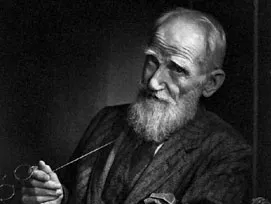
George Bernard Shaw, born on July 26, 1856, in Dublin, Ireland, is one of the most influential playwrights, critics, and social commentators of the late 19th and early 20th centuries. A towering figure in literature and drama, Shaw’s works continue to resonate with audiences worldwide, offering sharp critiques of society, politics, and human behavior. This article explores Shaw’s life, his rise to fame, and the key highlights of his illustrious career.
Early Life: The Formative Years
George Bernard Shaw was born into a family of modest means. His father, George Carr Shaw, was an alcoholic who struggled to maintain steady employment, while his mother, Lucinda Elizabeth Shaw, was a music teacher with aspirations of a more cultured life. The family’s financial instability deeply influenced Shaw’s early years, instilling in him a sense of resilience and independence that would later define his career.
Shaw’s formal education was sporadic at best. He attended various schools in Dublin but found them largely uninspiring and inadequate. Instead, Shaw educated himself through extensive reading, particularly drawn to the works of William Shakespeare and the Bible. These texts provided him with a foundation in literature and rhetoric that would later be reflected in his writing.
In 1876, at the age of 20, Shaw moved to London, where his mother had relocated to teach singing. Shaw arrived in the bustling metropolis with little money but a wealth of ideas. The London of the late Victorian era was a city of contrasts—great wealth alongside deep poverty, rapid industrialization alongside social inequality—and it was here that Shaw began to develop the ideas that would later shape his work.
Early Career: The Struggles and the Rise
Shaw’s early years in London were marked by struggle. He initially attempted to establish himself as a novelist, writing five novels between 1879 and 1883. However, these early efforts met with little success, and Shaw’s novels were largely ignored by both publishers and the public. Despite these setbacks, Shaw remained undeterred, channeling his frustration into other forms of writing.
It was during this period that Shaw became deeply involved in socialist politics. The publication of Karl Marx’s “Das Kapital” had a profound impact on Shaw, leading him to join the Fabian Society in 1884. The Fabian Society was an intellectual movement advocating for the gradual implementation of socialism through reform rather than revolution. Shaw quickly became one of the society’s most prominent members, using his skills as a writer and orator to promote socialist ideas.
Shaw’s involvement with the Fabian Society brought him into contact with many of the leading intellectuals and activists of the time, including Sidney Webb and Beatrice Webb, who were instrumental in shaping the society’s direction. Shaw’s political writings during this period helped establish his reputation as a sharp and insightful social critic.
Transition to Criticism: The Emergence of a Voice
While Shaw’s early attempts at fiction may have faltered, he found his voice as a critic. In 1885, he began working as a literary critic for the Pall Mall Gazette, and later as a music critic for The Star. His work as a critic allowed him to refine his writing style, which was characterized by wit, clarity, and a willingness to challenge conventional thinking.
Shaw’s criticism was not limited to literature and music; he also wrote extensively on art, theater, and social issues. His critiques were often controversial, as he did not hesitate to take on the established norms of the Victorian era. Shaw’s critical writings gained him a reputation as one of the most incisive commentators of his time, and he quickly became a prominent figure in London’s intellectual circles.
One of Shaw’s most significant contributions during this period was his work as a theater critic for the Saturday Review. His essays on theater, later collected in “Our Theatres in the Nineties,” were groundbreaking in their analysis of contemporary drama. Shaw championed the works of Henrik Ibsen, whose realistic portrayals of social issues resonated with Shaw’s own beliefs about the role of theater as a medium for social change.
The Playwright Emerges: Early Works and Influence
Shaw’s experiences as a critic and his exposure to the works of Ibsen inspired him to write his own plays. In 1892, Shaw produced his first play, Widowers’ Houses, which tackled the issue of slum landlords in London. The play was the first of Shaw’s “Plays Unpleasant,” a series of works designed to provoke and challenge audiences by addressing controversial social issues.
Over the next few years, Shaw continued to write plays that confronted the moral and social hypocrisies of the time. Mrs. Warren’s Profession (1894) dealt with the taboo subject of prostitution, while The Philanderer (1898) and Candida (1898) explored themes of marriage and sexual politics. Shaw’s plays were characterized by their sharp dialogue, complex characters, and a refusal to provide easy answers to the questions they posed.
Despite the provocative nature of his work, Shaw’s plays began to gain recognition and were increasingly performed in London’s theaters. His reputation as a playwright grew, and by the turn of the century, Shaw was regarded as one of the leading figures in British theater.
Peak of Fame: Masterpieces and Recognition
The early 20th century marked the peak of George Bernard Shaw’s fame and influence. During this period, he wrote some of his most famous and enduring works, including Man and Superman (1903), Major Barbara (1905), and Pygmalion (1913). These plays showcased Shaw’s unique ability to blend social commentary with humor and wit, creating works that were both entertaining and intellectually stimulating.
Pygmalion, in particular, became one of Shaw’s most celebrated plays. The story of a phonetics professor who transforms a Cockney flower girl into a refined lady, Pygmalion explored themes of class, identity, and language. The play was a critical and commercial success, and it later served as the basis for the popular musical My Fair Lady.
In 1923, Shaw wrote Saint Joan, a dramatization of the life of Joan of Arc. The play was widely praised for its complex portrayal of Joan as both a saint and a heretic, and it is considered one of Shaw’s greatest works. The success of Saint Joan further solidified Shaw’s reputation as one of the greatest playwrights of his time.
Shaw’s contributions to literature and theater were recognized in 1925 when he was awarded the Nobel Prize in Literature. The Nobel Committee praised Shaw for his work, describing it as marked by “idealism and humanity, its stimulating satire often being infused with a singular poetic beauty.” However, true to his contrarian nature, Shaw refused to accept the monetary award, stating, “I can forgive Alfred Nobel for inventing dynamite, but only a fiend in human form could have invented the Nobel Prize.”
Social Critic and Public Intellectual: Beyond the Stage
While George Bernard Shaw is best known for his work as a playwright, his influence extended far beyond the theater. Throughout his life, Shaw remained deeply engaged in social and political issues, using his platform to advocate for a wide range of causes, including socialism, vegetarianism, and women’s rights.
Shaw’s commitment to social justice was reflected in his involvement with the Fabian Society, where he continued to play a leading role in promoting socialist ideas. He also supported various progressive movements, including the suffragette movement and the campaign for Irish independence. Shaw’s writings on politics and society were widely read, and his opinions were often sought on the major issues of the day.
Shaw’s ability to combine intellectual rigor with a flair for the dramatic made him one of the most influential public intellectuals of his time. He was a master of the art of persuasion, using his wit and eloquence to challenge the status quo and inspire change.
Later Years and Legacy
Even as he entered his later years, George Bernard Shaw remained an active and prolific writer. He continued to produce plays, essays, and critiques well into his 90s, never losing his sharpness of mind or his commitment to his ideals. His later works, including The Apple Cart (1929) and Too True to Be Good (1932), reflected his continued interest in exploring complex social and political themes.
Shaw’s death on November 2, 1950, marked the end of an era in British theater and literature. He died at the age of 94, following complications from a fall in his garden while chasing a butterfly—a fittingly whimsical end for a man who had spent his life challenging conventions and embracing the unexpected.
Shaw’s legacy is profound and far-reaching. He is remembered as one of the greatest playwrights in the English language, a master of satire, and a fearless social critic. His plays continue to be performed around the world, and his ideas remain relevant to contemporary discussions about society, politics, and the human condition.
Conclusion: The Enduring Impact of George Bernard Shaw
George Bernard Shaw’s life and work are a testament to the power of ideas and the importance of challenging the status quo. Through his plays, essays, and public speeches, Shaw used his talents to shine a light on the social injustices of his time and to provoke thought and debate.
As a playwright, Shaw revolutionized the English theater, introducing a new kind of drama that was both intellectually engaging and socially conscious. His plays, with their sharp dialogue and complex characters, remain as compelling today as they were when they were first written.
As a social critic, Shaw’s influence extended beyond the stage, shaping the political and intellectual landscape of his time. His commitment to social justice, equality, and human rights continues to inspire new generations of thinkers and activists.
In the end, George Bernard Shaw was more than just a playwright; he was a force for change, a voice for the marginalized, and a beacon of intellectual courage. His legacy is one of brilliance, wit, and an unwavering commitment to the betterment of society.


