
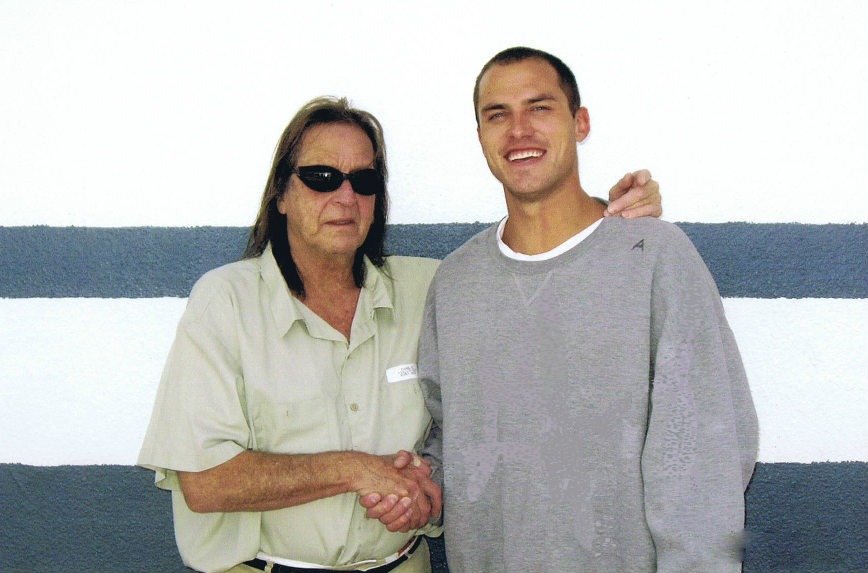
George Jung, often known as “Boston George,” is one of the most infamous figures in the history of American drug trafficking. His life story, filled with extraordinary highs and devastating lows, has captivated many, especially after being immortalized in the 2001 film Blow, where Johnny Depp played his character. Jung’s journey from a small-town boy in Massachusetts to a key player in the Medellín Cartel is a tale of ambition, risk, and ultimately, the high price of a life steeped in crime.
Early Life and Beginnings
George Jacob Jung was born on August 6, 1942, in Boston, Massachusetts. He grew up in Weymouth, a small town where he was raised by his parents, Frederick Jung and Ermine O’Neill. Despite his modest beginnings, George showed early signs of ambition. Although his academic performance was far from stellar, he was a standout football player in high school, displaying the kind of drive and determination that would later fuel his rise in the drug world.
After graduating from Weymouth High School in 1961, Jung enrolled at the University of Southern Mississippi. There, he studied advertising, but his college years were short-lived; he never completed his degree. Instead, Jung’s life took a dramatic turn when he was first arrested for soliciting a police officer who was working undercover as a prostitute. This brush with the law marked the beginning of a long and complicated relationship with crime.
Entry into the Drug Trade
In the mid-1960s, George Jung started experimenting with marijuana, not just as a user but also as a small-time dealer. It was during this period that he realized the potential profits that could be made by selling drugs on a larger scale. The pivotal moment came in 1967 when Jung reconnected with an old friend from his childhood. This friend, who had connections in California, helped Jung understand the massive financial gains that could be achieved by distributing cannabis in the New England area.
Initially, Jung’s operation was modest. He enlisted his girlfriend, who worked as an airline hostess, to smuggle small quantities of marijuana in her luggage. However, Jung’s ambitions quickly grew. He began expanding his network and operations, extending his reach as far as Puerto Vallarta, Mexico. This is where Jung began purchasing large quantities of marijuana, which he would then smuggle back into the United States using private planes stolen from small airports.
At the peak of his operation, George Jung was earning around $250,000 per month—a sum that would be worth well over a million dollars in today’s money. His success was not just due to his boldness but also his keen understanding of logistics and distribution, skills that would later make him a key figure in the infamous Medellín Cartel.
The Rise to Notoriety
Jung’s first major setback came in 1974 when he was arrested in Chicago. He was caught with 660 pounds (about 300 kilograms) of marijuana, leading to his incarceration at the federal prison in Danbury, Connecticut. It was here that fate introduced him to Carlos Lehder Rivas, a young man of German-Colombian descent who would become one of Jung’s most influential partners.
Lehder, who had connections with the emerging Medellín Cartel in Colombia, saw in Jung the perfect partner to expand their operations into the United States. Jung, in turn, taught Lehder the intricacies of the American drug market. Upon their release, the two men set into motion one of the most successful cocaine smuggling operations in history. They would transport hundreds of kilos of cocaine from the Colombian ranch of Pablo Escobar—the notorious leader of the Medellín Cartel—directly to the United States.
Initially, George Jung kept his American contact, Richard Barile, a secret from Lehder and other members of the cartel to maintain his position as a middleman and secure his profits. Jung’s strategy paid off for a while, as he amassed millions of dollars. His money was often deposited in Panamanian banks, far from the reach of U.S. authorities.
Betrayal and Continued Struggles
However, Lehder eventually bypassed Jung, establishing direct contact with Barile, which significantly diminished Jung’s role and profits. Despite this setback, Jung continued to be involved in the drug trade, albeit with a reduced role. His life became increasingly chaotic as he became a heavy user of cocaine himself, further complicating his business dealings.
In 1987, Jung was arrested again at his home near Nauset Beach, Massachusetts, in a DEA raid. Although he was temporarily released, his freedom was short-lived. He quickly became entangled in another drug deal, which led to his re-arrest, once again due to the betrayal of a former associate.
Final Downfall
The early 1990s marked the beginning of the end for George Jung’s criminal career. In 1994, he was caught with nearly 800 kilograms of cocaine in Topeka, Kansas. This bust led to a 60-year prison sentence, and Jung was incarcerated at the Otisville Federal Prison in New York. His story could have ended there, but fate had other plans.
Cultural Legacy: The Film Blow and Later Years
In 2001, George Jung’s life became the subject of the film Blow, directed by Ted Demme and based on the book of the same name, which Jung co-authored with Bruce Porter. The movie brought Jung’s story to a global audience, with Johnny Depp’s portrayal of Jung adding a layer of Hollywood glamor to his otherwise gritty and tumultuous life. The film depicted not only Jung’s rise in the drug world but also the personal costs of his criminal lifestyle, including the strained relationship with his daughter.
While in prison, Jung began writing again. He collaborated with screenwriter T. Rafael Cimino, the nephew of renowned director Michael Cimino, on a novel titled Heavy. This book was intended to be a sequel to Blow and a prequel to Cimino’s novel Mid Ocean.
Jung’s time behind bars was marked by his cooperation with authorities. He testified in the trial of his former partner, Carlos Lehder, which resulted in a reduced sentence. After years of incarceration, George Jung was released from the Federal Correctional Institution in Fort Dix, New Jersey, in June 2014. Following his release, he moved to the West Coast, where he attempted to reintegrate into society.
Conclusion: The Complex Legacy of George Jung
George Jung’s life is a testament to the allure of quick wealth and the devastating consequences that often accompany it. His story is one of ambition, ingenuity, and the darker side of the American dream. Jung was a man who rose from a small-town background to become one of the most significant figures in the global drug trade, only to be brought down by the same forces he once sought to control.
In the end, George Jung remains a symbol of the excesses of the 1970s and 1980s, a time when the drug trade flourished and individuals like Jung became infamous figures. His story, immortalized in film and literature, serves as a cautionary tale about the high stakes of the criminal underworld and the personal toll it exacts.


