
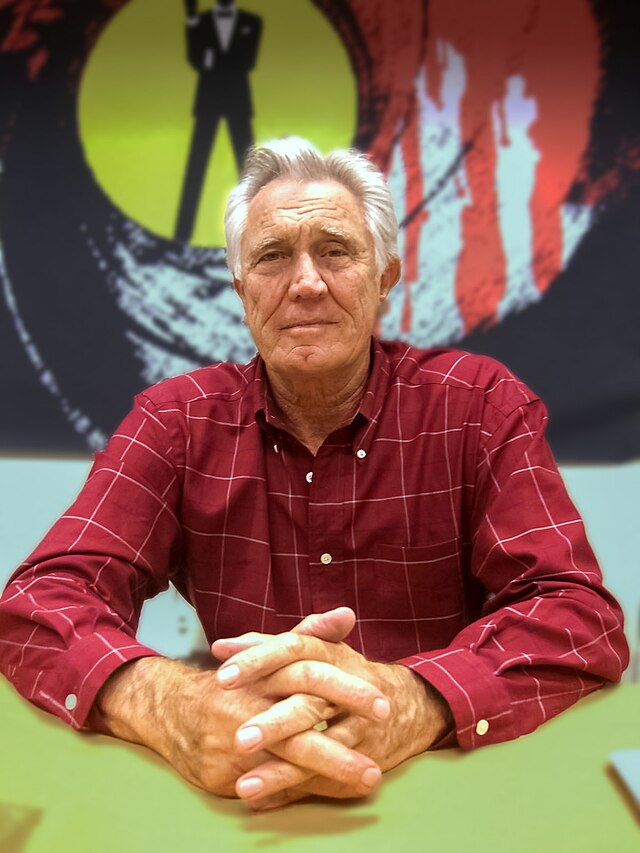
George Lazenby is a name that resonates with James Bond fans and cinephiles alike. Born on September 5, 1939, in Goulburn, New South Wales, Australia, Lazenby’s journey to fame is a remarkable tale of serendipity, talent, and the occasional stroke of luck. His career, marked by a brief but iconic portrayal of James Bond, has left an indelible mark on the film industry. This article explores George Lazenby’s life, his rise to fame, and the highlights of his career, providing insights into the man behind the legend.
Early Life and Beginnings
George Robert Lazenby was born into a working-class family; his father was a railway worker. His early life was spent in the rural town of Goulburn, where he attended Goulburn Public School and later Goulburn High School. However, Lazenby did not complete his high school education, leaving at the age of 14. The family moved to Queanbeyan, where his father opened a store, and young George found work as a car salesman and mechanic. These early jobs provided Lazenby with the skills and confidence that would later serve him in his acting career.
Lazenby’s life took a significant turn in 1963 when he moved to London. His relocation was motivated by love; he followed a woman he had fallen for, a bold move that would ultimately set him on the path to stardom. In London, Lazenby resumed work as a car salesman, but fate had other plans. His striking looks and charismatic personality caught the eye of a talent scout, who suggested he try his hand at modeling.
Modeling Career and Path to James Bond
Lazenby quickly found success as a model, earning an impressive £25,000 annually, a substantial sum at the time. His big break came when he was cast as the lead in a commercial for Big Fry Chocolate. This role catapulted him into the spotlight, and in 1966, he was named Top Model of the Year.
Lazenby’s transition from modeling to acting was facilitated by a chance encounter with Albert R. Broccoli, the producer of the James Bond films. In 1968, after Sean Connery had vacated the role of Bond, Lazenby met Broccoli at a barbershop in London. Broccoli, who recognized Lazenby from the Big Fry commercial, saw potential in the young Australian. He invited Lazenby to audition for the role of James Bond in the upcoming film, On Her Majesty’s Secret Service.
The Role of a Lifetime: James Bond
Lazenby’s audition was successful, and he was cast as the iconic British spy, James Bond. This casting choice was groundbreaking, as Lazenby was an unknown actor with no formal training, stepping into a role that had been defined by Sean Connery. On Her Majesty’s Secret Service was released in 1969, and although Lazenby’s performance received mixed reviews, the film has since gained recognition as one of the best in the Bond series.
Despite the film’s success, Lazenby’s tenure as James Bond was short-lived. Before the movie was even released, Lazenby announced that he would not reprise the role. He cited dissatisfaction with the treatment he received from the producers and a desire to avoid being typecast. This decision shocked many, as Lazenby was at the height of his fame, but it also reflected his independent spirit and desire to chart his own course.
The 1970s: A Career in Flux
After leaving the Bond franchise, Lazenby’s career took a different trajectory. In 1970, he worked in Hong Kong with martial arts legend Bruce Lee, though their collaboration was cut short by Lee’s untimely death. The following year, Lazenby starred in Universal Soldier, a film that did not achieve significant commercial success but allowed him to explore different aspects of his acting abilities.
Lazenby continued to act throughout the 1970s, appearing in films like Chi l’ha vista morire? (1972), directed by Aldo Lado, and Stoner (1974), a martial arts film that capitalized on the popularity of the genre at the time. He also ventured into television, appearing in TV movies like Is There Anybody There? and series like Cover Girls and Evening in Byzantium. These roles, while not as high-profile as his Bond appearance, demonstrated Lazenby’s versatility as an actor.
1980s: A Resurgence in Popularity
The 1980s saw a resurgence in Lazenby’s career, partly due to the renewed interest in his portrayal of James Bond. He made a cameo as Bond in the comedy The Nude Bomb (1980), which played on his association with the character. He also appeared in a variety of films, including The Last Harem (1981) and Hell Hunters (1986), and took on a recurring role in the popular soap opera General Hospital.
Lazenby’s television work continued throughout the decade, with appearances in shows like Alfred Hitchcock Presents, where he played a character reminiscent of James Bond. These roles allowed Lazenby to reconnect with audiences and showcase his range as an actor.
The 1990s and Beyond: Cult Status and Later Career
In the 1990s, Lazenby’s career took an unexpected turn when he became involved in the soft-core film series Emmanuelle. He starred in several installments, including Emmanuelle’s Secret, Emmanuelle’s Revenge, and Emmanuelle’s Perfume. While these films were a far cry from the high-stakes world of James Bond, they enjoyed a cult following and further solidified Lazenby’s status as a versatile actor unafraid to take on diverse roles.
Lazenby also appeared in Fatally Yours (1996) and had a memorable role in The Path of the Dragon (1998), which drew on his earlier martial arts experiences. In 1999, he portrayed the father of the titular character in the TV series The Pretender, showcasing his ability to take on more mature and nuanced roles.
Personal Life and Relationships
George Lazenby’s personal life has been as eventful as his career. In 2002, he married American tennis star Pam Shriver, with whom he had three children. The couple’s relationship was the subject of media attention, particularly due to the significant age difference between them. Unfortunately, the marriage ended in divorce in 2011, but Lazenby remained a dedicated father to his children.
Lazenby has often spoken about his experiences in the film industry and his decision to walk away from the Bond franchise. He has expressed no regrets, stating that he values his independence and the diverse career he was able to build post-Bond. His life story is a testament to the idea that success can come in many forms and that staying true to oneself is the ultimate achievement.
Legacy and Cultural Impact
George Lazenby’s legacy is a fascinating blend of iconic moments and unexpected turns. His single outing as James Bond remains a significant chapter in the history of the franchise, with many fans and critics re-evaluating On Her Majesty’s Secret Service over the years. The film is now praised for its emotional depth and Lazenby’s fresh take on the character, which contrasted sharply with Sean Connery’s more rugged portrayal.
Lazenby’s impact extends beyond his Bond role. His willingness to experiment with different genres and roles has made him a cult figure in the film world. From his work in martial arts films to his television appearances, Lazenby has shown that an actor’s career can be rich and varied, even without the continuous spotlight of a blockbuster franchise.
His story is also a cautionary tale about the pressures of fame and the importance of personal agency. Lazenby’s decision to step away from Bond at the peak of his fame was seen as career suicide by many, but in retrospect, it was a move that allowed him to pursue a wide range of opportunities and live life on his own terms.
Conclusion
George Lazenby’s journey from a small-town car salesman to an international film star is a story of unexpected opportunities and bold choices. His role as James Bond may have defined his early career, but his later work and personal philosophy have defined his legacy. Lazenby’s life is a testament to the power of taking risks, embracing change, and staying true to oneself.
As we reflect on George Lazenby’s contributions to film and popular culture, it is clear that his impact goes beyond his brief tenure as James Bond. He remains a fascinating figure in the world of entertainment, a man who has navigated the ups and downs of fame with grace and resilience. His story is not just one of cinematic history but also a reminder of the enduring appeal of a true original.


