
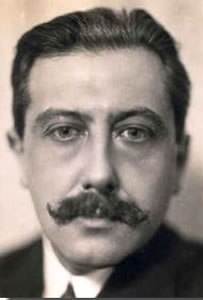
Georges Bernanos, born on February 21, 1888, in Paris, France, was a renowned French author and essayist known for his profound spiritual and philosophical insights. His work often delved into the conflict between good and evil within the human soul, making him a significant figure in 20th-century literature. Bernanos’s life was marked by his deep Catholic faith, his experiences during the World Wars, and his complex relationship with nationalism and politics.
Early Life and Education
Georges Bernanos was born into a family with deep roots in Lorraine, France, and possibly of Spanish descent. He was educated at various Catholic schools and seminaries, eventually earning degrees in literature and law from the prestigious Sorbonne University in Paris. His education deeply influenced his traditionalist Catholic views and his disdain for the bourgeoisie.
Initial Foray into Politics and Journalism
In the early 20th century, Bernanos became involved with the Action Française, a nationalist and anti-parliamentary movement led by Charles Maurras. Bernanos was particularly active in the Camelots du Roi, the movement’s militant wing. He led monarchist groups and even supported an unsuccessful attempt to restore the monarchy in Portugal. By October 1913, he was the editor of the monarchist weekly L’Avant Garde de Normandie in Rouen, which allowed him to establish his reputation as a journalist.
World War I and Personal Life
Bernanos served as a dragoon in World War I, experiencing the brutal realities of trench warfare. He was wounded during the conflict, and this period profoundly impacted his worldview. In April 1918, he married Jeanne Talbert d’Arc, and they had six children over the next sixteen years. After the war, Bernanos struggled to support his growing family, working for an insurance company while nurturing his passion for writing.
Literary Career and Major Works
Bernanos’s literary career took off with the publication of Under the Sun of Satan in 1926, a novel that introduced his recurring themes of spiritual struggle and redemption. This work, along with The Joy (1929) and Diary of a Country Priest (1936), established him as a leading Catholic novelist. Diary of a Country Priest, in particular, received critical acclaim and was adapted into a successful film by Robert Bresson in 1951.
His works often explored the tension between good and evil, as well as the inner turmoil of his characters. Bernanos’s deep Catholic faith and mystical inclinations were evident in his writing, which frequently drew on religious themes and imagery.
Shift in Ideological Views
Bernanos’s ideological journey is marked by significant shifts. Initially a staunch supporter of Action Française, he distanced himself from the movement after Pope Pius XI condemned it. His time in Spain during the Spanish Civil War further altered his views. Witnessing the brutality of the Francoist regime, Bernanos penned The Great Cemeteries under the Moon (1938), a scathing critique of the nationalist repression he had once supported. This work marked a turning point in his life, showcasing his disillusionment with the extreme right and his commitment to speaking out against injustice.
Exile and Later Works
In 1938, Bernanos, seeking to escape the political turmoil in Europe, moved with his family to Brazil. There, he attempted to farm while continuing his writing. He contributed articles to the French Resistance during World War II, maintaining his commitment to anti-totalitarianism and human dignity.
Among his notable later works is Monsieur Ouine (1943), a dark and complex novel that delves into the depths of human evil. Another significant work is his only play, Dialogues of the Carmelites (1949), which was later adapted into an opera by Francis Poulenc and a film in 1960.
Return to France and Death
After World War II, Bernanos returned to France, where he continued to write and engage in public discourse. His health, however, was failing, and he passed away on July 5, 1948, in Paris. His death marked the end of a life dedicated to exploring the human condition and challenging the moral complacency of his time.
Legacy and Impact
Georges Bernanos’s legacy is defined by his unwavering commitment to exploring the spiritual dimensions of human life. His works remain influential, offering profound insights into the moral and existential dilemmas faced by individuals. Bernanos’s exploration of good and evil, faith and doubt, continues to resonate with readers and scholars alike.
Nuances and Historical Context
Bernanos’s life and work must be understood within the broader historical and cultural context of early 20th-century Europe. His initial alignment with nationalist movements reflected the widespread disillusionment with the Third Republic and the perceived moral decline of society. However, his later repudiation of these movements and his critique of totalitarianism highlight his intellectual and moral growth.
His time in Spain during the Civil War was particularly transformative. Witnessing the atrocities committed by Franco’s forces against civilians, Bernanos’s The Great Cemeteries under the Moon stands as a powerful testament to his moral outrage and his commitment to truth. This work not only criticized Francoist repression but also challenged the broader European Catholic community to confront the moral implications of their political alliances.
Religious and Philosophical Influences
Bernanos was deeply influenced by his Catholic faith, which permeated his writing. His works often drew on religious themes, exploring the nature of sin, redemption, and the struggle between good and evil. His reading of Léon Bloy, the Bible, and other religious texts shaped his worldview and his literary voice.
Bernanos’s engagement with existential and psychological themes also reflects his broader intellectual interests. His exploration of the human psyche, influenced by his reading of Freud, Conrad, and Pirandello, added depth to his characters and enriched his narrative style.
Personal Traits and Anecdotes
Bernanos was known for his fiery temperament and his uncompromising moral stance. His refusal of the Legion of Honor three times is indicative of his disdain for what he saw as hollow accolades. He preferred to live a life of authenticity and integrity, even if it meant enduring financial hardship and social ostracism.
His humor and wit were also notable. The epitaph he penned for himself, “Si prega l’angelo trombettiere di suonare forte: il defunto è duro di orecchie” (“Please ask the trumpet-playing angel to play loudly: the deceased is hard of hearing”), reflects his irreverent spirit and his ability to face death with a sense of humor.
Conclusion
Georges Bernanos remains a towering figure in French literature, celebrated for his deep moral insight and his exploration of the human soul. His journey from nationalist activism to a profound critique of totalitarianism and his unwavering commitment to his faith and moral principles define his legacy. Bernanos’s works continue to inspire and challenge readers, offering timeless reflections on the nature of good and evil, faith and doubt, and the enduring quest for truth and justice.


