
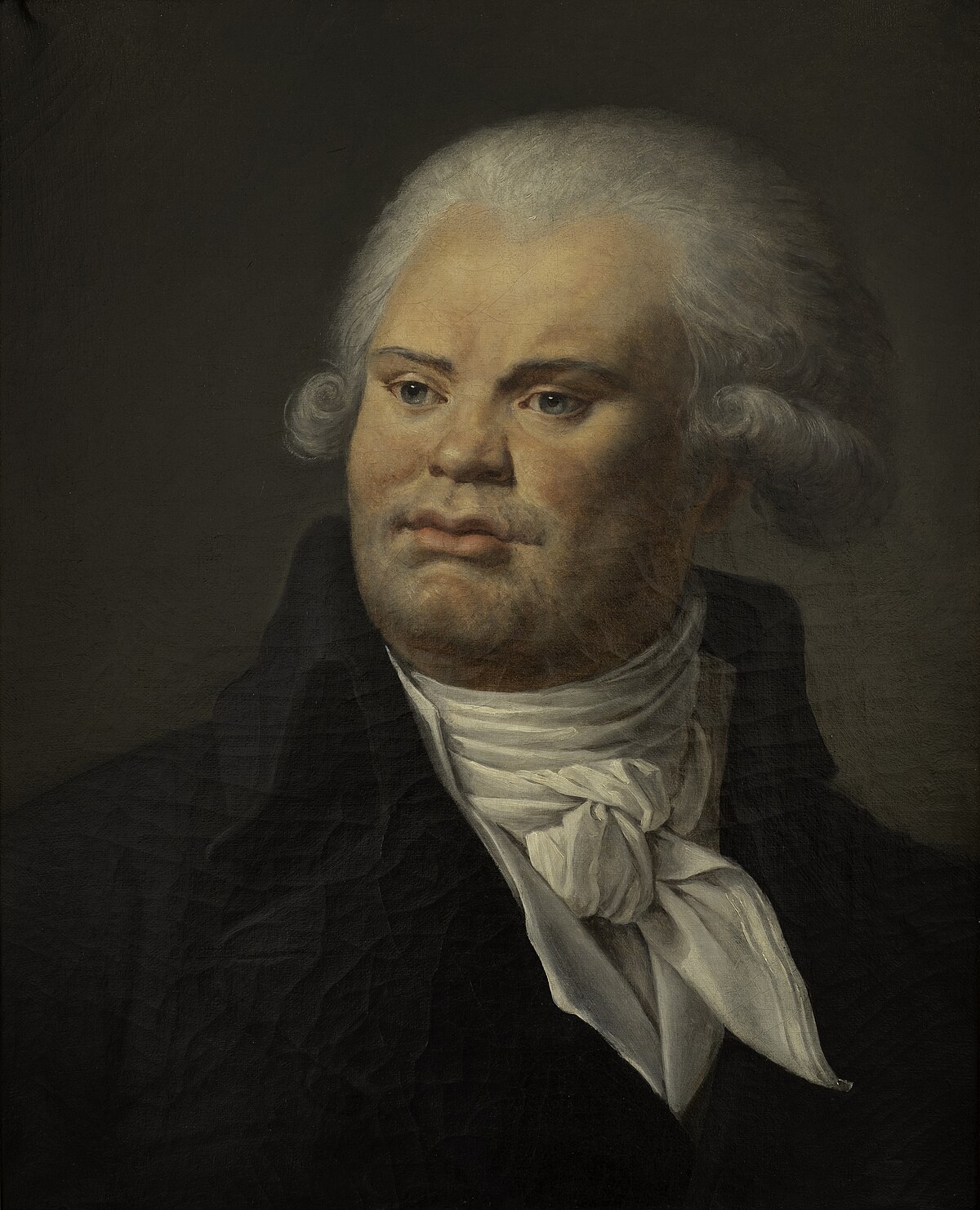
Georges Jacques Danton was a central figure in the French Revolution, known for his powerful oratory, his leadership in the revolutionary government, and his tragic fall from grace. Born on October 26, 1759, in Arcis-sur-Aube, France, Danton’s life was marked by his passionate commitment to the revolutionary cause, his role in the establishment of the French Republic, and his eventual execution during the Reign of Terror. This article will explore Danton’s early life, his rise to prominence during the Revolution, his key contributions to the revolutionary government, and the circumstances leading to his dramatic downfall.
Early Life and Education
Georges Jacques Danton was born into a modest family in the small town of Arcis-sur-Aube. His father, Jacques Danton, was an attorney with a troubled past, having lost his first wife and five children before marrying Marie-Jeanne-Bestelot, Georges’ mother. Georges was the fifth of seven children and displayed a lively and adventurous spirit from a young age. Unlike many of his contemporaries, Danton was not particularly inclined toward academic pursuits. He preferred outdoor activities and was known for his vivacious and rebellious nature.
Despite his lack of enthusiasm for formal education, Danton eventually enrolled at the University of Reims, where he studied law. In 1785, he graduated with a degree in law and moved to Paris, where he began his career as a prosecutor. However, his legal practice did not bring him much financial success, and he frequently relied on his family for support. During this period, Danton spent much of his time in Parisian cafés, reading the works of Enlightenment thinkers and engaging in political discussions.
Marriage and Early Career
Danton’s personal life took a significant turn when he met Antoinette-Gabrielle Charpentier, the daughter of a wealthy café owner in Paris. The couple married in 1787, and Danton used his wife’s dowry to purchase the position of an attorney at the King’s Counsel, a common practice at the time. He established his law office in the Cour de Commerce, where a statue now stands in his honor. The marriage also marked the beginning of Danton’s transformation from a struggling lawyer to a prominent figure in Parisian society.
Danton and Antoinette-Gabrielle had three sons, although their first child, François, tragically died in infancy. The couple’s other two sons, Antoine and François Georges, survived. During these years, Danton appeared to be on the path to a comfortable bourgeois life as a successful attorney. However, the brewing revolutionary fervor in France soon drew him into the political arena.
The French Revolution and Danton’s Rise to Power
The French Revolution, which began in 1789, was a period of profound social and political upheaval in France. Danton, with his fiery temperament and belief in radical change, quickly became involved in the revolutionary movement. His first recorded participation in revolutionary activities was on July 13, 1789, the day before the storming of the Bastille. Danton delivered a stirring speech at the Cordeliers Club, urging the people to take up arms in defense of their rights.
The Cordeliers Club, based in the former Convent of the Cordeliers, was a radical political group that played a significant role in the early stages of the Revolution. Danton quickly rose to prominence within the club and became its president. The club published revolutionary pamphlets, including the influential L’Ami du peuple (The People’s Friend), written by Jean-Paul Marat. Danton’s leadership and oratory skills made him a key figure in the club, which operated almost like a parallel government, challenging the authority of the established regime.
Danton was directly involved in the storming of the Bastille on July 14, 1789, a pivotal event in the Revolution that symbolized the fall of the Ancien Régime. Following the Bastille’s fall, Danton became one of the most vocal critics of the government led by the Marquis de Lafayette and the Paris Commune. He called for the establishment of a republican government and his impassioned speeches contributed to the growing unrest in Paris, leading to the massacre at the Champ de Mars in 1791.
Due to his revolutionary activities, Danton became a target for the authorities. He was forced to flee to England for several months to avoid arrest. However, he returned to France later that year, taking a more cautious approach to avoid further persecution.
Leadership in the Revolutionary Government
By 1792, Danton had become a leading figure in the Revolution. He was elected president of the electoral district of the Théâtre Français, where he delivered one of his most famous speeches advocating for the legal equality of all citizens. His influence continued to grow, and he played a central role in the events leading to the overthrow of the monarchy on August 10, 1792. Danton believed that the existence of the monarchy was a significant obstacle to the realization of revolutionary ideals.
After the fall of the monarchy, Danton was appointed Minister of Justice in the newly established revolutionary government. In this role, he was responsible for overseeing the administration of justice during one of the most tumultuous periods in French history. He also became a member of the Committee of Public Safety, the powerful body that effectively governed France during the Reign of Terror.
As a member of the Committee of Public Safety, Danton sought to end the war between France and the coalition of European powers through diplomatic means. He believed that a strong central government was necessary to restore order in France and ensure the success of the Revolution. However, his pragmatic approach and willingness to negotiate with France’s enemies put him at odds with more radical revolutionaries, including Maximilien Robespierre.
Fall from Power and Execution
Danton’s influence began to wane as the Revolution became increasingly radical. By 1793, the political landscape had shifted, and Robespierre and other Jacobins had gained the upper hand. Danton’s moderate stance and his efforts to curb the excesses of the Revolution led to his political downfall. He was not re-elected to the Committee of Public Safety, and Robespierre emerged as the dominant figure in the revolutionary government.
In October 1793, Danton retreated to his hometown of Arcis-sur-Aube, hoping to distance himself from the escalating violence in Paris. However, his friends and political allies urged him to return to the capital, fearing that Robespierre’s growing power posed a threat to the Revolution’s original ideals. Danton returned to Paris in November, but by this time, the Reign of Terror was in full swing.
Danton initially supported Robespierre’s efforts to suppress counter-revolutionaries, including the execution of Hébert and his followers. However, he soon became disillusioned with the growing extremism of the revolutionary government. Danton’s calls for moderation and an end to the Terror put him at odds with Robespierre, who saw him as a threat to his authority.
In March 1794, Danton was arrested on charges of corruption and counter-revolutionary activities. Despite a passionate defense at his trial, he was convicted and sentenced to death by the Revolutionary Tribunal. On April 5, 1794, Danton was guillotined, along with several of his closest allies. According to legend, his last words were a request to the executioner to show his severed head to the crowd, saying, “It will be worth seeing.”
Legacy and Historical Significance
Georges Jacques Danton’s life and death are emblematic of the tumultuous and often contradictory nature of the French Revolution. He was a passionate advocate for the rights of the common people, a brilliant orator, and a key figure in the establishment of the French Republic. However, his willingness to compromise and his pragmatic approach ultimately led to his downfall in an era marked by ideological extremism.
Danton’s legacy is complex. He is remembered as both a hero of the Revolution and a cautionary figure whose moderate stance could not withstand the radical currents of the time. His story serves as a reminder of the dangers of political extremism and the fine line between revolutionary zeal and tyranny.
Danton’s life has been the subject of numerous books, plays, and films, reflecting his enduring significance in French history. His speeches and writings continue to be studied by historians and political theorists, offering insights into the challenges of revolutionary leadership and the dynamics of political power.
Conclusion: Danton’s Enduring Influence
Georges Jacques Danton’s impact on the French Revolution and modern political thought cannot be overstated. As one of the Revolution’s most prominent leaders, he played a crucial role in shaping the early stages of the French Republic. His commitment to the principles of liberty, equality, and fraternity, coupled with his pragmatic approach to governance, left an indelible mark on French history.
Danton’s tragic end, a victim of the very Revolution he helped to lead, underscores the volatility of revolutionary movements and the inherent risks faced by those who seek to change the world. Despite his downfall, Danton remains a symbol of the power of rhetoric, the importance of compromise, and the dangers of political fanaticism.
As we continue to study and reflect on the French Revolution, Georges Jacques Danton’s life serves as a powerful reminder of the complexities of political change and the enduring struggle for justice and equality.


