
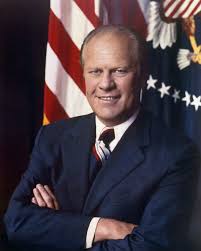
Gerald Ford, the 38th President of the United States, was a man whose life was characterized by resilience, dedication, and an unwavering commitment to his country. Born on July 14, 1913, in Omaha, Nebraska, Ford’s journey from a humble Midwestern upbringing to the highest office in the land is a testament to his perseverance and sense of duty. His presidency, though brief, was marked by significant challenges and decisions that would leave a lasting impact on the nation.
Early Life and Education
Gerald Ford was born as Leslie Lynch King Jr. to parents Dorothy Ayer Garner and Leslie Lynch King Sr. His early life was tumultuous; his parents divorced shortly after his birth, and his mother remarried Gerald Rudolph Ford Sr., who became a pivotal figure in his life. Ford took his stepfather’s name and was raised in Grand Rapids, Michigan, where he grew up with Midwestern values of hard work, honesty, and integrity.
Ford’s formative years were spent in Michigan, where he attended South High School and later the University of Michigan. At the University of Michigan, Ford excelled academically and athletically, becoming a star on the university’s football team. His leadership qualities were evident even then, but despite his athletic prowess, Ford chose to pursue a career in law rather than professional sports.
In 1935, Ford moved to New Haven, Connecticut, where he worked as an assistant football coach at Yale University. During this time, he applied to Yale Law School and, after initially being rejected, was eventually admitted. Ford’s determination and work ethic paid off when he graduated with a law degree in 1941. These early experiences in academia and athletics laid the groundwork for Ford’s future career in public service.
The Path to Politics
After completing his education, Gerald Ford returned to Michigan, where he opened a law practice with a college friend. However, his legal career was short-lived due to the outbreak of World War II. In 1942, Ford enlisted in the U.S. Navy, serving with distinction in the Pacific Theater. He rose to the rank of lieutenant commander and was discharged in 1946, returning home with a renewed sense of purpose.
Ford’s military service reinforced his belief in public service, and upon his return, he entered the political arena. In 1948, he ran for a seat in the U.S. House of Representatives as a Republican candidate from Michigan’s 5th congressional district. Ford won the election and began what would become a 25-year career in the House of Representatives.
Congressional Career and Rise to Prominence
Gerald Ford’s time in Congress was marked by his steady rise through the ranks of the Republican Party. He quickly established himself as a loyal and hardworking representative, earning the respect of his colleagues on both sides of the aisle. Ford’s legislative focus was broad, but he was particularly interested in defense, foreign policy, and fiscal responsibility.
In 1965, Ford was elected as the House Minority Leader, a position he held for nearly a decade. As Minority Leader, Ford was known for his pragmatic approach to governance, often working across party lines to achieve legislative goals. His leadership during this time was instrumental in shaping the Republican Party’s policies and strategies, particularly during the turbulent 1960s and early 1970s.
Ford’s political philosophy was rooted in moderation and bipartisanship. He believed in the importance of maintaining a strong national defense, controlling government spending, and upholding the rule of law. These principles guided his actions as Minority Leader and would later define his presidency.
The Watergate Scandal and the Vice Presidency
The early 1970s were a time of political upheaval in the United States, with the Watergate scandal shaking the very foundations of American democracy. In 1973, Vice President Spiro Agnew resigned amid allegations of corruption, leaving President Richard Nixon to appoint a new vice president. Nixon selected Gerald Ford, who was widely respected for his integrity and experience in Congress.
Ford’s appointment as vice president was met with bipartisan approval, and he was swiftly confirmed by Congress. His tenure as vice president was short but eventful, as the Watergate scandal continued to unfold, leading to Nixon’s resignation in August 1974. With Nixon’s departure, Gerald Ford was sworn in as the 38th President of the United States, becoming the first and only person to assume the presidency without having been elected as either president or vice president.
The Ford Presidency: Challenges and Achievements
Gerald Ford’s presidency was marked by a series of unprecedented challenges. Taking office in the wake of the Watergate scandal, Ford’s primary objective was to restore public trust in the government. He famously declared, “Our long national nightmare is over,” signaling his intention to heal a nation deeply divided by political scandal and social unrest.
One of Ford’s most controversial decisions was his pardon of Richard Nixon, granted just a month after taking office. The pardon was intended to help the country move forward, but it sparked widespread public outrage and significantly damaged Ford’s political standing. Despite the backlash, Ford stood by his decision, believing it was necessary for national healing.
Domestically, Ford faced the daunting task of addressing the economic challenges of the mid-1970s. The country was grappling with high inflation, unemployment, and an energy crisis. Ford’s response included a series of measures aimed at curbing inflation and stimulating economic growth. His administration introduced the “Whip Inflation Now” (WIN) campaign, encouraging Americans to conserve energy and reduce spending. However, the effectiveness of these measures was mixed, and Ford struggled to stabilize the economy during his time in office.
In foreign policy, Ford continued the détente policies initiated by his predecessors, seeking to ease tensions with the Soviet Union and China. He also faced challenges in the Middle East, particularly in the aftermath of the Yom Kippur War and the ongoing Arab-Israeli conflict. Ford worked to maintain U.S. influence in the region while navigating the complexities of Cold War geopolitics.
Ford’s presidency was also notable for his efforts to promote human rights and reduce government secrecy. He signed the Privacy Act of 1974, which aimed to safeguard personal information held by the government, and the Freedom of Information Act, which increased transparency and accountability in federal agencies.
The 1976 Presidential Election and Post-Presidency
Gerald Ford’s presidency was brief, lasting just over two years, but it was a period of significant transition for the country. In 1976, Ford ran for a full term as president but faced a tough primary challenge from former California Governor Ronald Reagan. Ford narrowly won the Republican nomination but ultimately lost the general election to Democrat Jimmy Carter.
Despite his defeat, Ford’s legacy as a president who sought to restore integrity to the White House endured. After leaving office, Ford remained active in public life, speaking on political issues and participating in various civic and charitable activities. He wrote his memoirs, “A Time to Heal,” reflecting on his presidency and the turbulent times in which he served.
In the years following his presidency, Ford received numerous honors and accolades for his public service. He was awarded the Presidential Medal of Freedom in 1999, the highest civilian honor in the United States, recognizing his contributions to the nation.
Personal Life and Legacy
Gerald Ford’s personal life was marked by his strong family values and dedication to his loved ones. He married Elizabeth “Betty” Bloomer in 1948, and the couple had four children: Michael, John, Steven, and Susan. Betty Ford was an influential figure in her own right, known for her advocacy on issues such as substance abuse and breast cancer awareness. The Betty Ford Center, a leading treatment facility for addiction, was established in her name.
Ford’s legacy is one of humility, integrity, and service. He was a man who never sought the presidency but stepped into the role during a time of national crisis, bringing stability and a sense of decency to the office. His decision to pardon Nixon remains a topic of debate, but it is also a testament to his belief in the need for national reconciliation.
Gerald Ford passed away on December 26, 2006, at the age of 93. His death marked the end of an era, but his contributions to American history continue to be remembered and respected. Ford’s presidency may have been brief, but his impact on the nation was profound, guiding the country through one of its most challenging periods with grace and determination.
Conclusion
Gerald Ford’s life and career offer a compelling narrative of leadership, resilience, and commitment to public service. From his early days as a football player and law student to his unexpected rise to the presidency, Ford’s journey was shaped by his steadfast character and dedication to the principles of honesty and integrity.
As the 38th President of the United States, Ford played a crucial role in restoring confidence in the government after the Watergate scandal. His decisions, though sometimes controversial, were guided by a desire to do what was best for the country, even at great personal and political cost.
Ford’s legacy lives on as a reminder of the importance of integrity in leadership and the enduring value of public service. His life story serves as an inspiration to those who seek to make a positive impact on the world, demonstrating that even in the face of adversity, it is possible to lead with dignity and honor.


