
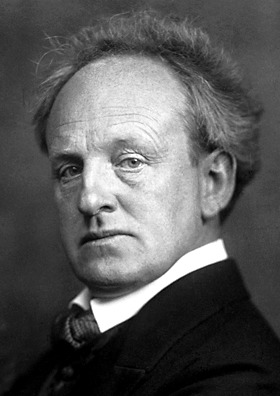
Gerhart Johann Robert Hauptmann, born on November 15, 1862, in Obersalzbrunn, Germany (now Szczawno-Zdrój, Poland), was a towering figure in German literature, widely recognized for his contributions to drama and naturalism. Hauptmann’s work earned him the Nobel Prize in Literature in 1912, marking him as one of the most significant playwrights and novelists of his time. His life and career, characterized by a deep exploration of social issues, spiritual quests, and human suffering, left an indelible mark on both German and world literature.
Early Life and Educational Struggles
Gerhart Hauptmann was the youngest of four children born to Robert and Marie Hauptmann. His early life was marked by a struggle against the rigid educational systems of the time. Hauptmann found the strict, authoritarian environment of the German schools oppressive, and this aversion led to a troubled academic career. He initially attended a high school in Breslau (now Wrocław, Poland) but soon abandoned it to pursue agricultural studies, which also proved to be an ill-suited path for him.
Hauptmann’s interest in the arts became apparent during his adolescence, leading him to enroll in the Academy of Fine Arts in Breslau. However, his time there was short-lived, as he found himself dissatisfied and restless. In 1882, at the age of 20, Hauptmann left the academy and joined his brother Carl at the University of Jena, where he attended various lectures without much focus or success. This period of intellectual wandering reflected Hauptmann’s search for a deeper purpose, a quest that would later define his literary works.
Artistic Awakening and Early Literary Efforts
Hauptmann’s life took a decisive turn when he traveled to Italy in 1884. His time in Rome, Naples, and Capri proved transformative, awakening a passion for literature and the arts. It was in Rome that Hauptmann decided to dedicate his life to writing, a decision that he later described as the moment when he “finally decided for literature.” He initially pursued sculpture during his stay in Rome but soon realized that writing was his true calling.
Upon returning to Germany in 1885, Hauptmann married Mary Thienemann, a woman of considerable wealth. This marriage provided him with the financial stability to focus entirely on his writing. His early literary output included both poetry and prose, but it was the dramatic arts that would ultimately bring him the most acclaim.
The Rise of Naturalism and Dramatic Success
The late 19th century was a period of significant change in European literature, with naturalism emerging as a dominant force. Naturalism sought to depict life realistically, often focusing on the harsh realities faced by the working class. Hauptmann became one of the foremost exponents of this movement in Germany, and his plays were instrumental in bringing naturalism to the German stage.
In 1889, Hauptmann published his first major play, Vor Sonnenaufgang (Before Sunrise), which depicted the destructive effects of alcohol on a peasant family. The play was a bold departure from the idealized portrayals of rural life that were common in German theater at the time. It shocked audiences with its raw depiction of poverty, alcoholism, and social decay, but it also established Hauptmann as a leading figure in German drama.
Following the success of Vor Sonnenaufgang, Hauptmann continued to produce a series of influential plays. Die Weber (The Weavers), written in 1892, is perhaps his most famous work. The play dramatizes the Silesian weavers’ revolt of 1844, portraying the weavers as victims of an oppressive industrial system. Die Weber was groundbreaking in its sympathetic portrayal of the working class and its critique of industrial capitalism, and it remains a powerful statement on social justice.
Another notable work from this period is Hanneles Himmelfahrt (The Assumption of Hannele, 1893), which blends naturalism with elements of mysticism and fantasy. The play tells the story of a young girl who escapes her abusive life through dreams of heavenly salvation. This work demonstrated Hauptmann’s ability to merge stark realism with a more symbolic and spiritual narrative, broadening the scope of naturalist drama.
Evolution of Style and Thematic Exploration
As Hauptmann’s career progressed, his writing began to evolve, moving away from strict naturalism and incorporating more symbolic and fantastical elements. Die versunkene Glocke (The Sunken Bell, 1896) is a prime example of this shift. The play, a symbolic fairy tale, explores themes of creativity, love, and the conflict between art and life. It was well-received and demonstrated Hauptmann’s versatility as a playwright.
At the turn of the 20th century, Hauptmann continued to explore a variety of themes and styles. His works during this period often delved into the psychological and spiritual struggles of individuals, reflecting his ongoing interest in human suffering and redemption. Der arme Heinrich (Poor Heinrich, 1902) is one such work, which examines the themes of guilt, redemption, and the possibility of spiritual salvation.
In 1903, Hauptmann published Rose Bernd, a tragic play about a young woman who becomes the victim of societal and personal pressures, leading to her downfall. This work is notable for its exploration of gender and social issues, and it remains one of Hauptmann’s most powerful statements on the human condition.
Nobel Prize and Later Works
Hauptmann’s contributions to literature were recognized internationally when he was awarded the Nobel Prize in Literature in 1912. The Nobel Committee praised him for his “fertile, varied, and outstanding production in the realm of dramatic art.” This recognition solidified Hauptmann’s status as one of the leading literary figures of his time.
Despite this acclaim, Hauptmann’s later works did not achieve the same level of success as his earlier plays. Nevertheless, he continued to write prolifically, producing a wide range of novels, poems, and essays. His 1910 novel, Der Narr in Christo Emanuel Quint (The Fool in Christ Emanuel Quint), is a notable example of his later work, focusing on the theme of religious experience and the search for spiritual truth.
Another significant work from this period is Der Ketzer von Soana (The Heretic of Soana, 1918), which explores the conflict between paganism and Christianity. This novel, like many of Hauptmann’s later works, reflects his deep interest in religion, mysticism, and the existential questions that define the human experience.
In his final years, Hauptmann turned his attention to autobiographical and reflective works. His memoir, Das Buch der Leidenschaft (The Book of Passion, 1930), offers insights into his personal life, artistic struggles, and the influences that shaped his work. His last major work, Der grosse Traum (The Great Dream, 1942), is a poetic exploration of life’s ultimate questions, drawing on motifs from Dante and other great literary figures.
Legacy and Impact on German Literature
Gerhart Hauptmann passed away on June 6, 1946, in Agnetendorf (now Jagniątków, Poland), at the age of 84. His death marked the end of an era in German literature, but his legacy continues to influence writers and playwrights to this day.
Hauptmann’s body of work is vast, encompassing 45 plays, 18 novels and novellas, 6 epic poems, and 3 collections of poetry. His exploration of social issues, human psychology, and spirituality made him a central figure in the naturalist movement, and his influence extended far beyond Germany. Hauptmann’s ability to blend realism with symbolism and mysticism allowed him to create works that resonate on multiple levels, making him a truly unique voice in world literature.
In the broader context of German literature, Hauptmann stands alongside figures like Goethe, Schiller, and Lessing as one of the pillars of German drama. His work helped shape the direction of modern German theater, and his plays continue to be performed and studied for their artistic and social significance.
Conclusion
Gerhart Johann Robert Hauptmann was more than just a playwright and novelist; he was a thinker, a philosopher, and a pioneer of modern drama. His works, rooted in the social and political realities of his time, continue to speak to contemporary audiences with their timeless themes of struggle, redemption, and the human condition. Hauptmann’s legacy is one of profound artistic achievement, and his influence on literature and theater will be felt for generations to come.


