
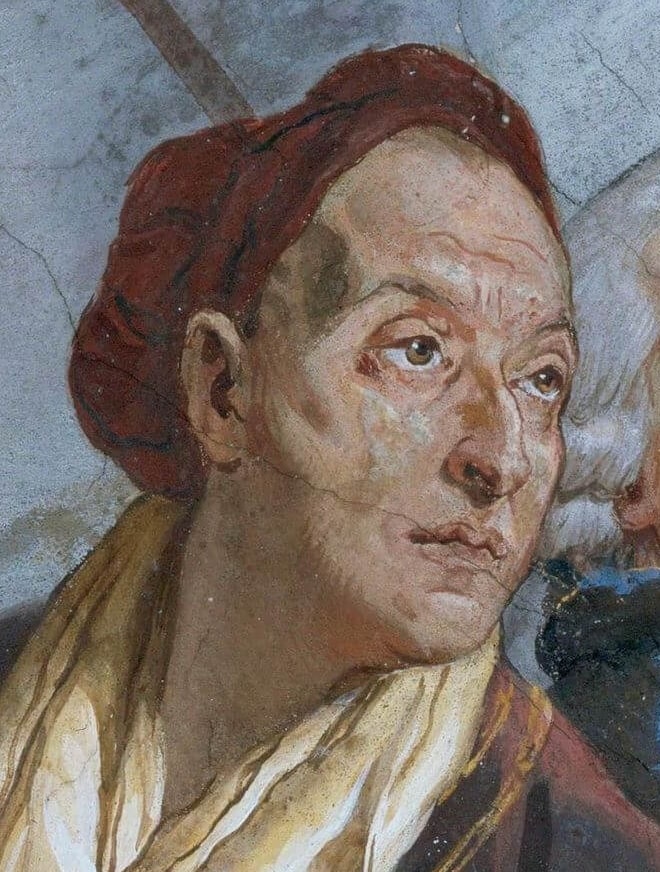
Giambattista Tiepolo, born on March 5, 1696, in Venice, stands as one of the most significant figures in the history of art. Known for his exceptional skills as a painter and engraver, Tiepolo’s work transcended the borders of Italy, earning him international acclaim during his lifetime and beyond. His journey from a Venetian artist to one of the most sought-after painters in Europe is a testament to his mastery, innovation, and ability to capture the grandeur and spirituality of his time.
Early Life and Artistic Training
Tiepolo’s early life was rooted in the rich cultural environment of Venice, a city that had long been a hub for artistic innovation and excellence. He began his artistic education in the studio of Gregorio Lazzarini, a prominent Venetian painter known for his eclectic style and ability to blend different artistic traditions. Under Lazzarini’s tutelage, Tiepolo honed his skills in drawing, composition, and the use of color, setting the foundation for his future success.
By 1717, Tiepolo had already established himself as an independent artist, as evidenced by his membership in the Fraglia dei Pittori Veneziani, a prestigious guild of Venetian painters. This early recognition marked the beginning of a career that would see Tiepolo rise to prominence not only in Venice but across Europe.
Marriage and Family Life
In 1719, Tiepolo married Maria Cecilia Guardi, the sister of fellow painters Francesco and Giannantonio Guardi. This union was conducted in secret, likely due to the complex social and familial dynamics of the time. The couple had ten children, including Giandomenico and Lorenzo Tiepolo, who would later follow in their father’s footsteps and become accomplished painters in their own right. The Tiepolo family became a significant artistic dynasty, contributing to the continuation and evolution of Venetian art in the 18th century.
Rise to Fame: The Udine Years
Tiepolo’s first major break came in 1726 when he was commissioned to create a series of frescoes in Udine, a town in northeastern Italy. His work in the Chapel of the Holy Sacrament in the Udine Cathedral, as well as in the local castle and the Patriarchal Palace, showcased his extraordinary talent for large-scale compositions and his ability to imbue religious subjects with a sense of drama and divine light. These frescoes, characterized by their dynamic compositions and vibrant colors, established Tiepolo as a leading figure in the Baroque movement.
The success of the Udine frescoes brought Tiepolo widespread recognition, leading to further commissions across Italy. His ability to convey complex theological themes through his art, combined with his technical proficiency, made him a favorite among religious and secular patrons alike.
Major Works and Achievements
Throughout his career, Tiepolo produced an astonishing number of works, each reflecting his unique artistic vision and technical mastery. Some of his most notable works include:
-
Apollo and Marsyas (1720-1722): This oil painting, housed in the Gallerie dell’Accademia in Venice, is a stunning example of Tiepolo’s early work, showcasing his ability to blend classical mythology with the dramatic intensity of Baroque art.
-
The Martyrdom of St. Bartholomew (1722): Located in the Church of San Stae in Venice, this painting highlights Tiepolo’s skill in depicting religious themes with emotional depth and vivid detail.
-
The Rape of Europa (c. 1725): Another masterpiece from his early period, this oil painting, also in the Gallerie dell’Accademia, captures the mythological story of Europa with a sense of movement and drama that would become hallmarks of Tiepolo’s style.
-
The Frescoes in the Palazzo Labia, Venice (1745-1750): Among his most celebrated works, these frescoes, depicting the story of Cleopatra and Mark Antony, are renowned for their grandeur, complex compositions, and the use of light and color to enhance the narrative.
-
The Würzburg Residence Frescoes (1750-1753): Perhaps Tiepolo’s most famous work, the frescoes in the Würzburg Residence in Germany are considered one of the greatest achievements of Baroque art. These works, including the depiction of the marriage of Emperor Frederick I Barbarossa, are noted for their scale, the complexity of the compositions, and the artist’s ability to create a sense of architectural space within the frescoes themselves.
-
Villa Pisani Frescoes (1760-1762): Tiepolo’s work at Villa Pisani in Stra, near Venice, further cemented his reputation as one of the leading fresco painters of his time. The frescoes, particularly the “Apotheosis of the Pisani Family,” are celebrated for their intricate detail, vibrant color palette, and the seamless integration of mythological and historical themes.
Later Years and Legacy
In 1762, Tiepolo was invited to Madrid by King Charles III of Spain to work on the decoration of the newly constructed Royal Palace. This commission was a testament to Tiepolo’s international fame and the high regard in which he was held by the European aristocracy. In Madrid, Tiepolo created a series of frescoes that would be among his last major works, including the “Glory of Spain” in the Throne Room and the “Apotheosis of the Spanish Monarchy” in the Hall of Mirrors.
Tiepolo’s time in Spain marked the culmination of his career, bringing together the various elements of his artistic style in a final, triumphant expression. His work in Madrid was celebrated for its grandeur, complexity, and the way it reflected the political and cultural aspirations of the Spanish monarchy.
Giambattista Tiepolo passed away on March 27, 1770, in Madrid, at the age of 74. His death marked the end of an era in European art, but his influence continued to be felt long after his passing. Tiepolo’s legacy is evident not only in the works of his sons, who carried on the family tradition of painting but also in the broader development of European art in the late 18th and early 19th centuries.
Tiepolo’s Artistic Style and Influence
Tiepolo’s artistic style is characterized by its dynamic compositions, dramatic use of light and color, and the ability to convey complex narratives through visual art. His work is often associated with the late Baroque and Rococo movements, but it also foreshadows the neoclassical trends that would emerge in the late 18th century.
One of Tiepolo’s most significant contributions to art was his ability to create a sense of movement and energy within his compositions. Whether depicting a religious scene, a mythological narrative, or a historical event, Tiepolo’s paintings are filled with a sense of dynamism and life. This quality is particularly evident in his frescoes, where the figures seem to move and interact with the architectural space around them.
Tiepolo was also a master of color, using a bright, luminous palette to create a sense of light and atmosphere in his works. His use of color was not just decorative but served to enhance the emotional impact of his paintings, drawing viewers into the scene and making them feel part of the narrative.
In addition to his technical skills, Tiepolo was also a gifted storyteller. His ability to convey complex theological and mythological themes through his art made him a favorite among patrons who sought to use art as a means of communicating moral and philosophical ideas. Tiepolo’s work often contains layers of meaning, with each element of the composition carefully chosen to contribute to the overall message of the painting.
Historical Context and Legacy
Tiepolo’s work must be understood within the broader context of 18th-century European art and culture. This was a period of great political and social change, with the rise of Enlightenment ideas, the expansion of European empires, and the growing influence of the bourgeoisie. Art during this time was often used as a tool for expressing and legitimizing the power and authority of the ruling classes, and Tiepolo’s work is no exception.
However, Tiepolo’s art also reflects the complexities and contradictions of his time. While his work was often commissioned by the aristocracy and the church, it also contains elements of irony and satire, particularly in his depictions of historical and mythological subjects. This tension between the official and the subversive is one of the reasons why Tiepolo’s work continues to resonate with modern audiences.
Today, Tiepolo is remembered as one of the greatest painters of the 18th century, and his work is celebrated for its technical brilliance, its emotional depth, and its ability to capture the spirit of an age. His influence can be seen in the work of later artists, including Francisco Goya, who admired Tiepolo’s ability to combine realism with a sense of the fantastical.
In conclusion, Giambattista Tiepolo’s life and work represent a pinnacle of European art, blending the grandeur of the Baroque with the emerging trends of the Enlightenment. His legacy as a master painter and a storyteller remains undiminished, and his works continue to be studied and admired for their beauty, complexity, and insight into the human condition.


