
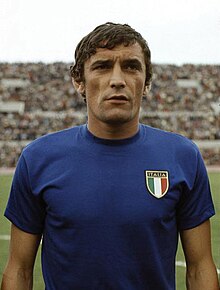
Gigi Riva, born Luigi Riva on November 7, 1944, in Leggiuno, Varese, Italy, is a name that resonates deeply within the world of football. Often hailed as one of the greatest Italian strikers of all time, Riva’s legacy extends far beyond his on-field achievements. Known for his powerful left foot, explosive speed, and relentless determination, Riva became a symbol of dedication, loyalty, and excellence in Italian sports. This article delves into the life and career of Gigi Riva, exploring his rise to fame, his impact on Italian football, and the moments that have defined his extraordinary journey.
Early Life and Beginnings
Luigi “Gigi” Riva was born into a modest family in the small town of Leggiuno, near Varese, in northern Italy. His early years were marked by a love for football, a passion that would soon become the driving force of his life. As a young boy, Riva’s talent was evident, and he quickly made a name for himself in local youth teams. His skill on the field caught the attention of scouts, leading to his first professional contract with Legnano, a club in Italy’s Serie C.
Despite the humble beginnings, Riva’s potential was undeniable. His performances at Legnano were impressive enough to attract the interest of bigger clubs. However, it was Cagliari, a team from the island of Sardinia, that would forever change the course of his career. In 1963, Riva made the move to Cagliari, a decision that would not only shape his future but also elevate the status of the club.
The Cagliari Years: Loyalty and Triumph
Gigi Riva’s transfer to Cagliari marked the beginning of a love affair between the player and the club that would last his entire career. At the time, Cagliari was a relatively unknown team, far from the traditional powerhouses of Italian football. The decision to move to Sardinia was not an easy one for the young Riva, who was leaving behind the familiarity of northern Italy for the relative isolation of the island. However, it was a decision that would pay off in ways he could never have imagined.
Riva’s impact on Cagliari was immediate. His physical prowess, combined with his incredible goal-scoring ability, transformed the team into a formidable force in Italian football. Under his leadership, Cagliari achieved promotion to Serie A, the top tier of Italian football, in the 1963-64 season. This was just the beginning of a remarkable journey.
In Serie A, Riva’s performances continued to impress. His ability to score from almost any position on the field, particularly with his powerful left foot, earned him the nickname “Rombo di Tuono” (Roar of Thunder), a moniker given to him by the famous Italian sports journalist Gianni Brera. This nickname perfectly encapsulated Riva’s style of play: fierce, unstoppable, and awe-inspiring.
During his time at Cagliari, Riva consistently rejected offers from some of the most prestigious clubs in Europe, including Juventus, AC Milan, and Inter Milan. His loyalty to Cagliari was unwavering, a rarity in the modern game where players often chase bigger contracts and more prominent stages. Riva’s decision to stay with Cagliari, despite the potential for greater fame and success elsewhere, endeared him to the fans and cemented his status as a club legend.
Achievements and Records
Gigi Riva’s career is filled with remarkable achievements and records that still stand today. Perhaps the most significant of these is his goal-scoring record for the Italian national team. Riva scored 35 goals in 42 appearances for Italy, a record that remains unbroken to this day. His scoring prowess was a key factor in Italy’s success during the late 1960s and early 1970s.
One of Riva’s most memorable moments came in 1968 when Italy won the European Championship. Riva was instrumental in Italy’s victory, scoring crucial goals and leading the team with his characteristic determination and skill. This triumph was a significant milestone in Italian football history and solidified Riva’s reputation as one of the nation’s greatest players.
In the 1969-70 season, Riva led Cagliari to their first and only Serie A title. This victory was a monumental achievement for the club and for Riva personally. Cagliari’s success was largely attributed to Riva’s incredible goal-scoring ability—he finished as the top scorer in Serie A for three seasons (1966-67, 1968-69, and 1969-70). His contribution to Cagliari’s historic title win is still celebrated today, and the team’s triumph is considered one of the greatest underdog stories in Italian football.
Riva’s loyalty to Cagliari also meant that he never sought personal glory in the form of individual awards, although his talent and achievements would have made him a strong contender for honors like the Ballon d’Or. In 1970, he finished second in the Ballon d’Or voting, behind his Italian national teammate Gianni Rivera. This near-miss remains a point of discussion among football historians, many of whom believe Riva’s achievements deserved greater recognition on the international stage.
Challenges and Injuries
Despite his many successes, Riva’s career was not without its challenges. His physical style of play, while effective, also made him prone to injuries. The most significant of these occurred in 1967 when Riva suffered a broken leg while playing for Italy. This injury sidelined him for several months and raised questions about whether he would ever return to his best form.
However, Riva’s resilience and determination saw him bounce back stronger than ever. He returned to the field with the same ferocity that had defined his career, continuing to score goals and lead Cagliari to new heights. Unfortunately, another serious injury struck in 1970 when he broke his other leg during an international match. This second injury was a major setback, and while Riva continued to play at a high level, it marked the beginning of the end of his playing career.
Riva’s career finally came to a close in 1976 after yet another injury. His last match was on February 1, 1976, against AC Milan, where Cagliari lost 3-1. The decision to retire was a difficult one for Riva, but it was clear that his body could no longer withstand the demands of professional football.
Post-Retirement and Legacy
After retiring from playing, Gigi Riva continued to contribute to the world of football in various capacities. He briefly served as the president of Cagliari, where he worked to instill the values of loyalty and dedication that had defined his career. However, it was his role with the Italian national team that would see Riva remain in the public eye for many years.
In the early 1990s, Riva joined the Italian national team’s staff, where he served as a team manager and advisor. His experience and knowledge were invaluable to the team, and he played a significant role in Italy’s success during this period, including their run to the final of the 1994 World Cup in the United States.
Riva’s contributions to Italian football were formally recognized in 2005 when Cagliari retired his iconic number 11 jersey. This honor is a testament to his impact on the club and his enduring legacy in Sardinian football. Even today, Gigi Riva is regarded as the greatest player in Cagliari’s history, and his name is synonymous with the club’s golden era.
In November 2022, Riva’s life story was immortalized in a biography titled “Mi chiamavano Rombo di Tuono” (“They Called Me Roar of Thunder”), co-written with journalist Gigi Garanzini. The book offers an in-depth look at Riva’s life, his career, and the challenges he faced both on and off the field. It serves as a reminder of the incredible journey Riva undertook, from a small town in northern Italy to the pinnacle of world football.
The following year, in 2023, filmmaker Riccardo Milani released a docufilm about Riva’s life, further solidifying his legacy as one of Italy’s greatest sports figures. The film was well-received and provided fans with a visual narrative of Riva’s extraordinary career.
Sadly, on January 22, 2024, Gigi Riva passed away in his beloved Cagliari at the age of 79. His death marked the end of an era for Italian football, but his legacy continues to inspire generations of players and fans alike. Riva’s story is not just one of sporting success; it is a tale of loyalty, perseverance, and the enduring power of sport to unite and inspire.
Conclusion
Gigi Riva’s life and career are a testament to the power of talent, hard work, and loyalty. From his humble beginnings in Leggiuno to his status as a football legend in Cagliari, Riva’s journey is one of the most remarkable stories in the history of Italian football. His records, achievements, and the love he garnered from fans across Italy and beyond ensure that his legacy will endure for many years to come.
As we remember Gigi Riva, we celebrate not only his achievements on the field but also the values he embodied—dedication, resilience, and an unwavering commitment to his team and his fans. Riva may be gone, but his impact on the world of football will never be forgotten.


