
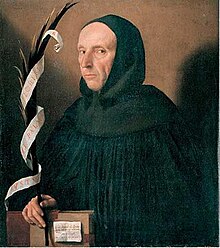
Girolamo Savonarola, born on September 21, 1452, in Ferrara, Italy, is one of the most intriguing and controversial figures of the Italian Renaissance. A Dominican friar, preacher, and reformer, Savonarola’s life and work have left an indelible mark on the history of Florence and the broader Christian world. His relentless pursuit of moral and spiritual reform, combined with his prophetic zeal, eventually led to his downfall, but his legacy continues to resonate today.
Early Life and Religious Calling
Girolamo Savonarola was born into a family with a strong tradition of education and service. His grandfather was a physician and a scholar, and Savonarola himself was initially inclined towards the study of medicine, philosophy, and music. However, at the age of 23, Savonarola experienced a profound spiritual awakening. Disillusioned with the moral decay he perceived in society and driven by a deep desire for purification, he abandoned his studies and joined the Dominican Order at the Convent of San Domenico in Bologna in 1475.
Savonarola’s decision to become a Dominican friar marked the beginning of his journey as a religious reformer. He was ordained as a priest in 1476 and continued his theological studies in Bologna before returning to his hometown of Ferrara. His early years as a preacher were marked by a focus on the moral and spiritual renewal of the Church and society. Savonarola quickly gained a reputation for his fervent and passionate sermons, which often centered on the themes of repentance, the dangers of worldly pleasures, and the impending judgment of God.
Rise to Prominence in Florence
Savonarola’s life took a significant turn in 1482 when he was appointed lector of Sacred Scripture at the Convent of San Marco in Florence. This appointment placed him at the heart of one of the most culturally vibrant cities of the Renaissance, and it was here that Savonarola’s influence began to grow. Florence, under the rule of the Medici family, was a center of art, culture, and intellectual activity, but it was also, in Savonarola’s eyes, a city plagued by moral corruption and decadence.
Savonarola’s sermons in Florence quickly gained attention for their apocalyptic tone and their harsh critique of both the Church and society. He warned of divine punishment for the city’s sins, denouncing the practice of astrology, the participation of clergy in secular festivities, and the general moral laxity that had become pervasive. His message resonated with many Florentines who were disillusioned with the excesses of the Renaissance and the corruption within the Church.
Savonarola’s prophetic warnings seemed to come to fruition in 1494 when Charles VIII of France invaded Italy, threatening to sack Florence. The Florentine ruler, Piero de’ Medici, was humiliated by the French king, leading to widespread discontent and the eventual expulsion of the Medici family from the city. With the Medici gone, Savonarola emerged as a key figure in the political and spiritual life of Florence.
Theocratic Rule and Moral Reform
In the aftermath of the Medici’s expulsion, Savonarola assumed a position of significant authority in Florence. He spearheaded efforts to reform the city’s government, advocating for a more democratic and republican system that would involve all social classes. Savonarola’s vision for Florence was not just political but deeply spiritual; he sought to transform the city into a “New Jerusalem,” a model of Christian virtue and moral purity.
One of the most famous and controversial aspects of Savonarola’s rule was his campaign to eradicate what he saw as the corrupting influences of Renaissance culture. He organized the infamous “Bonfire of the Vanities” in 1497, during which thousands of objects deemed sinful—such as books, art, cosmetics, and luxury goods—were burned in a public square. This event was emblematic of Savonarola’s radical approach to moral reform, which often bordered on fanaticism.
Savonarola’s harsh measures and his criticism of the Church hierarchy, particularly Pope Alexander VI, earned him both fervent supporters and powerful enemies. His followers, known as the “Piagnoni” (Weepers), were deeply devoted to his cause, but his opponents, including the “Arrabbiati” (Enraged Ones) and the “Palleschi” (supporters of the Medici), worked tirelessly to undermine his influence.
Conflict with the Papacy and Downfall
Savonarola’s outspoken criticism of the Church, particularly his denunciation of Pope Alexander VI as corrupt and unworthy of the papal office, eventually led to his excommunication in 1497. Despite this, Savonarola continued to preach, insisting that he was following God’s will and that the Pope’s actions were illegitimate. His defiance of papal authority and his failure to secure an alliance with Charles VIII against the Pope left him increasingly isolated.
By 1498, the political and social climate in Florence had shifted dramatically. The city’s economy was in decline, and many Florentines had grown weary of Savonarola’s strict moral regime. His enemies seized the opportunity to act, and on April 9, 1498, Savonarola was arrested. He was subjected to multiple trials and torture, during which he was forced to confess to heresy and schism. On May 23, 1498, Girolamo Savonarola, along with two of his closest followers, was hanged and burned in Florence’s Piazza della Signoria.
Legacy and Historical Impact
The life and death of Girolamo Savonarola have had a profound and lasting impact on both religious and political thought. Savonarola’s calls for reform and his critique of the Church prefigured the Protestant Reformation, which would begin just a few decades after his death. Figures such as Martin Luther and John Calvin, while differing in many respects from Savonarola, were influenced by his insistence on the need for a return to spiritual purity and his challenge to the authority of the Pope.
In Florence, Savonarola’s legacy was complex. While he was vilified by many in the years following his death, he was also revered by others who saw him as a martyr for the cause of moral and religious reform. His influence can be seen in the works of many of his contemporaries and those who followed him, including the artist Sandro Botticelli and the philosopher Pico della Mirandola.
Savonarola’s writings, including his sermons, treatises, and letters, continue to be studied for their insights into the religious and political dynamics of the late 15th century. His ideas on governance, particularly his advocacy for a republic guided by Christian principles, have been the subject of much scholarly debate. Machiavelli, who lived in Florence during Savonarola’s rise and fall, famously referred to him as a “prophet disarmed,” highlighting the tension between moral idealism and political reality that characterized Savonarola’s life.
Theological and Cultural Contributions
Savonarola’s theological contributions, while often overshadowed by his political actions, are significant. His emphasis on personal piety, repentance, and the direct relationship between the individual and God was a precursor to the ideas that would later shape the Reformation. He also stressed the importance of scripture and sought to make the Bible more accessible to the people, encouraging the laity to engage directly with religious texts.
Culturally, Savonarola’s influence extended to the arts. While he condemned much of the Renaissance art as decadent, his impact on artists like Botticelli, who reportedly destroyed some of his own works following Savonarola’s teachings, is undeniable. The moral and religious rigor that Savonarola advocated found expression in the somber and introspective tone of much of the art and literature of the period.
Conclusion: A Controversial Figure
Girolamo Savonarola remains a deeply controversial figure in history. To some, he is a visionary reformer and a martyr who stood against the corruption of the Church and the moral decay of society. To others, he is a fanatical zealot whose rigid ideology and harsh methods ultimately led to his downfall. Regardless of one’s perspective, it is clear that Savonarola’s life and work had a profound impact on the course of history, shaping the religious and political landscape of Renaissance Italy and beyond.
His legacy, marked by both admiration and condemnation, serves as a reminder of the complex interplay between religion, politics, and society. Savonarola’s story is one of conviction, courage, and controversy—a story that continues to resonate with those who seek to understand the challenges of moral and spiritual leadership in a world fraught with corruption and compromise.


