
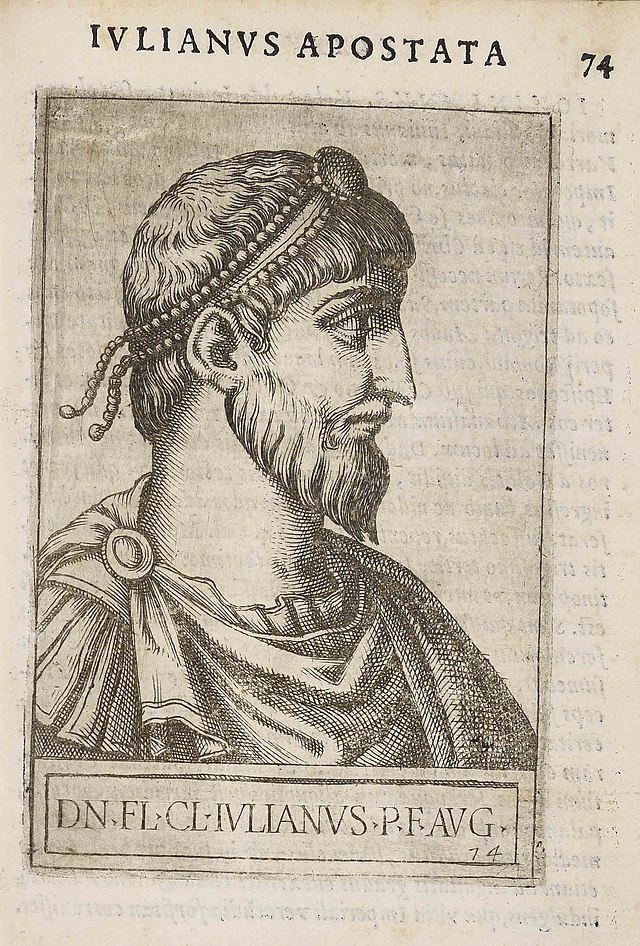
Giuliano l’Apostata, known as Julian the Apostate in English, remains one of the most intriguing and controversial figures in Roman history. Born Flavius Claudius Julianus in 331 AD in Constantinople, Julian’s life was marked by intellectual rigor, military prowess, and a determined, albeit ultimately unsuccessful, attempt to restore paganism in the Roman Empire. This article delves deep into the life, achievements, and historical significance of Julian, exploring his rise to power, his religious reforms, and his lasting impact on the Roman world.
Early Life and Background
Julian was born into the Constantinian dynasty, a lineage that had already seen significant turmoil and bloodshed by the time of his birth. His father, Julius Constantius, was the half-brother of Emperor Constantine the Great, a figure pivotal in the Christianization of the Roman Empire. Julian’s mother, Basilina, died shortly after his birth, leaving him and his half-brother, Gallus, under the care of relatives.
The political climate in which Julian was raised was perilous. After the death of Constantine in 337 AD, a bloody purge ensued, targeting many members of the imperial family. Julian narrowly escaped this massacre, which claimed the lives of his father and other male relatives. As a result, Julian spent much of his early life in seclusion, educated under the strict supervision of the Christian Bishop Eusebius of Nicomedia. His education was deeply rooted in Christian doctrine, but as he matured, Julian developed a profound interest in classical Greek philosophy and paganism, which would later define his reign.
Education and Philosophical Development
Julian’s early education laid the foundation for his later philosophical pursuits. He was well-versed in the works of Homer, Plato, and other classical authors, which nurtured his growing disenchantment with Christianity. This intellectual rebellion was further fueled by his studies in Nicomedia, where he was introduced to the teachings of the Neoplatonists, particularly through the works of Iamblichus, a philosopher who emphasized the mystical aspects of pagan religion.
In 354 AD, after the execution of his half-brother Gallus, Julian was summoned to the court of his cousin, Emperor Constantius II, in Milan. Although this period was fraught with danger, it also allowed Julian to deepen his philosophical studies. He later moved to Athens, where he fully embraced Neoplatonism and the pagan traditions associated with it. Athens, a city steeped in the traditions of ancient Greece, provided the ideal environment for Julian to cultivate his philosophical beliefs, distancing himself further from Christianity.
Rise to Power
Julian’s rise to power was both swift and unexpected. In 355 AD, Constantius II, recognizing Julian’s potential, appointed him as Caesar and tasked him with the defense of the western provinces of the Roman Empire, particularly Gaul, which was under constant threat from Germanic tribes. Julian proved to be an able military leader, achieving a significant victory at the Battle of Strasbourg in 357 AD, where he defeated the Alemanni, a confederation of Germanic tribes.
His successes in Gaul earned him the loyalty of his troops and the respect of the Roman Senate. However, his growing popularity also led to tension with Constantius II, who saw Julian as a potential rival. In 360 AD, after Constantius ordered a portion of Julian’s army to be transferred to the eastern front, Julian’s soldiers proclaimed him Augustus, effectively challenging Constantius’s authority. A civil war seemed inevitable, but it was averted when Constantius died in 361 AD, leaving Julian as the uncontested ruler of the Roman Empire.
Religious Reforms and Pagan Revival
Julian’s ascension to the throne marked a significant shift in the religious landscape of the Roman Empire. Unlike his predecessors, who had embraced Christianity, Julian sought to revive paganism, which had been in decline since Constantine’s reign. Julian’s religious policies were driven by his deep conviction that Christianity was a key factor in the moral and cultural decline of the Roman Empire.
Julian’s efforts to restore paganism were multifaceted. He repealed the anti-pagan laws enacted by his predecessors, restored the traditional rites and ceremonies of the Roman religion, and sought to rebuild and repair pagan temples that had fallen into disrepair. Moreover, he reintroduced the practice of animal sacrifice, which had been largely abandoned under Christian rule, and encouraged the worship of the traditional Roman gods.
Julian’s most controversial religious policy was his attempt to curb the influence of Christianity. He issued edicts that restricted Christians from teaching classical literature and philosophy, arguing that those who rejected the pagan gods should not have the privilege of educating the Roman elite. Additionally, he sought to undermine the Christian clergy by removing the privileges and tax exemptions that had been granted to them under Constantine and his successors.
Despite his efforts, Julian’s religious reforms faced significant resistance. Christianity had become deeply entrenched in Roman society, particularly among the urban population and the military. Julian’s policies alienated many of his subjects, who saw his attempts to revive paganism as a step backward. Moreover, his short reign—he ruled for only two years as sole emperor—meant that his reforms were largely undone after his death.
Military Campaigns and Death
In addition to his religious policies, Julian is also remembered for his military campaigns, particularly his ill-fated campaign against the Sassanian Empire in Persia. Julian saw this campaign as a way to bolster his authority and restore the glory of the Roman Empire, which had suffered several defeats at the hands of the Persians.
In 363 AD, Julian launched a massive invasion of Persia, leading an army of over 60,000 men deep into enemy territory. Initially, the campaign was successful, with Julian’s forces winning several battles and advancing as far as the Persian capital, Ctesiphon. However, logistical difficulties, harsh terrain, and stiff resistance from the Persian army soon turned the tide against the Romans.
During a skirmish near the Tigris River, Julian was mortally wounded by a spear, reportedly thrown by a Persian soldier. According to some accounts, Julian’s last words were, “Vicisti, Galilaee!” (“You have won, Galilean!”), a reference to Jesus Christ, whom Julian had tried to supplant with his pagan reforms. Julian died on June 26, 363 AD, at the age of 31, and with his death, the dream of a pagan revival in the Roman Empire died as well.
Legacy and Historical Significance
Julian the Apostate’s reign, though brief, has been the subject of considerable debate among historians and scholars. His attempt to restore paganism in a Christianizing empire was seen by many as anachronistic, a futile effort to turn back the clock on history. However, others have viewed Julian as a tragic figure, a philosopher-king who tried to preserve the traditional values of Roman civilization in the face of a rapidly changing world.
Julian’s writings, which include philosophical treatises, orations, and satirical works, offer valuable insights into his thoughts and beliefs. His most famous works include “The Caesars,” a satirical critique of his imperial predecessors, and “Against the Galileans,” a polemical work attacking the Christian faith. These writings reveal Julian as a man deeply committed to his beliefs, willing to challenge the dominant religious and cultural norms of his time.
In the centuries following his death, Julian’s legacy was shaped largely by Christian writers, who portrayed him as a heretic and a tyrant. The epithet “Apostate,” which was attached to his name, reflects the Christian view of Julian as a renegade who betrayed the faith. However, in recent times, there has been a re-evaluation of Julian’s legacy, with some scholars emphasizing his philosophical contributions and his role as a defender of traditional Roman values.
Conclusion
Giuliano l’Apostata, or Julian the Apostate, remains one of the most complex and fascinating figures in Roman history. His life was marked by intellectual brilliance, military success, and a passionate commitment to the revival of paganism. While his efforts to restore the old gods ultimately failed, Julian’s reign represents a pivotal moment in the history of the Roman Empire, a final, determined stand for the ancient traditions in the face of an increasingly Christian world.
Julian’s legacy continues to be a subject of scholarly interest and debate. His writings, though often overshadowed by his political and military achievements, provide a window into the mind of a man who sought to bridge the gap between the classical and Christian worlds. Though his reign was brief, Julian’s impact on the Roman Empire and the course of Western history remains significant, offering a poignant reminder of the challenges and complexities of religious and cultural change.


