
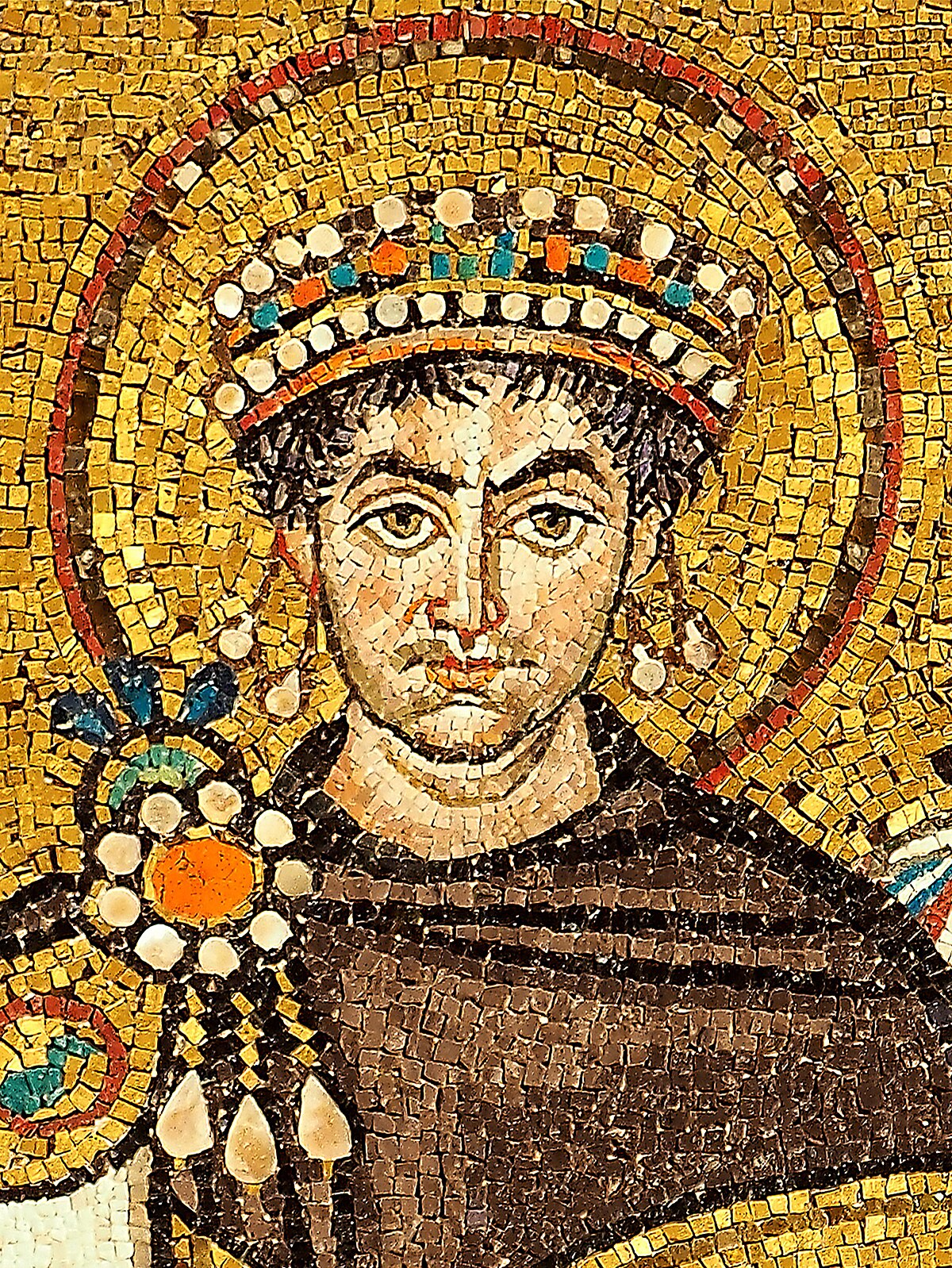
Giustiniano I, known as Flavius Petrus Sabbatius Iustinianus in Latin, was born in 482 AD in Tauresium, a small village in the region of Dardania, which is located in present-day North Macedonia. He is widely recognized as one of the most significant and influential emperors of the Byzantine Empire. His reign, which lasted from 527 to 565 AD, is often regarded as a golden age for the Byzantine Empire, characterized by extensive territorial expansion, ambitious legal reforms, and monumental construction projects. This article delves into the life, achievements, and legacy of Giustiniano I, providing detailed insights into his historical context and the nuances of his rule.
Early Life and Rise to Power
Giustiniano was born into a modest family; his mother was the sister of General Justin, who would later ascend to the imperial throne as Emperor Justin I. Despite his humble origins, Giustiniano’s prospects were greatly enhanced by his uncle’s rise to power. Adopted by Justin, Giustiniano received a comprehensive education in philosophy, jurisprudence, and military strategy, laying the foundation for his future role as emperor.
In 518 AD, Justin I was proclaimed emperor, and Giustiniano’s advancement within the Byzantine military and administrative hierarchy was swift. By 521 AD, he was appointed as consul, and just a few years later, he was promoted to the position of commander of the Eastern army. His rapid ascent was a testament to his abilities and the favor he enjoyed under his uncle’s reign.
The Marriage to Theodora: A Love That Defied Convention
One of the most significant personal events in Giustiniano’s life was his marriage to Theodora, a former actress with a controversial past, including work as a courtesan. The union was not without its challenges, as Byzantine law at the time prohibited men of high rank from marrying actresses or servants. However, Giustiniano was deeply in love with Theodora and was determined to marry her.
To overcome this legal obstacle, Giustiniano persuaded his uncle, Emperor Justin I, to issue an edict that abolished the law barring such marriages. This action not only facilitated his marriage to Theodora in 525 AD but also had broader social implications, as it diminished the rigid class distinctions that had previously dominated Byzantine society. Theodora would go on to become a powerful and influential figure in Giustiniano’s reign, playing a crucial role in both his domestic and foreign policies.
Ascension to the Throne and Early Reforms
Giustiniano was officially proclaimed co-emperor with his uncle on April 1, 527 AD, and upon Justin I’s death in August of the same year, he became the sole ruler of the Byzantine Empire. From the outset of his reign, Giustiniano was determined to restore the Roman Empire to its former glory. His ambitions were grand, and he quickly set about implementing a series of reforms and initiatives that would come to define his reign.
One of Giustiniano’s most enduring legacies is the Corpus Juris Civilis, also known as the Justinian Code, a comprehensive codification of Roman law. This legal compilation, completed in 529 AD, served as the foundation for the legal systems of many modern European nations and has had a lasting influence on Western legal tradition. The Justinian Code was not merely a collection of existing laws; it was an ambitious project that sought to clarify, simplify, and standardize Roman law across the vast Byzantine Empire.
The Nika Riots: A Turning Point in Giustiniano’s Reign
Despite his early successes, Giustiniano’s reign was not without its challenges. In January 532 AD, a significant uprising known as the Nika Riots broke out in Constantinople, threatening to overthrow his rule. The riots were sparked by discontent over high taxes and the influence of certain officials within Giustiniano’s administration. The unrest reached its peak during the chariot races at the Hippodrome, where factions of the populace, known as the Blues and the Greens, united in opposition to the emperor.
Initially, Giustiniano attempted to placate the rioters by dismissing some of his unpopular ministers, including John of Cappadocia and Tribonian. However, these concessions were not enough to quell the rebellion, and the situation escalated to the point where the rioters declared a new emperor, Hypatius, a nephew of the former Emperor Anastasius I.
In the face of this existential threat, Giustiniano considered fleeing the city, but it was Theodora who persuaded him to stay and fight for his throne. Demonstrating her resolve and influence, Theodora’s famous words—”The royal purple is the noblest shroud”—inspired Giustiniano to take decisive action. He ordered his generals, Belisarius and Mundus, to suppress the revolt by force. The ensuing crackdown was brutal, resulting in the deaths of over 30,000 people in the Hippodrome, but it effectively ended the rebellion and solidified Giustiniano’s rule.
Military Campaigns and Territorial Expansion
With his authority firmly reestablished, Giustiniano embarked on a series of military campaigns aimed at reclaiming the lost territories of the Western Roman Empire. His most notable general, Belisarius, led successful campaigns in North Africa, Italy, and parts of Spain, significantly expanding the Byzantine Empire’s territory.
The Vandalic War (533–534 AD) saw Belisarius defeat the Vandal Kingdom in North Africa, reclaiming the province for the Byzantine Empire. This victory was followed by the Gothic War (535–554 AD), during which Belisarius and later General Narses waged a protracted campaign against the Ostrogoths in Italy. The conflict resulted in the reconquest of the Italian Peninsula, including the city of Rome itself, which had fallen under barbarian control after the fall of the Western Roman Empire.
In addition to these campaigns, Giustiniano also sought to secure the empire’s eastern borders against the Sassanian Empire. Although these efforts were less successful and often resulted in costly and inconclusive wars, they nonetheless reflected Giustiniano’s determination to restore and protect the Roman Empire’s territorial integrity.
Architectural and Cultural Legacy: The Hagia Sophia
Giustiniano’s reign was also marked by an ambitious program of public works and architectural achievements. The most iconic of these is the Hagia Sophia in Constantinople, which was completed in 537 AD. This magnificent cathedral, with its massive dome and innovative architectural design, remains one of the most significant and enduring symbols of Byzantine architecture. It served as the central church of Eastern Orthodox Christianity for nearly 1,000 years and later became a mosque under Ottoman rule. Today, it stands as a museum and a testament to Giustiniano’s vision and the cultural achievements of his reign.
In addition to the Hagia Sophia, Giustiniano commissioned the construction of numerous other churches, fortifications, and public buildings throughout the empire. These projects were not merely expressions of piety or imperial grandeur; they were also practical responses to the challenges of the time, including the need to defend the empire’s borders and maintain its infrastructure.
Legal Reforms and Administrative Changes
Beyond his military and architectural achievements, Giustiniano was also a prolific legislator. His legal reforms extended beyond the Justinian Code to include a series of administrative changes aimed at strengthening the centralization of power and improving the efficiency of the imperial government.
One of the key aspects of Giustiniano’s administrative reforms was the reorganization of the provinces. He abolished the diocesan structure established by Emperor Diocletian, consolidating smaller provinces into larger administrative units. This move was intended to streamline governance and reduce the influence of local governors, who had often acted with a high degree of autonomy. Giustiniano also sought to curtail the power of the Praetorian Prefects, reducing their role to that of provincial governors.
Despite these efforts, Giustiniano struggled to eliminate corruption within the government. Even some of his closest advisors, such as the Praetorian Prefect Peter Barsymes, were implicated in corrupt practices. Giustiniano’s attempts to address these issues through legislation often fell short, as the deeply entrenched nature of corruption in the Byzantine bureaucracy proved difficult to overcome.
The Plague of Justinian: A Catastrophic Event
Giustiniano’s reign was also marked by one of the most devastating pandemics in history, known as the Plague of Justinian. This outbreak of bubonic plague, which began in 541 AD, swept through the Byzantine Empire, killing an estimated 25% of the population. The plague had a profound impact on the empire, weakening its military and economic strength and contributing to a decline in population that would take centuries to recover.
Giustiniano himself contracted the plague but miraculously survived. The pandemic, however, left the empire in a weakened state, and Giustiniano’s later years were marked by increasing difficulty in maintaining the empire’s territorial gains and managing its finances. The costs of his military campaigns, combined with the economic toll of the plague, drained the imperial treasury, leading to financial strains that would plague his successors.
The Final Years and Legacy
Giustiniano continued to rule the Byzantine Empire until his death on November 14, 565 AD. His later years were marked by a mix of successes and challenges, as he struggled to maintain the vast empire he had built. Despite the difficulties, Giustiniano’s reign left an indelible mark on the history of the Byzantine Empire and the broader world.
His legacy is most evident in the legal, architectural, and cultural achievements of his reign. The Corpus Juris Civilis remains one of the most significant contributions to the development of Western legal systems, while the Hagia Sophia continues to stand as a symbol of Byzantine architectural prowess. Giustiniano’s efforts to restore the Roman Empire, though only partially successful, laid the groundwork for the Byzantine Empire’s continued influence in the centuries to come.
In the historical context, Giustiniano I is often remembered as a ruler who was both ambitious and visionary, but also as one who faced immense challenges in achieving his goals. His reign represents a pivotal moment in the history of the Byzantine Empire, characterized by both remarkable achievements and significant struggles.


