
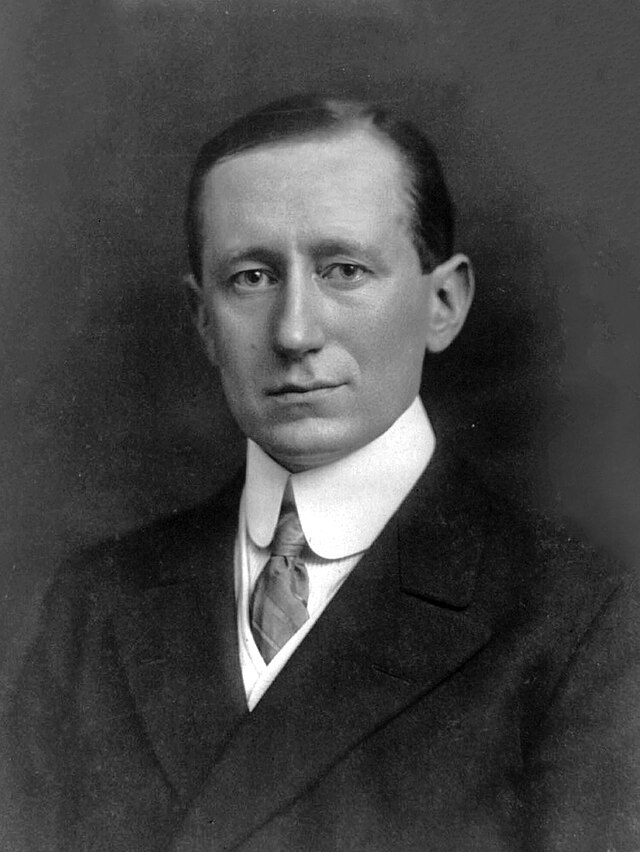
Introduction
Guglielmo Marconi, born on April 25, 1874, in Bologna, Italy, was a pioneering Italian inventor and electrical engineer whose groundbreaking work in long-distance radio transmission earned him global recognition. Known as the “father of radio,” Marconi’s contributions to wireless telegraphy revolutionized communication and laid the foundation for modern wireless technology. This article delves into the life of Guglielmo Marconi, exploring his age, fame, and key life highlights, while also providing detailed insights into the historical context and significance of his achievements.
Early Life and Background
Guglielmo Giovanni Maria Marconi was born into a wealthy family; his father, Giuseppe Marconi, was an Italian landowner, and his mother, Annie Jameson, was of Irish descent, the granddaughter of the founder of Jameson & Sons, the famous whiskey distillery. Marconi’s upbringing in the Villa Griffone in Pontecchio, near Bologna, provided him with the environment to explore his early interest in science.
From a young age, Marconi demonstrated an aptitude for technical experimentation. Although he did not receive a formal education in a traditional academic setting, Marconi was tutored privately and had access to a well-stocked library where he immersed himself in the works of the great scientists of his time. His early fascination with electricity and the theories of Heinrich Hertz, who demonstrated the existence of electromagnetic waves, inspired Marconi to explore the possibilities of wireless communication.
The Birth of Wireless Telegraphy
Marconi’s interest in wireless communication began to take shape in the early 1890s. At the age of 20, he conducted his first experiments in the attic of Villa Griffone, using rudimentary equipment to transmit signals across short distances. In 1895, Marconi successfully sent a wireless signal over a distance of 1.5 miles on the family estate. This experiment marked the birth of wireless telegraphy, an achievement that would eventually lead to the development of radio.
Understanding the potential commercial and military applications of his invention, Marconi sought to patent his work. In 1896, at the age of 22, he moved to England, where he filed for his first patent, “Improvements in Transmitting Electrical Impulses and Signals, and in Apparatus There-for.” This patent was granted in 1897, marking the official recognition of Marconi’s invention.
Founding Marconi’s Wireless Telegraph Company
In 1897, Marconi founded the Marconi’s Wireless Telegraph Company in London, a venture that would play a pivotal role in the commercialization of wireless communication. The company focused on developing and refining Marconi’s technology, leading to the establishment of wireless telegraph stations across Europe and beyond.
One of the most significant early demonstrations of Marconi’s wireless system came in 1899, when he successfully transmitted signals across the English Channel from Dover, England, to Wimereux, France. This achievement proved the feasibility of long-distance wireless communication and solidified Marconi’s reputation as a leading innovator in the field.
Transatlantic Transmission and Global Fame
The dawn of the 20th century brought Marconi international fame with his most ambitious project yet: the first transatlantic wireless communication. On December 12, 1901, Marconi received the first transatlantic signal at St. John’s, Newfoundland, Canada, sent from Poldhu, Cornwall, England. The signal, consisting of the Morse code for the letter “S,” traveled over 2,000 miles across the Atlantic Ocean, an unprecedented feat that demonstrated the potential of wireless communication on a global scale.
This achievement catapulted Marconi into the global spotlight, earning him accolades and recognition from governments and scientific communities around the world. By the age of 27, Marconi was a household name, and his work was hailed as a major technological breakthrough.
Contributions to Maritime Safety and the Titanic Disaster
Marconi’s wireless telegraphy quickly found practical applications, particularly in maritime communication. Ships equipped with Marconi’s wireless systems could communicate with each other and with shore stations, enhancing safety at sea. The significance of this technology was tragically underscored during the sinking of the RMS Titanic in 1912. The ship’s Marconi wireless operators, Jack Phillips and Harold Bride, sent distress signals that were received by nearby vessels, leading to the rescue of 706 survivors. This incident highlighted the lifesaving potential of Marconi’s invention and further cemented his legacy.
In recognition of his contributions, Marconi was awarded numerous honors, including the title of “Sir” by the British government. In 1914, at the age of 40, he was appointed a Senator in Italy, and in 1929, he was granted the title of Marchese.
Nobel Prize and Scientific Recognition
In 1909, Guglielmo Marconi was awarded the Nobel Prize in Physics, an honor he shared with German physicist Karl Ferdinand Braun. The Nobel Committee recognized Marconi “in recognition of their contributions to the development of wireless telegraphy.” This prestigious award validated Marconi’s work and positioned him among the most esteemed scientists of his time.
Marconi’s Nobel Prize was not just a personal triumph but also a significant milestone in the history of communication technology. His work laid the groundwork for the development of modern radio, television, and later, the internet, making him one of the most influential inventors of the 20th century.
Later Innovations and the Development of Radio
Marconi’s pioneering work did not stop with his early successes. Throughout the 1910s and 1920s, he continued to innovate and refine his wireless technology. He focused on improving the range and reliability of radio signals, experimenting with shortwave transmissions and directional antennas.
One of Marconi’s significant contributions during this period was his work on shortwave radio, which allowed for long-distance communication using high-frequency waves. This technology proved essential for international broadcasting and military communications, further expanding the impact of Marconi’s inventions.
In the 1930s, Marconi began exploring the possibilities of microwave transmission, a precursor to radar technology. His work in this area laid the foundation for the development of radar during World War II, demonstrating Marconi’s lasting influence on modern communication and defense systems.
Personal Life and Legacy
Guglielmo Marconi’s personal life was as dynamic as his professional career. In 1905, he married Beatrice O’Brien, with whom he had four children. The marriage ended in divorce in 1924, after which Marconi married Maria Cristina Bezzi-Scali in 1927. The couple had one daughter, Maria Elettra, who would later play a significant role in preserving her father’s legacy.
Marconi’s legacy is preserved not only through his contributions to science and technology but also through numerous institutions and awards named in his honor. The Marconi Society, founded in 1974, continues to promote advancements in communication technology, and the Marconi Prize is awarded annually to individuals who have made significant contributions to the field.
Marconi’s impact on the world of communication is immeasurable. His inventions revolutionized the way people connect and share information, laying the foundation for the global communication networks that we rely on today. His work exemplifies the power of innovation and the enduring impact of visionary thinking.
Death and Posthumous Honors
Guglielmo Marconi passed away on July 20, 1937, at the age of 63, following a heart attack. His death marked the end of an era, but his legacy continues to resonate in the fields of communication and technology. Marconi’s contributions are celebrated worldwide, and his name remains synonymous with the invention of radio.
In honor of his achievements, Marconi was given a state funeral in Italy, and radio stations across the world observed a two-minute silence as a tribute to the man who made wireless communication possible. His final resting place is in Sasso Marconi, near Bologna, where a mausoleum and a museum dedicated to his life and work stand as testaments to his enduring legacy.
Conclusion
Guglielmo Marconi’s life and work stand as a testament to the power of human ingenuity and the profound impact of technological innovation. From his early experiments in wireless telegraphy to his pioneering work in radio and radar, Marconi’s contributions have shaped the modern world in ways that continue to be felt today.
As we reflect on Marconi’s legacy, it is important to recognize the broader historical context of his achievements. His work not only revolutionized communication but also played a crucial role in shaping the 20th century, influencing everything from global commerce to military strategy. Marconi’s story is one of relentless curiosity, determination, and a vision that transcended the boundaries of his time.
Marconi’s life serves as an inspiration for future generations of innovators, reminding us of the importance of pushing the boundaries of what is possible and the lasting impact that one individual can have on the world.


