
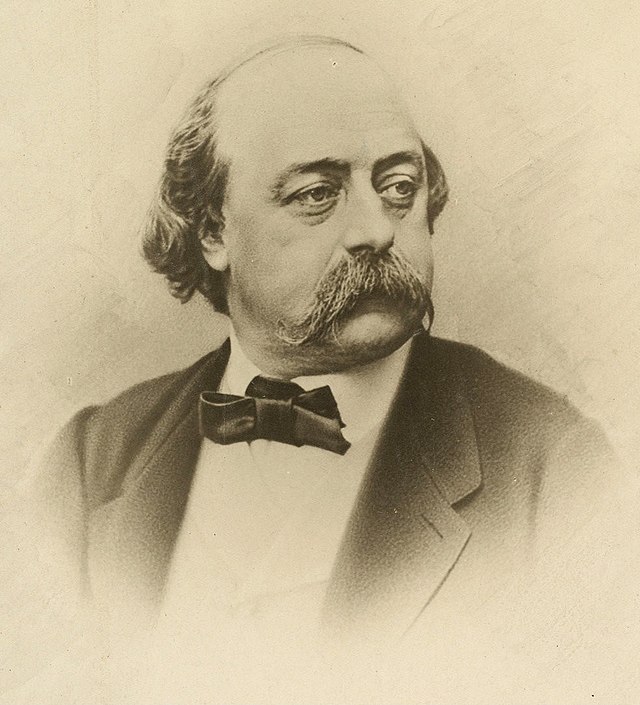
Gustave Flaubert, a towering figure in French literature, was born on December 12, 1821, in Rouen, France. The second of three children, Flaubert’s upbringing was steeped in the intellectual and cultural milieu of his family. His father, a prominent surgeon, and his mother, a wealthy landowner, provided Flaubert with a privileged environment that fostered his early literary interests.
Early Life and Education
From a young age, Flaubert exhibited a natural inclination toward writing. By his teenage years, he was already penning stories, deeply influenced by the Romantic movement that dominated the literary scene of the time. A pivotal moment in his youth occurred in 1836 when he met Elise Foucault on the beaches of Trouville. This encounter ignited a passionate, albeit unfulfilled, love affair that would profoundly influence his later work, most notably “Sentimental Education” (1843-1845).
In 1840, Flaubert moved to Paris to study law, but his lack of enthusiasm for the subject was evident. He was far more captivated by the vibrant literary and artistic circles of the city. However, in 1844, his life took a dramatic turn when he suffered his first epileptic seizure, leading him to abandon his studies and return to his family home in Rouen.
A Life Dedicated to Literature
The mid-1840s were a period of personal and professional upheaval for Flaubert. In 1846, both his father and sister passed away, leaving Flaubert to assume responsibility for his family’s estate in Croisset, a small village along the Seine River. It was here, in the solitude of the countryside, that Flaubert would write his most celebrated works.
Flaubert’s personal life was marked by a tumultuous relationship with the writer Louise Colet, which lasted until 1855. Their intense correspondence offers deep insights into Flaubert’s thoughts on literature, art, and society. This period also saw Flaubert’s disillusionment with the political climate of France, particularly after witnessing the 1848 revolution in Paris. The rise of Napoleon III and the perceived failure of the bourgeoisie further fueled his cynicism toward the society of his time.
Literary Masterpieces and Legacy
Flaubert’s literary career truly took off in the 1850s. Between 1851 and 1856, he wrote “Madame Bovary,” a novel that would redefine European literature. Published in serialized form in the “Revue de Paris,” “Madame Bovary” broke new ground with its unflinching portrayal of bourgeois life and the disillusionment of its protagonist, Emma Bovary. The novel’s realistic style, which meticulously documented the minutiae of daily life, marked a departure from the Romantic ideals of the time.
However, “Madame Bovary” also sparked controversy. Its candid exploration of adultery and the moral decay of its characters led to charges of immorality against Flaubert. In 1857, he was put on trial for obscenity, though he was ultimately acquitted. The trial only served to heighten the novel’s notoriety and cemented Flaubert’s reputation as a fearless critic of contemporary society.
Following the success of “Madame Bovary,” Flaubert embarked on writing “Salammbo” (1862), a historical novel set in ancient Carthage. This work, inspired by his travels in the Middle East and North Africa, showcased his ability to vividly recreate distant times and places. Yet, it was his return to the themes of disillusionment and societal critique in “Sentimental Education” (1869) that reaffirmed his status as one of the leading novelists of his generation.
Later Life and Challenges
The later years of Flaubert’s life were marked by both personal and professional challenges. The Franco-Prussian War (1870-1871) forced him to leave Croisset temporarily, and the subsequent economic hardships took a toll on his already fragile health. The death of his mother in 1872 left Flaubert devastated, and he struggled to maintain his financial stability.
Despite these difficulties, Flaubert continued to write. In 1874, he published “The Temptation of Saint Anthony,” a work that had been in development for over two decades. This deeply philosophical and religious exploration was followed by “Three Tales” (1877), a collection that included “A Simple Heart,” “Saint Julian the Hospitaller,” and “Herodias.” These stories are often lauded for their stylistic precision and emotional depth.
Flaubert’s final years were spent working on “Bouvard and Pécuchet,” a satirical novel that remained unfinished at the time of his death. This work, which was published posthumously in 1881, is considered a seminal piece in the genre of dark humor and reflects Flaubert’s deep-seated cynicism toward human folly and the futility of intellectual pursuits.
On May 8, 1880, Flaubert died in Croisset, likely from complications related to his epilepsy. He left behind a legacy that would influence countless writers and thinkers, including Marcel Proust, James Joyce, and Virginia Woolf.
Flaubert’s Enduring Influence
Gustave Flaubert’s influence on literature cannot be overstated. His commitment to artistic integrity, his meticulous attention to detail, and his belief in the “mot juste” (the exact word) have made him a revered figure among writers and critics alike. Flaubert’s works, particularly “Madame Bovary,” continue to be studied and analyzed for their innovative narrative techniques and their unflinching exploration of the human condition.
In many ways, Flaubert’s life and work embody the tensions of his time: the clash between Romanticism and Realism, the struggle between artistic ambition and societal expectations, and the personal battles with health and financial stability. His ability to transform these struggles into timeless works of art is what makes Gustave Flaubert a towering figure in the annals of literary history.


