
Gustave Moreau, born on April 6, 1826, in Paris, France, is celebrated as one of the most influential French Symbolist painters. Known for his intricate, mythological, and often mystical compositions, Moreau’s work profoundly impacted the art world, particularly influencing later movements such as Surrealism. His life, marked by a deep intellectual curiosity and an unwavering commitment to his artistic vision, has left a lasting legacy in the annals of art history. This article delves into Moreau’s age, fame, and significant life highlights, exploring his journey from a young artist in Paris to becoming a pivotal figure in the Symbolist movement.
Early Life and Educational Background
Gustave Moreau was born into a cultured and intellectually stimulating environment. His father, Louis Moreau, was an architect who provided Gustave with access to a vast library of books on literature, architecture, and art. This early exposure to classical knowledge and artistic principles played a crucial role in shaping Moreau’s future as an artist. His mother, Pauline, also encouraged his artistic inclinations, fostering an environment where creativity was nurtured.
Moreau’s early education at the Collège Rollin in Paris, however, was not marked by academic excellence. He struggled with formal education, which led him to pursue a more private and self-directed form of learning. In 1844, after much preparation, he successfully obtained his baccalaureate. Despite his reserved and somewhat reclusive personality, which kept him distant from social interactions, Moreau found solace and expression in art from a young age. His early artistic training was under the guidance of François-Édouard Picot, who introduced him to the techniques of classical painting and the grandeur of Italian Renaissance art.
Early Artistic Career and Influences
At the age of twenty, Moreau was admitted to the prestigious École des Beaux-Arts in Paris. However, his time there was short-lived, as he did not win the coveted Prix de Rome, a prestigious scholarship for studying art in Italy. Disillusioned with the academic conventions of the time, Moreau left the École in 1849, deciding to carve his own path in the art world. This decision marked the beginning of his lifelong departure from traditional academic art and his journey toward developing a unique, visionary style.
During this period, Moreau was profoundly influenced by the works of Théodore Chassériau, a follower of Eugène Delacroix and Jean-Auguste-Dominique Ingres. Chassériau’s fusion of Romanticism with classical themes resonated with Moreau, who was also deeply inspired by the emotional intensity and exoticism in Delacroix’s work. Moreau’s early paintings, such as “Self-Portrait at the Age of Twenty-Four” (1850) and “Hamlet” (1850), reflect these influences, blending dramatic subject matter with a meticulous attention to detail.
Moreau’s early career was marked by his rejection of conventional academic norms and his fascination with the exotic and the mythical. His paintings from this period, including works like “Two Modern Amazons” and “The Tepidarium,” began to reveal his interest in mythological themes, a subject that would dominate his later works.
The Grand Tour and Artistic Maturity
In 1857, Moreau embarked on a grand tour of Italy, a journey that was pivotal in his artistic development. Traveling through Rome, Florence, and Venice, he immersed himself in the masterpieces of the Italian Renaissance. The works of Vittore Carpaccio in Venice, in particular, left a lasting impression on him. This exposure to Italian art enriched Moreau’s understanding of composition, color, and narrative, elements that would become central to his mature style.
Upon returning to Paris, Moreau’s work began to attract attention. His friendships with artists like Pierre Puvis de Chavannes and Edgar Degas further influenced his artistic outlook. Between the late 1850s and early 1860s, Moreau produced several significant works, including “Study of an Adolescent,” “Portrait of Edgar Degas,” and “Oedipus and the Sphinx” (1864). The latter, exhibited at the Paris Salon in 1864, marked Moreau’s first major success and established him as a prominent figure in the art world.
“Oedipus and the Sphinx” encapsulates Moreau’s mature style, characterized by a blend of classical mythology with a deep psychological and symbolic undercurrent. The painting, depicting the moment when Oedipus confronts the Sphinx, is imbued with a sense of mystery and foreboding, qualities that would become hallmarks of Moreau’s work. The critical acclaim he received for this piece solidified his reputation and encouraged him to delve deeper into the symbolic and mystical themes that fascinated him.
Symbolism and the Height of Fame
As Moreau’s career progressed, he became increasingly associated with the Symbolist movement, which sought to express ideas and emotions through symbolic imagery rather than direct representation. Symbolism, which emerged as a reaction against the realism and naturalism that dominated the art of the time, found a perfect advocate in Moreau, whose works often transcended mere visual representation to explore deeper philosophical and spiritual themes.
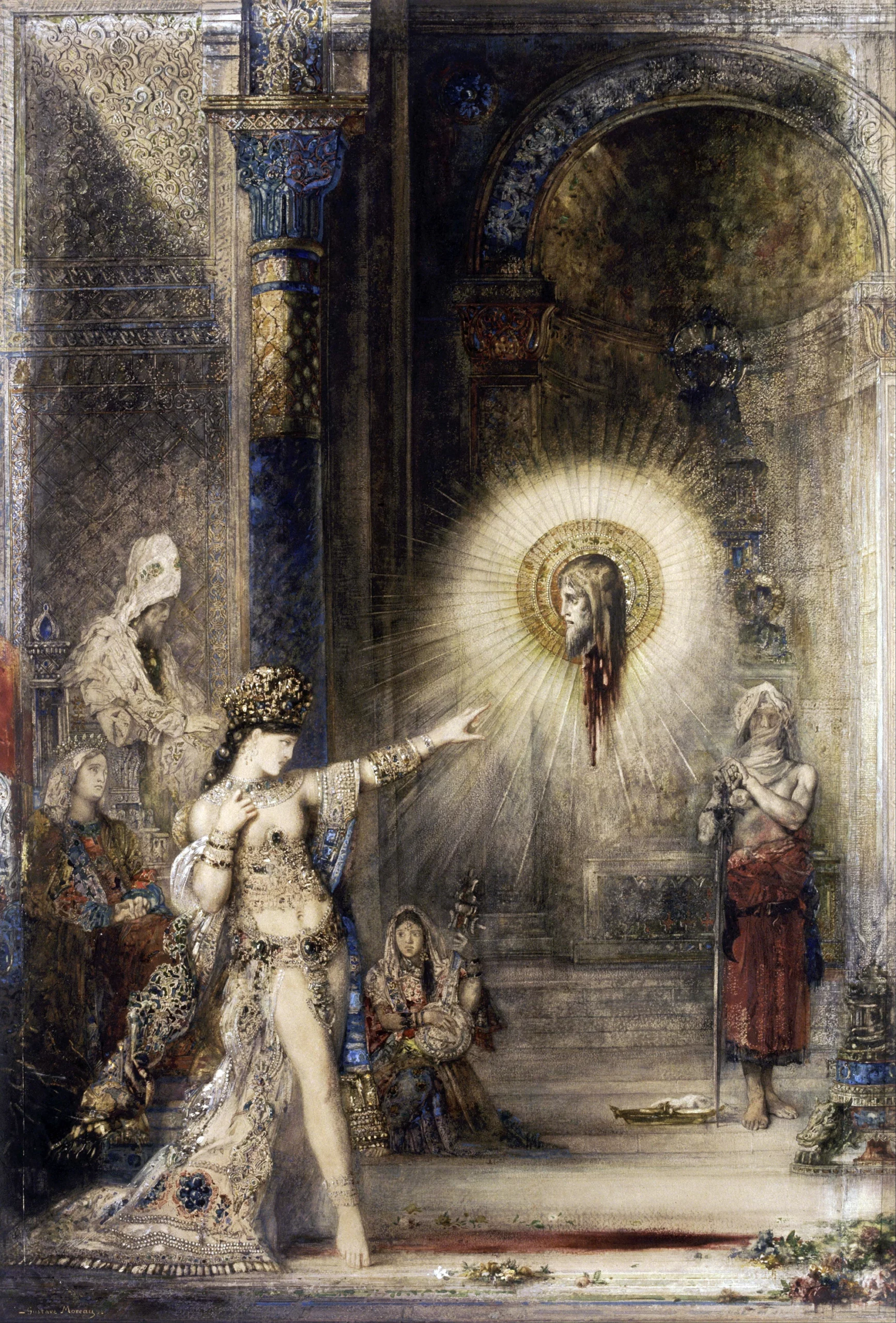
One of the most recurring themes in Moreau’s work during this period was the figure of Salome, the Judean princess who, according to the Bible, danced for King Herod and demanded the head of John the Baptist as a reward. Moreau’s obsession with this character led to the creation of several masterpieces, including “Salome Dancing before Herod” (1876) and “The Apparition” (1876). These works, with their elaborate compositions, rich colors, and intricate details, exemplify Moreau’s ability to weave together history, myth, and personal imagination into a cohesive and compelling narrative.
Moreau’s depiction of Salome, often referred to as the “painter of Salome,” became iconic. His works from this period are notable not only for their technical brilliance but also for their exploration of themes such as sensuality, power, and the divine. The complex interplay of these elements in Moreau’s paintings captivated the art world and solidified his place as a leading figure in Symbolist art.
Later Career and Pedagogical Contributions
In the 1880s, Moreau’s style evolved further, becoming increasingly elaborate and intricate. His compositions during this time, such as the illustrations for Jean de La Fontaine’s fables, demonstrate his growing fascination with the fusion of myth and history. Moreau’s ability to create a mystical and sensual atmosphere in his paintings made him a unique voice in the art world, one that was both admired and emulated by his contemporaries.
In 1891, Moreau’s influence extended beyond his own work when he was appointed as a professor at the École des Beaux-Arts in Paris. Here, he mentored a new generation of artists, many of whom would go on to become prominent figures in the Fauvist movement, including Henri Matisse, Georges Rouault, and Pierre-Albert Marquet. Moreau’s teaching philosophy emphasized the importance of imagination and the inner vision of the artist, principles that resonated deeply with his students.
Moreau’s later works, such as “The Life of Humanity” (1886), “Jupiter and Semele” (1895), and “Orpheus on the Tomb of Eurydice” (1891), reflect a continued exploration of mythological and symbolic themes. These paintings, characterized by their intricate detail and rich symbolism, are considered among his most important contributions to the Symbolist movement.
Legacy and Impact on Modern Art
Gustave Moreau’s death on April 18, 1898, marked the end of an era in French art, but his influence continued to resonate long after his passing. He was buried in the Montmartre Cemetery in Paris, a resting place befitting an artist of his stature. Today, Moreau is regarded as a precursor to both the Symbolist and Surrealist movements, with his work bridging the gap between the Romanticism of the early 19th century and the avant-garde explorations of the 20th century.
Moreau’s legacy is preserved not only through his paintings but also through the Musée Gustave Moreau in Paris, which was established in his former home and studio. The museum, which houses over 1,200 of his paintings, drawings, and watercolors, provides a comprehensive look at his artistic journey and his contributions to the world of art.
Moreau’s influence on modern art cannot be overstated. His emphasis on imagination and the exploration of the subconscious mind paved the way for the Surrealists, who saw in Moreau a kindred spirit. Artists such as Salvador Dalí and Max Ernst cited Moreau as an inspiration, particularly in their use of symbolic imagery and their exploration of dreamlike and fantastical themes.
Moreover, Moreau’s role as a teacher at the École des Beaux-Arts had a profound impact on the development of modern art. His students, many of whom became leading figures in the Fauvist movement, carried forward his ideas about color, form, and imagination, contributing to the evolution of modernist art in the early 20th century.
Conclusion
Gustave Moreau’s life and career were marked by a relentless pursuit of artistic excellence and a deep commitment to exploring the symbolic and mystical dimensions of art. His work, characterized by its intricate detail, rich symbolism, and imaginative power, continues to captivate audiences and inspire artists today.
Moreau’s legacy as a pioneer of Symbolism and a mentor to some of the most important artists of the 20th century ensures that his contributions to the art world will not be forgotten. Through his paintings, Moreau invites us into a world where myth, history, and imagination converge, offering a glimpse into the infinite possibilities of artistic expression.
As we reflect on Moreau’s life, we are reminded of the enduring power of art to transcend the boundaries of time and place, to speak to the deepest aspects of the human experience, and to inspire future generations of artists to explore the uncharted territories of the imagination.


