
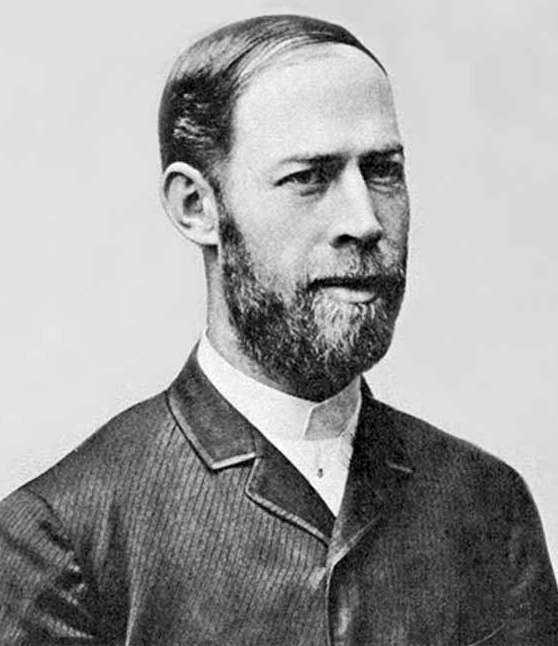
Heinrich Rudolf Hertz (1857-1894) was a pioneering German physicist whose groundbreaking work laid the foundation for modern wireless communication. Best known for proving the existence of electromagnetic waves, Hertz’s contributions to science have had a lasting impact, influencing the development of radio, television, and even modern-day telecommunications. This article delves into his life, achievements, and legacy, providing a comprehensive overview of his contributions to the scientific community.
Early Life and Education
Heinrich Rudolf Hertz was born on February 22, 1857, in Hamburg, Germany, into a family of Jewish origin that had converted to Christianity. His father, Gustav Ferdinand Hertz, was a respected politician and a member of the city council of Hamburg, while his mother, Anna Elisabeth Pfefferkorn, came from a family with a strong medical background. This intellectual environment likely played a role in nurturing Hertz’s early interest in science and learning.
From a young age, Hertz exhibited a keen intellect and a curiosity that extended beyond the natural sciences. He was not only adept in mathematics and physics but also had a passion for languages, mastering Arabic and Sanskrit during his university years. This diverse educational background would later contribute to his methodical approach to scientific experimentation and theoretical development.
Hertz pursued his higher education at several prestigious institutions across Germany, including Dresden, Munich, and Berlin. It was in Berlin where he truly began to shine, studying under two of the most renowned physicists of the time, Gustav Robert Kirchhoff and Hermann von Helmholtz. These mentors recognized Hertz’s potential and provided him with the guidance and support that would be instrumental in his future discoveries.
In 1880, Hertz completed his Ph.D. under Helmholtz’s supervision, focusing on the field of electrodynamics. Following his graduation, Hertz remained closely associated with Helmholtz, serving as his assistant for several years. This period was critical for Hertz, as it allowed him to develop his research skills and delve deeper into the study of electromagnetism.
The Discovery of Electromagnetic Waves
Heinrich Hertz’s most famous achievement came during his tenure as a professor at the University of Karlsruhe, where he began experimenting with the theories proposed by James Clerk Maxwell. Maxwell had predicted the existence of electromagnetic waves, but it was Hertz who, in 1887, provided the first empirical proof of their existence.
Hertz’s experiments involved the use of a device he developed called the “Hertzian dipole,” which could generate and detect electromagnetic waves. By creating sparks between two metal spheres, Hertz was able to produce radio waves, which he then detected using a simple loop antenna placed several meters away. These experiments conclusively demonstrated that electromagnetic waves could travel through the air, confirming Maxwell’s theoretical predictions.
This discovery was monumental in the world of physics, as it provided the first tangible evidence of the wave-like nature of light and other forms of electromagnetic radiation. Hertz’s work paved the way for the development of wireless communication technologies, such as radio and television, and eventually led to the modern telecommunications industry.
In recognition of his groundbreaking work, the unit of frequency in the International System of Units (SI) was named the “hertz” (Hz) in his honor. This unit, which measures the number of cycles per second, is now universally used to quantify the frequency of electromagnetic waves, including radio waves, sound waves, and even the oscillations of atomic particles.
Impact on the Scientific Community
Hertz’s discovery of electromagnetic waves had far-reaching implications, not only in the field of physics but also in the broader scientific community. His experiments provided a foundation for future research in electromagnetism, leading to the development of new technologies and a deeper understanding of the physical world.
One of the most significant impacts of Hertz’s work was the eventual invention of the radio. Inspired by Hertz’s experiments, Italian inventor Guglielmo Marconi developed the first practical wireless telegraphy system in the late 1890s. This invention revolutionized communication, allowing messages to be transmitted over long distances without the need for physical wires.
Hertz’s work also had a profound influence on the study of light and optics. His experiments with ultraviolet light led to the discovery of the photoelectric effect, a phenomenon in which light causes the emission of electrons from a material. Although Hertz did not fully understand the implications of this effect, it later became a cornerstone of quantum theory, with Albert Einstein providing a theoretical explanation that earned him the Nobel Prize in Physics in 1921.
Moreover, Hertz’s experiments challenged the prevailing scientific theories of his time, particularly the concept of the “ether.” For centuries, scientists believed that light and other electromagnetic waves required a medium, known as the ether, to propagate through space. Hertz’s experiments, along with the work of other physicists like Michelson and Morley, provided evidence that the ether did not exist, leading to a paradigm shift in the understanding of electromagnetic phenomena.
The Personal Side of Heinrich Hertz
Despite his immense contributions to science, Heinrich Hertz’s life was tragically short. He died at the young age of 36 on January 1, 1894, in Bonn, Germany, from granulomatosis with polyangiitis, a rare and serious autoimmune disease that affects blood vessels. His untimely death cut short a brilliant career, leaving many to wonder what further discoveries he might have made had he lived longer.
Hertz’s personal life was marked by his dedication to his work and his strong connections with his family. He married Elisabeth Doll, the daughter of a professor, in 1886, and the couple had two daughters, Johanna and Mathilde. Despite the demands of his scientific career, Hertz was known to be a devoted husband and father, and his family life provided him with much-needed respite from his rigorous academic pursuits.
Hertz’s legacy continued through his descendants, who also made significant contributions to science. His nephew, Gustav Ludwig Hertz, was awarded the Nobel Prize in Physics in 1925 for his work on inelastic electron collisions in gases. Gustav’s son, Carl Hellmuth Hertz, became one of the pioneers of medical ultrasonography, further cementing the Hertz family’s place in the annals of scientific history.
The Legacy of Heinrich Hertz
Heinrich Hertz’s legacy extends far beyond his lifetime, influencing not only the field of physics but also the development of modern technology. His discovery of electromagnetic waves is considered one of the cornerstones of modern physics, and it laid the groundwork for many of the technologies we take for granted today.
In addition to his scientific achievements, Hertz’s legacy is also reflected in the honors and recognitions he received posthumously. In 1930, the Heinrich-Hertz-Institut for Oscillation Research was established in Berlin to honor his contributions to science. This institute has since become a leading center for research in telecommunications and information technology.
Hertz’s name also lives on in the many places and institutions that have been named after him. In addition to the unit of frequency, “hertz,” his name has been given to craters on the Moon and Mars, as well as streets, schools, and universities around the world.
Historical Context and Broader Implications
To fully appreciate Heinrich Hertz’s contributions to science, it’s essential to understand the historical context in which he lived and worked. The late 19th century was a period of rapid scientific advancement, with new discoveries and theories challenging the established order. Hertz’s work came at a time when the scientific community was grappling with the implications of Maxwell’s equations, which had unified the study of electricity and magnetism into a single theory of electromagnetism.
Hertz’s experiments provided the missing link between theory and observation, proving that Maxwell’s equations accurately described the behavior of electromagnetic waves. This breakthrough not only validated Maxwell’s work but also opened up new avenues of research in physics, leading to the development of quantum theory and the theory of relativity in the early 20th century.
Moreover, Hertz’s discovery had a profound impact on the way people communicated. The development of radio, television, and later, mobile phones and the internet, can all be traced back to Hertz’s pioneering work on electromagnetic waves. These technologies have transformed every aspect of modern life, from how we communicate and entertain ourselves to how we conduct business and access information.
Conclusion
Heinrich Rudolf Hertz was a brilliant physicist whose discoveries have had a lasting impact on both science and society. His work on electromagnetic waves not only provided the foundation for the development of wireless communication but also revolutionized our understanding of the physical world. Despite his short life, Hertz’s contributions to science continue to resonate today, influencing everything from modern telecommunications to our understanding of the fundamental nature of light and energy.
Hertz’s legacy is a testament to the power of curiosity, perseverance, and the relentless pursuit of knowledge. His work serves as an inspiration to scientists and engineers around the world, reminding us of the profound impact that one person’s discoveries can have on the world. As we continue to explore the mysteries of the universe, we do so standing on the shoulders of giants like Heinrich Rudolf Hertz.
His name, etched into the very fabric of modern science, serves as a constant reminder of the importance of scientific inquiry and the enduring impact of those who dare to question the unknown.


