
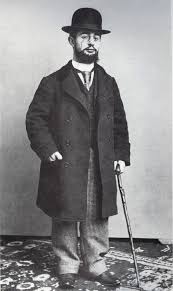
Henri de Toulouse-Lautrec, born on November 24, 1864, in Albi, France, is one of the most renowned and influential artists of the late 19th century. Known for his distinctive style and unique perspective on the world, Toulouse-Lautrec’s work captured the vibrant and often decadent atmosphere of Parisian nightlife during the Belle Époque. His life, marked by physical challenges and personal struggles, is as fascinating as his art, which continues to captivate audiences worldwide.
Early Life and Family Background
Henri Marie Raymond de Toulouse-Lautrec was born into an aristocratic family with a long lineage. His father, Count Alphonse de Toulouse-Lautrec, and his mother, Adèle de Toulouse-Lautrec, were first cousins, a common practice among European nobility at the time to preserve wealth and status within families. However, this consanguinity likely contributed to the genetic disorders that would profoundly impact Henri’s life.
From a young age, Toulouse-Lautrec faced numerous health challenges. He suffered from a congenital condition known as pycnodysostosis, a rare genetic disorder that affects bone growth and density. This condition, coupled with several childhood accidents, left him with severely stunted growth. By adulthood, his legs had stopped growing, leaving him with an adult torso but child-sized legs. He reached a height of only 1.52 meters (about 5 feet) and walked with a limp, which further isolated him from his peers and society at large.
Despite these challenges, Toulouse-Lautrec was a bright and lively child. His parents divorced when he was four years old, and he was raised primarily by his mother, who supported his early interest in art. He moved to Paris with his mother at a young age, where he attended the Lycée Fontanes (now Lycée Condorcet). However, his health issues eventually forced him to leave formal education.
The Path to Art: Training and Influences
Toulouse-Lautrec’s physical limitations led him to seek solace in art from an early age. His mother encouraged his artistic pursuits, and he began taking drawing lessons from René Princeteau, a family friend and accomplished painter. Princeteau was instrumental in introducing young Henri to the world of art, particularly the depiction of horses, which was a subject of great interest to both the mentor and the student.
In 1881, Toulouse-Lautrec decided to pursue art full-time. He moved to Montmartre, a bohemian district in Paris known for its vibrant artistic community. There, he studied under renowned artists Léon Bonnat and later Fernand Cormon. Montmartre was the epicenter of avant-garde culture in Paris, and it was here that Toulouse-Lautrec began to develop his unique style, influenced by the works of Edgar Degas, Édouard Manet, and the emerging Post-Impressionist movement.
At Cormon’s studio, Toulouse-Lautrec met and befriended several other young artists, including Vincent van Gogh, Louis Anquetin, and Émile Bernard. This group of artists would go on to challenge traditional artistic norms and push the boundaries of modern art. Toulouse-Lautrec’s early works often depicted the life of the upper class, focusing on activities such as horse riding and hunting. However, as he became more immersed in the Montmartre scene, his subject matter shifted to reflect the nightlife, cabarets, and brothels that defined the area.
The Art of Montmartre: Capturing the Belle Époque
The 1880s and 1890s were a time of great social and cultural change in Paris, known as the Belle Époque. Montmartre, with its cabarets, dance halls, and theaters, was the heart of this vibrant nightlife. Toulouse-Lautrec became a regular at many of these establishments, including the famous Moulin Rouge, which opened in 1889. His experiences in Montmartre became the primary focus of his art, and he is best known for his depictions of the performers, dancers, and patrons of these venues.
Toulouse-Lautrec’s art is characterized by its bold use of color, dynamic compositions, and keen observation of human behavior. He was a master of capturing the essence of his subjects with just a few strokes, often using exaggerated lines and forms to convey movement and emotion. His works, which include paintings, drawings, and posters, provide a vivid snapshot of Parisian society during this period.
One of his most famous works is the 1891 poster Moulin Rouge: La Goulue, which was commissioned by the cabaret’s owner, Charles Zidler. This poster, featuring the dancer La Goulue (real name Louise Weber), is a quintessential example of Toulouse-Lautrec’s style. The bold colors, fluid lines, and innovative composition set it apart from traditional academic art and made it an instant success. The poster not only brought Toulouse-Lautrec widespread recognition but also helped to establish the art of the poster as a legitimate form of artistic expression.
Toulouse-Lautrec’s posters and lithographs became highly sought after, and he produced numerous works for various cabarets, theaters, and performers. His art captured the energy and excitement of the Belle Époque while also providing a commentary on the hedonism and excesses of the time. Despite his growing fame, Toulouse-Lautrec remained an outsider, both because of his physical appearance and his unconventional lifestyle.
Personal Struggles and Artistic Triumphs
While Toulouse-Lautrec’s art flourished, his personal life was marked by loneliness and physical pain. His short stature and disabilities made him a target of ridicule, and he often felt alienated from society. To cope with his physical and emotional pain, Toulouse-Lautrec turned to alcohol, becoming a heavy drinker at a young age. Absinthe, a potent alcoholic drink popular among artists and writers of the time, became his preferred escape.
Toulouse-Lautrec’s health deteriorated rapidly in the late 1890s. His alcoholism, combined with the effects of his genetic condition, led to frequent bouts of depression and illness. Despite his declining health, he continued to produce a significant body of work during this period, including portraits, landscapes, and illustrations for magazines.
In 1899, Toulouse-Lautrec suffered a mental breakdown and was confined to a sanatorium. While there, he continued to draw, producing a series of works based on the circus, which he had always been fascinated by. After his release, he returned to Paris but never fully recovered. His health continued to decline, and on September 9, 1901, at the age of 36, Henri de Toulouse-Lautrec died from complications related to alcoholism and syphilis.
Legacy and Influence
Henri de Toulouse-Lautrec’s impact on the art world is profound. His work bridged the gap between traditional academic art and the emerging modernist movements of the 20th century. He was a pioneer in the use of lithography as a fine art form, and his posters are considered masterpieces of graphic design. Toulouse-Lautrec’s ability to capture the human condition with empathy, humor, and honesty has made his work timeless.
Toulouse-Lautrec’s art continues to be celebrated around the world. His works are housed in major museums, including the Musée d’Orsay in Paris, the Museum of Modern Art in New York, and the National Gallery in London. The Toulouse-Lautrec Museum in Albi, his birthplace, is dedicated to his life and work and holds the largest collection of his art.
In addition to his influence on visual art, Toulouse-Lautrec’s work has inspired countless writers, filmmakers, and musicians. His life and art have been the subject of numerous books, documentaries, and films, most notably the 1952 film Moulin Rouge, directed by John Huston, which won two Academy Awards.
Conclusion: The Enduring Legacy of Henri de Toulouse-Lautrec
Henri de Toulouse-Lautrec was an artist who defied convention and overcame immense personal challenges to leave an indelible mark on the art world. His work provides a unique window into the vibrant and often tumultuous world of Belle Époque Paris, capturing the joys and sorrows of a society in flux. Despite his physical limitations and personal struggles, Toulouse-Lautrec’s artistic vision was boundless, and his influence continues to resonate more than a century after his death.
Toulouse-Lautrec’s legacy is not just in his art but also in his spirit of innovation and his ability to see beauty in the unconventional. His life story is a testament to the power of creativity and the enduring impact of art that speaks to the human experience. As we continue to admire and study his work, Henri de Toulouse-Lautrec remains a symbol of artistic genius and the triumph of the human spirit.


