
Hieronymus Bosch, born Jeroen Anthoniszoon van Aken on October 2, 1453, in ‘s-Hertogenbosch, Netherlands, is a renowned painter known for his distinctive and imaginative works that delve into themes of morality, sin, and human folly. Bosch’s enigmatic paintings, filled with fantastical imagery and intricate details, have captivated audiences for centuries. This article explores his life, career, and significant achievements, providing detailed insights and historical context to understand his enduring influence.
Early Life and Education
Birth and Family Background
Hieronymus Bosch was born in the town of ‘s-Hertogenbosch, in the southern part of the Netherlands, which was then part of the Duchy of Burgundy. His family, the van Aken clan, had a strong artistic tradition. Bosch’s grandfather Jan van Aken and his father Antonius van Aken were both painters. This familial background likely provided Bosch with his initial exposure to and training in the arts.
Early Artistic Influences
Bosch grew up during a time when ‘s-Hertogenbosch was a thriving commercial and artistic center. The city had a rich cultural scene, and Bosch would have been influenced by local and regional artistic traditions. He is believed to have learned the basics of painting and drawing from his family, working in the family workshop where they created various artworks, including frescoes and gilded wooden statues.
Artistic Career and Style Development
Marriage and Economic Stability
In 1479, Bosch married Aleid van de Meervenne, the daughter of a wealthy patrician. This marriage brought Bosch financial stability, allowing him to focus more on his artistic pursuits. With the economic security provided by his wife’s dowry, Bosch was able to experiment with his unique artistic style and themes.
Joining the Brotherhood of Our Lady
In 1486, Bosch became a member of the Illustrious Brotherhood of Our Blessed Lady, a prominent religious confraternity in ‘s-Hertogenbosch. This association included both clergy and lay members dedicated to the veneration of the Virgin Mary and engaged in various charitable activities. Bosch’s membership in this confraternity not only elevated his social standing but also influenced his artistic output, as many of his works contain religious themes and iconography.
Major Works and Artistic Evolution
Early Works
Bosch’s early works, dating from the 1470s, include pieces like “The Extraction of the Stone of Madness” (1488-1516), which critiques the folly of mankind and features a satirical depiction of a surgeon removing a stone from a patient’s head, symbolizing ignorance. Another significant early work is the “Epiphany” (circa 1475-1480), which showcases the influence of late Gothic art through its intricate lines and detailed figures.
The Garden of Earthly Delights
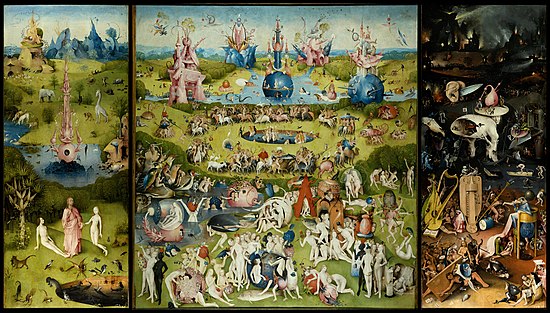
One of Bosch’s most famous works is “The Garden of Earthly Delights” (circa 1490-1510), a triptych that explores themes of paradise, sin, and damnation. The central panel depicts a fantastical garden filled with surreal scenes and bizarre creatures, symbolizing the fleeting nature of earthly pleasures. The left panel represents the Garden of Eden, while the right panel portrays a vivid and horrifying vision of Hell. This work exemplifies Bosch’s imaginative style and his ability to combine religious themes with intricate, allegorical imagery.
The Haywain Triptych
Another notable work is “The Haywain Triptych” (circa 1516), which illustrates the journey of humanity through life, influenced by greed and folly, towards inevitable damnation. The central panel shows a giant hay wagon being pulled through a chaotic landscape, symbolizing materialism and the transient nature of earthly possessions. The left panel depicts the fall of humanity, and the right panel, like in “The Garden of Earthly Delights,” shows the torments of Hell.
Later Career and Artistic Influence
Influence of the Italian Renaissance
In the late 15th and early 16th centuries, Bosch’s style began to incorporate elements of the Italian Renaissance, evident in his use of more open landscapes and monumental figures. Works from this period, such as the “Triptych of St. John the Baptist” (circa 1504) and “St. John on Patmos” (circa 1504-1505), show a blend of Gothic traditions with Renaissance influences.
Final Years and Last Works
In the final years of his life, Bosch created several significant works that continued to explore his recurring themes of morality, sin, and redemption. Notable pieces from this period include “The Last Judgment” (circa 1504-1508), a triptych depicting the final judgment of souls, and “The Temptation of St. Anthony” (circa 1505-1506), which illustrates the saint’s trials and tribulations with vivid and grotesque imagery.
Death and Legacy
Passing and Immediate Impact
Hieronymus Bosch died on August 9, 1516, in his hometown of ‘s-Hertogenbosch. His funeral was held with great ceremony in the Chapel of Our Lady, reflecting his significant status within the local community and the Brotherhood of Our Lady. At the time of his death, Bosch was already a well-respected artist, and his works were sought after by collectors and patrons.
Posthumous Recognition and Influence
Bosch’s reputation continued to grow after his death, influencing a wide range of artists and movements. His fantastical and often macabre imagery prefigured the Surrealist movement of the 20th century. Artists such as Salvador Dalí and Max Ernst drew inspiration from Bosch’s dreamlike and allegorical style. Additionally, his works had a significant impact on Northern Renaissance art, inspiring contemporaries and later artists who admired his innovative approach to religious and moral themes.
Challenges in Cataloging His Work
One of the challenges in studying Bosch’s oeuvre is the lack of concrete documentation. None of his works are dated, and few records exist that link specific commissions to the paintings. This has made it difficult for art historians to create a definitive chronological catalog of his work. Moreover, Bosch’s unique style evolved in a non-linear fashion, further complicating efforts to trace the development of his artistic career.
Conclusion
Hieronymus Bosch remains one of the most enigmatic and influential artists of the Northern Renaissance. His imaginative and often unsettling works continue to fascinate and provoke thought, centuries after their creation. Bosch’s ability to blend religious themes with fantastical and allegorical imagery set him apart from his contemporaries and left a lasting legacy in the world of art.
Bosch’s life and career are a testament to his extraordinary vision and creativity. From his early days in ‘s-Hertogenbosch to his enduring influence on modern art, Bosch’s work challenges viewers to contemplate the complexities of human nature and the moral consequences of their actions. As we reflect on his contributions, we celebrate Hieronymus Bosch as a true master of his craft and an enduring figure in the history of art.


