
Introduction
Hugo Pratt, born on June 15, 1927, in Rimini, Italy, is widely recognized as one of the most influential comic book artists and writers of the 20th century. His creations, particularly the iconic Corto Maltese, have left an indelible mark on the world of graphic novels and continue to inspire generations of artists and storytellers. Pratt’s life was as adventurous as the characters he created, reflecting a deep engagement with diverse cultures, historical events, and literary traditions. This article delves into his age, the rise to fame, and the significant milestones that defined his illustrious career, offering detailed insights and contextual nuances along the way.
Early Life and Family Background
Hugo Eugenio Pratt was born into a family that was as eclectic and cosmopolitan as his later works. His father, Rolando Pratt, was a career military officer of Romagnolo descent with English roots, while his mother, Evelina Genero, was the daughter of the Venetian poet Eugenio Genero. This mixed heritage and the intellectual atmosphere of his upbringing played a crucial role in shaping Pratt’s worldview and artistic sensibilities.
Pratt’s early years were marked by the upheavals of World War II. In 1942, when he was just 15, his father was captured in East Africa by British forces and subsequently died in a French concentration camp. This traumatic event had a profound impact on Pratt, both personally and creatively, as themes of loss, exile, and survival would later permeate his work.
Military Experience and Early Career
Following his father’s death, Pratt returned to Italy with the help of the Red Cross. He briefly attended a military academy in Città di Castello, but the course of his life changed dramatically with the armistice of Cassibile in 1943. Pratt joined the Italian Social Republic and served in the Battaglione Lupo of the X Flottiglia MAS, a special forces unit of the Italian navy. His time in the military was marked by danger and near-death experiences, including a narrow escape from execution by the SS, who mistakenly believed him to be a South African spy.
In 1945, as the war drew to a close, Pratt shifted allegiances and joined the Anglo-American forces, where he worked as an interpreter. This role not only provided him with valuable language skills but also exposed him to a broader range of cultural influences, which would later be reflected in his storytelling.
The Move to South America
After the war, Pratt returned to Venice, where he began his career as a comic book artist. In 1947, he co-founded the magazine Albo Uragano, which was later renamed Asso di Picche – Comics. The publication featured a masked hero, Asso di Picche, who quickly gained popularity, especially in Argentina. The success of this character led to an invitation from Editorial Abril in Buenos Aires, prompting Pratt and his colleagues to move to South America.
Pratt’s time in Argentina was a period of creative growth and exploration. He worked with Editorial Frontera, where he collaborated with the legendary Argentine writer Héctor Oesterheld on series such as Sgt. Kirk and Junglemen. These stories were notable for their complex characters and richly detailed settings, traits that would become hallmarks of Pratt’s later work.
While in Argentina, Pratt also began teaching at the Escuela Panamericana de Arte, where he formed lasting relationships with other notable artists, including Alberto Breccia. His time in South America also allowed him to travel extensively, visiting the Amazon and Mato Grosso regions, experiences that deeply influenced his artistic output.
The Creation of Corto Maltese
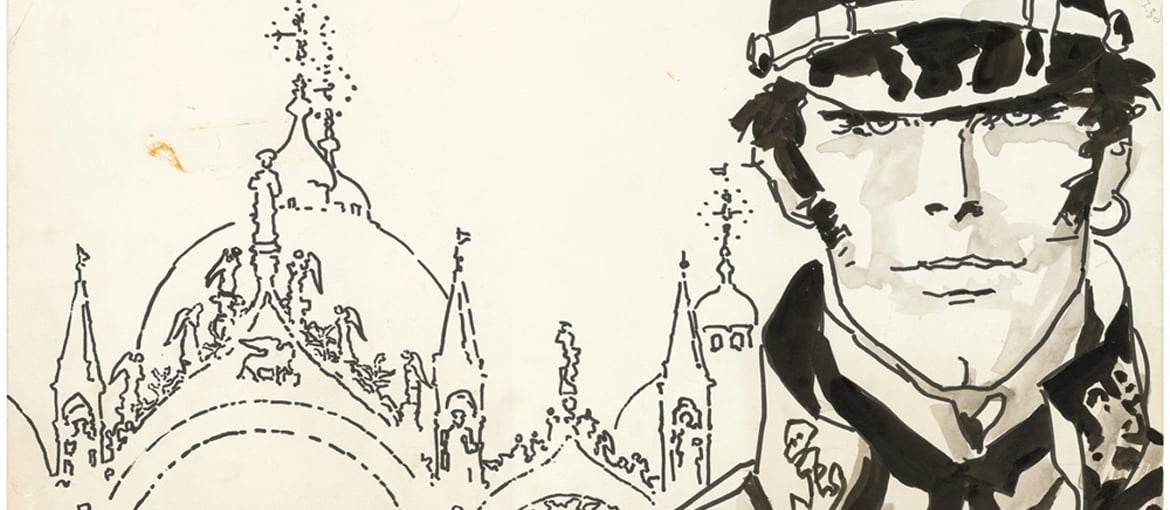
By the early 1960s, Pratt had returned to Europe, settling in Italy after stints in London and the United States. It was during this period that he began to develop what would become his most famous creation: Corto Maltese. The character first appeared in 1967 in the story Una ballata del mare salato (A Ballad of the Salt Sea), published in the magazine Sgt. Kirk. Corto Maltese was a quintessential adventurer, a sailor with a mysterious past who traveled the world, getting involved in various historical events and encounters.
Corto Maltese quickly became an international success, beloved for its blend of historical fiction, adventure, and literary allusion. Pratt’s intricate storytelling, combined with his distinctive, expressive art style, set a new standard for comic books and graphic novels. The series drew on a wide range of influences, from the swashbuckling tales of Alexandre Dumas to the seafaring adventures of Herman Melville and Joseph Conrad. The character of Corto Maltese was a reflection of Pratt himself: cosmopolitan, introspective, and driven by a deep curiosity about the world.
Later Works and International Recognition
Throughout the 1970s and 1980s, Hugo Pratt continued to produce Corto Maltese stories, each one adding depth and complexity to the character’s universe. In addition to Corto Maltese, Pratt worked on several other notable projects, including adaptations of classic literature for Il Corriere dei Ragazzi, such as L’Isola del Tesoro (Treasure Island) by Robert Louis Stevenson and Le Tigri di Mompracem (The Tigers of Mompracem) by Emilio Salgari.
Pratt’s work during this period was characterized by a gradual stylistic evolution. His art became more minimalist, focusing on the essential elements of composition and storytelling. This shift is particularly evident in the 1974 graphic novel Conte Sconta detta Arcana, where Pratt’s line work and narrative style became even more refined.
In 1976, Pratt’s growing interest in esoteric subjects led him to become a Freemason, joining the Grand Lodge of Italy and eventually reaching the rank of Master Mason. This aspect of his life, while private, influenced some of the themes in his later work, including the exploration of mysticism, secret societies, and hidden knowledge.
The Final Years and Legacy
In the early 1980s, Pratt began collaborating with other prominent artists, including Milo Manara, with whom he worked on the graphic novel Tutto ricominciò con un’estate indiana (Everything Began Again with an Indian Summer). This collaboration highlighted Pratt’s ability to seamlessly blend his narrative style with the visual language of another artist, creating a work that was both visually stunning and thematically rich.
By the mid-1980s, Pratt had moved to Switzerland, where he continued to work on his art while living near Lake Geneva. In 1987, he made the significant decision to transfer the rights to his entire body of work, both past and future, to the company CONG SA. This move ensured that his creations would be preserved and managed according to his wishes.
Hugo Pratt’s life came to an end on August 20, 1995, when he passed away in Lausanne, Switzerland, from colorectal cancer. His death marked the loss of one of the greatest storytellers of the 20th century, but his legacy continues to live on through his work.
Impact and Influence
Hugo Pratt’s influence on the world of comics and graphic novels is immeasurable. His creation of Corto Maltese not only set a new standard for the medium but also expanded the possibilities of what comic storytelling could achieve. Pratt’s work was characterized by a deep engagement with history, literature, and the human condition, making his stories resonate with readers on multiple levels.
Pratt’s storytelling was global in scope, reflecting his own experiences and interests in different cultures and historical periods. His ability to weave complex narratives that were both entertaining and thought-provoking set him apart from many of his contemporaries. Today, Pratt’s work is studied and celebrated not only for its artistic merits but also for its contributions to the broader cultural landscape.
Conclusion
Hugo Pratt was a visionary artist whose work transcended the boundaries of traditional comic books. From his early days in war-torn Italy to his adventures in South America and his later years in Switzerland, Pratt lived a life that was as colorful and adventurous as the characters he created. His legacy, particularly through Corto Maltese, continues to inspire and influence artists, writers, and readers around the world.
For anyone interested in the evolution of graphic novels and the power of storytelling through art, Hugo Pratt’s life and work offer a masterclass in creativity, innovation, and the enduring appeal of well-crafted narratives.


