
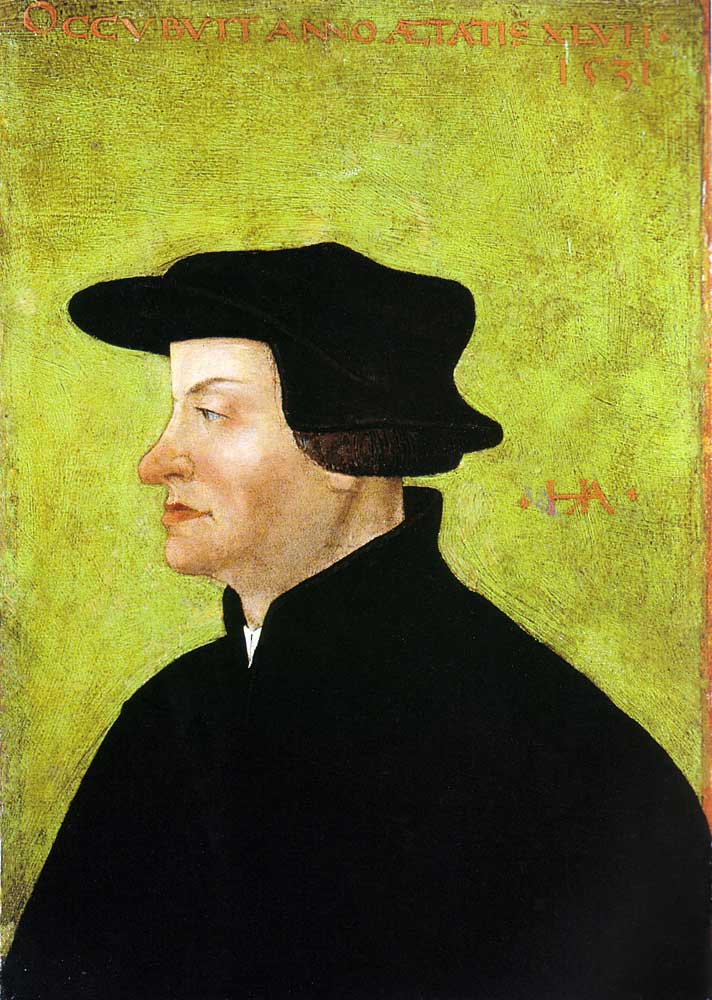
Huldrych Zwingli, often Italianized as Ulrico, was a key figure in the Protestant Reformation, particularly in Switzerland. Born on January 1, 1484, in Wildhaus, Switzerland, Zwingli’s influence reached far beyond his native land, impacting religious thought and practice across Europe. His life was marked by a relentless pursuit of religious reform, grounded in humanist ideals and a deep engagement with the scriptures.
Early Life and Education
Zwingli was born into a family of farmers and artisans, but his path was destined for intellectual and spiritual pursuits. He studied at the universities of Vienna and Basel, where he immersed himself in the classical works of antiquity as well as the scriptures. This education laid the foundation for his later work as a reformer.
At the University of Vienna, Zwingli was exposed to Renaissance humanism, which emphasized a return to the original texts and a critical approach to received traditions. This was a period of intellectual ferment, with scholars like Erasmus of Rotterdam, whom Zwingli admired, advocating for a Christianity that was more aligned with the teachings of Christ and less burdened by the institutionalized church’s dogmas.
Early Career and Shift Toward Reformation
Zwingli was ordained as a priest in 1506, beginning his career in Glarus, where he served as a pastor. It was here that Zwingli began to develop his own theological ideas, studying the New Testament in its original Greek and delving into the writings of the early Church Fathers. This scholarly work gradually led him to question the practices and teachings of the Catholic Church, particularly the emphasis on sacraments, the veneration of saints, and the celibacy of the clergy.
His time in Glarus also saw him serving as a military chaplain, which gave him a firsthand understanding of the political and social issues of his time. Zwingli was a fervent patriot and saw the mercenary service of Swiss soldiers as a corrupting influence, which he denounced in his preaching. This blend of religious and political concerns would characterize much of his later work.
Zwingli’s Reform in Zurich
In 1518, Zwingli was appointed as the pastor of the Grossmünster in Zurich, a position that would become the platform for his reformation efforts. It was here that Zwingli began to preach against the Catholic Church’s practices, particularly the sale of indulgences, which had already sparked Martin Luther’s reforms in Germany. Zwingli’s approach, however, was distinct. While Luther emphasized salvation by faith alone, Zwingli focused on the authority of the scriptures as the sole guide for Christian life.
One of Zwingli’s first major acts of reform was to end the practice of fasting during Lent, arguing that it was not biblically mandated. This action sparked significant controversy and marked the beginning of a broader movement to reform the church in Zurich. Zwingli, supported by the city council, began to systematically dismantle the Catholic practices that he saw as contrary to scripture.
He removed images and relics from churches, arguing that they were a form of idolatry. He also abolished the mass, replacing it with a simpler service that focused on preaching and the reading of scriptures. Zwingli’s reforms extended beyond the church to the social and political life of Zurich. He advocated for the closure of monasteries, redirecting their wealth to social services like education and care for the poor.
Theological Conflicts and the Marburg Colloquy
Zwingli’s reformation efforts were not without opposition. His teachings attracted both supporters and detractors, leading to a series of public debates, most notably the Marburg Colloquy in 1529. This meeting was an attempt to unite the various Protestant reformers, particularly Zwingli and Martin Luther, whose movements were the most prominent at the time.
However, the colloquy ended in failure due to a fundamental disagreement over the Eucharist. Luther believed in the real presence of Christ in the communion elements, while Zwingli argued that the bread and wine were merely symbolic. This disagreement highlighted the divergent paths of the Reformation in different parts of Europe and prevented a unified Protestant front against the Catholic Church.
Final Years and Legacy
The growing tension between the Protestant and Catholic cantons in Switzerland eventually led to armed conflict. In 1531, the Catholic cantons, frustrated by the economic blockade imposed by Zurich and its Protestant allies, launched an attack. Zwingli, who saw the defense of the reformed faith as a divine duty, joined the Zurich forces as a chaplain. He was wounded in the battle of Kappel and was subsequently captured and executed on October 11, 1531.
Zwingli’s death marked a turning point in the Reformation. While his movement did not spread as widely as Lutheranism or Calvinism, his ideas had a profound influence on later Protestant thought, particularly in Switzerland and among groups like the Anabaptists, Baptists, and Quakers.
Zwingli’s Theological Contributions
Zwingli’s theological writings, particularly his work “De vera et falsa religione commentarius” (1525), are considered foundational for the Reformed tradition. In this work, Zwingli laid out his vision for a church based solely on the authority of the Bible, rejecting the authority of the Pope and the traditions of the Catholic Church. He emphasized the sovereignty of God in all aspects of life and the need for a personal faith that was lived out in everyday actions, rather than through rituals and ceremonies.
Zwingli also contributed to the development of a distinct Reformed liturgy, which focused on the preaching of the word and the communal reading of scripture. His emphasis on simplicity and the rejection of what he saw as superstitious practices influenced the development of Reformed worship practices, which continue to be seen in many Protestant churches today.
Zwingli’s Influence on Modern Protestantism
While Zwingli’s name may not be as widely recognized as Luther or Calvin, his impact on modern Protestantism is significant. The Reformed tradition, which includes denominations such as the Presbyterian and Congregational churches, owes much to Zwingli’s ideas. His emphasis on the authority of scripture, the simplicity of worship, and the moral responsibility of the individual have become hallmarks of Reformed theology.
Moreover, Zwingli’s political engagement and his belief in the importance of a moral and just society have influenced the way many Protestant communities understand their role in the world. His ideas about the relationship between church and state, though not as fully developed as those of later thinkers like Calvin, laid the groundwork for discussions that continue to this day.
Conclusion: Zwingli’s Enduring Legacy
Huldrych Zwingli’s life was cut short, but his contributions to the Protestant Reformation were far-reaching. As a leader in Zurich, he not only reformed the church but also helped to shape the social and political landscape of his time. His commitment to the authority of scripture and his willingness to challenge the established church inspired others to continue the work of reform in Switzerland and beyond.
Today, Zwingli is remembered as a pioneer of the Reformed tradition, a man whose ideas about faith, scripture, and society continue to resonate in many Protestant communities around the world. His life serves as a reminder of the power of ideas to bring about profound change, even in the face of great opposition.


