
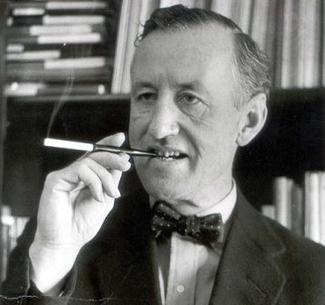
Ian Fleming is a name synonymous with espionage, adventure, and the world of secret agents. Best known as the creator of James Bond, the iconic British spy whose exploits have captivated audiences for decades, Fleming’s life was as colorful and intriguing as the characters he penned. Born into an aristocratic English family on May 28, 1908, in Mayfair, London, Fleming’s journey from a privileged upbringing to literary fame is a story worth telling.
Early Life and Education
Ian Lancaster Fleming was the second of four brothers, born to Valentine Fleming, a Conservative Member of Parliament and an officer in the British Army, and his wife, Evelyn. The Fleming family was well-connected, with ties to British aristocracy and a history of public service. However, Ian’s early life was marked by tragedy when his father was killed in action during World War I in 1917. This loss deeply affected young Ian, shaping his worldview and instilling in him a sense of duty and resilience.
Fleming’s education began at the prestigious Durnford School, followed by Eton College, where he was more noted for his athletic prowess than his academic achievements. A natural athlete, Fleming excelled in sports, particularly in track events, earning him a reputation as one of the top athletes at Eton. Despite his athletic success, his time at Eton was turbulent, with Fleming’s rebellious streak often clashing with the school’s strict discipline.
In an attempt to instill a sense of discipline, his mother enrolled him at the Royal Military Academy Sandhurst. However, Fleming’s time there was short-lived; he was expelled after just one year for a scandalous incident involving a romantic escapade. This episode marked the beginning of Fleming’s lifelong reputation as a charming but roguish figure.
Early Career and Wartime Service
After his expulsion from Sandhurst, Fleming’s mother sent him to Austria, hoping that the change of environment would set him on a more focused path. In Kitzbühel, a mountain town known for its skiing, Fleming flourished. He developed a love for the outdoors, particularly skiing and mountaineering, passions that would later feature prominently in his Bond novels.
Fleming’s academic pursuits continued at the universities of Munich and Geneva, where he studied foreign languages and political science. These studies were instrumental in shaping his understanding of international affairs, a knowledge that would later enrich his writing. After completing his studies, Fleming embarked on a career in journalism, working for the news agency Reuters. His early journalism career took him to various corners of the globe, including an assignment in Moscow, where he covered a significant trial that foreshadowed the Cold War tensions to come.
As World War II loomed on the horizon, Fleming’s career took a dramatic turn. In 1939, he was recruited into the British Naval Intelligence Division, where he served as a key figure in planning and executing covert operations. Fleming’s intelligence work during the war was instrumental in shaping the character of James Bond. He was involved in various top-secret missions, including the planning of Operation Goldeneye, a contingency plan for maintaining communication with Gibraltar in the event of a German invasion of Spain. The operation’s name would later become the title of one of the most famous James Bond novels and films.
The Birth of James Bond
Fleming’s wartime experiences provided him with a wealth of material that he would later use to create the world of James Bond. In 1952, while on his honeymoon in Jamaica with his wife, Anne Geraldine Rothermere, Fleming began writing his first Bond novel, Casino Royale. The novel introduced readers to Bond, a suave and ruthless British secret agent with a penchant for martinis, fast cars, and beautiful women. Casino Royale was an instant success, and it marked the beginning of one of the most enduring literary franchises in history.
Over the next twelve years, Fleming wrote a total of twelve Bond novels and two short story collections, including iconic titles such as From Russia with Love, Goldfinger, and Dr. No. Fleming’s Bond novels were characterized by their fast-paced plots, exotic locations, and a mix of glamour and danger. They also reflected the geopolitical tensions of the Cold War era, with Bond often pitted against Soviet agents and other global adversaries.
Fleming’s writing style was direct and cinematic, with a strong emphasis on action and suspense. His meticulous attention to detail, particularly in describing the technical aspects of espionage and the luxurious lifestyle of his protagonist, set his work apart from other spy novels of the time. Bond’s world was one of sophistication, danger, and intrigue, and it resonated with readers who were eager for escapism in the post-war years.
Life Beyond Bond
While Ian Fleming is best known for creating James Bond, his literary contributions extend beyond the world of espionage. In 1957, Fleming wrote The Diamond Smugglers, a non-fiction work that investigated the global diamond trade and the criminal networks that controlled it. The book was well-received and showcased Fleming’s skills as a journalist and researcher.
Fleming also ventured into children’s literature with Chitty Chitty Bang Bang, a whimsical novel about a magical car and the adventures of the family that owns it. Published in 1964, the book was a departure from the gritty world of espionage, but it demonstrated Fleming’s versatility as a writer. Chitty Chitty Bang Bang was later adapted into a successful film and stage musical, further cementing Fleming’s legacy as a storyteller.
Fleming’s personal life was as eventful as his professional career. Known for his love of luxury and indulgence, Fleming was an avid traveler, gourmand, and collector of rare books. He spent much of his later life at his Jamaican estate, Goldeneye, where he wrote many of his Bond novels. Despite his success, Fleming’s health began to decline in the early 1960s due to his heavy smoking and drinking. He suffered a heart attack in 1962 but continued to work, driven by his passion for writing and the Bond franchise.
Fleming’s Legacy and Impact
Ian Fleming passed away on August 12, 1964, at the age of 56, following a second heart attack. Despite his relatively short life, Fleming’s impact on popular culture has been immense. The James Bond series has become one of the most successful and enduring franchises in film history, with numerous adaptations, including the iconic portrayals by actors such as Sean Connery, Roger Moore, and Daniel Craig. The character of James Bond has become a cultural icon, representing a particular brand of British coolness, sophistication, and resilience.
Fleming’s influence extends beyond the Bond series. His approach to the spy genre, with its blend of realism and fantasy, has inspired countless writers and filmmakers. The tropes and conventions that Fleming established in his Bond novels—such as the glamorous settings, the high-stakes action, and the charismatic, flawed hero—have become staples of the genre.
Moreover, Fleming’s work has been the subject of extensive academic analysis, with scholars examining the themes of imperialism, masculinity, and class that run throughout the Bond novels. While some critics have taken issue with the portrayal of women and minorities in Fleming’s work, others have argued that his novels offer a complex reflection of the anxieties and aspirations of the mid-20th century.
Fleming’s Enduring Appeal
The continued popularity of James Bond more than half a century after Fleming’s death is a testament to the enduring appeal of his creation. The Bond novels and films have evolved with the times, adapting to changing cultural and political landscapes while retaining the core elements that Fleming introduced. Whether it’s the gadgets, the exotic locales, or the enigmatic hero at the center of it all, the world of James Bond continues to captivate audiences around the globe.
In conclusion, Ian Fleming’s life was as multifaceted and intriguing as the characters he created. From his aristocratic upbringing and rebellious youth to his wartime service and literary achievements, Fleming’s story is one of adventure, creativity, and enduring influence. His legacy as the creator of James Bond is secure, but his contributions to literature and popular culture extend far beyond a single character. Fleming’s work remains a touchstone for anyone interested in the worlds of espionage, adventure, and storytelling.


