
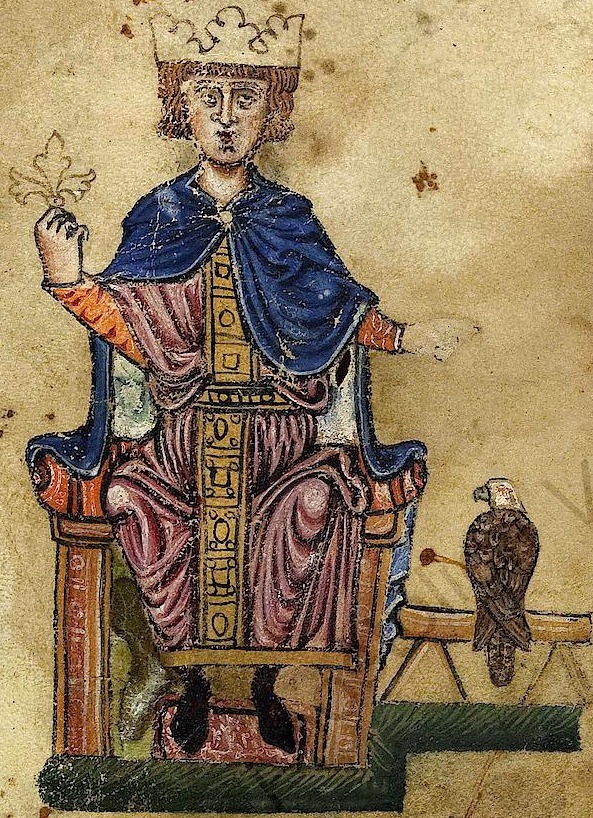
Federico II di Svevia, also known as Frederick II, was a towering figure of the Middle Ages, whose influence extended far beyond his native Italy and left a lasting impact on the history of Europe. Born in Jesi on December 26, 1194, under the shadow of a Germanic dynasty, Frederick II’s life was marked by his extraordinary political acumen, cultural patronage, and efforts to centralize power in a fragmented and turbulent era.
Early Life and Ascendancy
Frederick’s birth was an event of great significance, not only for his family but also for the future of Europe. He was born into the House of Hohenstaufen, a powerful German dynasty, and was the son of Emperor Henry VI and Constance of Sicily, herself a descendant of the Norman kings of Southern Italy. This lineage made him a legitimate heir to both the Holy Roman Empire and the Kingdom of Sicily, a union that would shape the political landscape of Europe for years to come.
Tragically, Frederick’s father, Henry VI, died when Frederick was just three years old. His mother, Constance, assumed the regency of Sicily, but her death in 1198 left the young Frederick an orphan. At the tender age of four, he was crowned King of Sicily, Duke of Puglia, and Prince of Capua, with Pope Innocent III acting as his guardian. This arrangement was intended to secure the papal influence over the Kingdom of Sicily and to keep Frederick away from the German crown.
However, Frederick’s destiny was not to be confined to Sicily. At the age of 14, in 1208, he was crowned King of Germany, and his ambitions soon extended beyond the borders of Italy. His early years as a ruler were marked by efforts to consolidate power in Southern Italy, where the political situation was anything but stable. During his absence in Germany, the Kingdom of Sicily had fallen into disarray, with local lords and city-states taking advantage of the monarchy’s weakness to assert their autonomy.
Frederick wasted no time in reasserting his authority. He confiscated illegally constructed fortresses, reclaimed royal rights over ports, markets, and customs, and imposed strict controls over the nobility. He also took steps to centralize the administration of the kingdom, laying the groundwork for what would become one of the most efficient and sophisticated bureaucracies of the medieval world.
Cultural and Intellectual Patronage
Frederick II was not only a shrewd politician but also a patron of the arts and sciences. His court in Palermo became a vibrant cultural center, attracting scholars, poets, and artists from all over the Mediterranean. He spoke multiple languages, including Latin, Sicilian, German, and Arabic, and his intellectual curiosity knew no bounds.
One of his most significant contributions to the intellectual life of the Middle Ages was the founding of the University of Naples in 1224, the first state university in the Western world. Frederick established the university to train the bureaucrats and jurists needed for his centralized state, and he offered generous incentives to students, including exemptions from taxes and military service. At the same time, he forbade his subjects from studying at the University of Bologna, which he viewed as a competitor.
Frederick’s interest in science and philosophy was also evident in his support for the translation of Arabic texts into Latin, particularly those related to medicine, astronomy, and mathematics. The School of Salerno, already a renowned center for medical studies, flourished under his patronage, and his court became a hub for the exchange of knowledge between the Christian and Muslim worlds.
Legal and Administrative Reforms
Frederick II’s reign was marked by a series of legal and administrative reforms that transformed the Kingdom of Sicily into a model of centralized government. In 1231, he promulgated the Constitutions of Melfi, a comprehensive code of laws that codified the rights and duties of his subjects, regulated the administration of justice, and established a uniform legal framework for the kingdom.
The Constitutions of Melfi were groundbreaking in several ways. They placed the king at the center of the judicial system, with judges acting as his representatives, and emphasized the principle of equity in the administration of justice. Frederick also took steps to curb the power of the nobility by prohibiting the sale of feudal lands without his consent and requiring his approval for the marriages of vassals.
In addition to his legal reforms, Frederick undertook extensive public works projects to improve the infrastructure of his kingdom. He built roads, bridges, and ports, and he took measures to ensure the safety of travelers and merchants. His most famous architectural achievement was the construction of Castel del Monte, a fortress in Puglia that is renowned for its unique octagonal shape and its blend of Gothic and Islamic architectural elements.
Conflict with the Papacy
Despite his many achievements, Frederick II’s reign was not without controversy. His attempts to centralize power and assert his authority over the church brought him into conflict with the papacy, leading to a series of excommunications and military confrontations.
Frederick’s relationship with the papacy was complex and often contentious. As a young king, he had been a ward of the pope, but as he grew older and more powerful, he began to challenge the papal authority. His decision to reclaim the Kingdom of Jerusalem during the Sixth Crusade, without the approval of the pope, further strained relations. Although he successfully negotiated the return of Jerusalem to Christian control, his actions were seen as a challenge to the pope’s spiritual authority.
The conflict reached its peak in 1239 when Pope Gregory IX excommunicated Frederick for his refusal to support a papal-led crusade. In response, Frederick invaded the Papal States, capturing several key cities and forcing the pope to flee Rome. The war between the emperor and the pope continued for several years, with neither side able to achieve a decisive victory.
Frederick’s defiance of the papacy made him a controversial figure in his time. To his supporters, he was a visionary ruler who sought to modernize and centralize his empire. To his detractors, particularly in the church, he was a dangerous heretic who sought to undermine the authority of the pope.
Legacy and Death
Federico II di Svevia’s legacy is one of both admiration and controversy. He died on December 13, 1250, at the age of 55, in the castle of Fiorentino in Puglia. His death marked the end of an era, but his influence continued to be felt long after his passing.
Frederick II was a man of contradictions: a German emperor who ruled over a predominantly Italian kingdom, a devout Christian who engaged in diplomatic negotiations with Muslim rulers, and a medieval monarch who laid the groundwork for the modern centralized state. His reign was marked by both great achievements and great challenges, and his legacy continues to be debated by historians to this day.
Frederick’s impact on the cultural and political landscape of Europe cannot be overstated. He was a ruler who recognized the importance of knowledge and culture, and he sought to foster both in his kingdom. His legal and administrative reforms laid the foundation for the modern state, and his patronage of the arts and sciences helped to bridge the gap between the Christian and Muslim worlds.
In the end, Frederick II di Svevia was a ruler who sought to transcend the limitations of his time. He was a man of vision and ambition, whose legacy continues to inspire and challenge us today. His life and reign are a testament to the complexity of medieval politics and the enduring power of ideas in shaping the course of history.


