
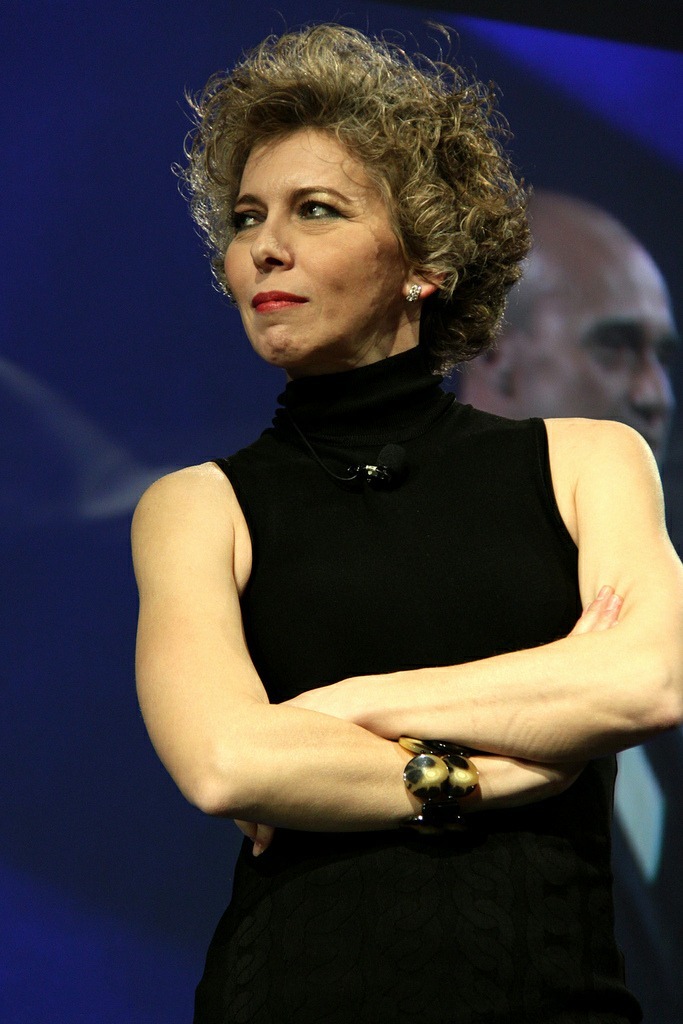
Irene Pivetti is a prominent Italian political figure, journalist, and television personality, best known for her role as the President of the Italian Chamber of Deputies from 1994 to 1996. Born on April 4, 1963, in Milan, Italy, Pivetti has had a dynamic career that spans politics, media, and public life. This article provides a comprehensive look into her life, tracing her journey from an academic scholar to one of Italy’s most influential political figures, and later, a media personality.
Early Life and Academic Foundations
Irene Pivetti was born into a family deeply rooted in the Italian entertainment industry. Her father, Paolo Pivetti, was a film director, and her mother, Grazia Gabrielli, was an actress. However, Irene’s initial career path was inspired by her maternal grandfather, Aldo Gabrielli, a renowned linguist. This influence led her to pursue an academic career, enrolling in the Università Cattolica del Sacro Cuore in Milan. She graduated with honors in philosophy and literature, demonstrating early on her intellectual capabilities and passion for scholarly pursuits.
During her time at university, Pivetti developed an interest in political and social issues, which would later shape her career. Her involvement in Catholic associations such as the ACLI (Italian Christian Workers’ Associations) provided her with a platform to engage in social activism and public speaking, honing the skills that would later serve her in politics.
Entry into Politics and the Rise to Power
Irene Pivetti’s formal entry into politics occurred in the early 1990s when she became affiliated with the Lega Nord, a regionalist political party that was gaining momentum in Italy. Her dedication and leadership qualities quickly propelled her to prominence within the party, and from 1990 to 1994, she served as the head of the party’s Catholic Consultation Committee and editor of the party’s magazine, Identità.
Pivetti’s political career took a significant leap forward when she was elected as a Member of Parliament in 1992. Her tenure as an MP was marked by her involvement in crucial legislative committees, particularly the Social Affairs Committee, where she worked on bioethics and local government reforms. These early efforts reflected her deep commitment to addressing complex societal issues through policy and legislation.
In 1994, Pivetti achieved a historic milestone by being elected as the President of the Italian Chamber of Deputies at the age of 31, making her the youngest person ever to hold this position in Italy. Her election came at a time of political upheaval, as Italy was transitioning from the First to the Second Republic, a period marked by the collapse of the traditional party system and the rise of new political movements. As President of the Chamber, Pivetti was tasked with navigating this challenging political landscape, ensuring the proper functioning of parliamentary procedures, and representing the institution with dignity and integrity.
Political Challenges and Independent Initiatives
Irene Pivetti’s tenure as President of the Chamber was characterized by her commitment to maintaining the formal rigor of parliamentary proceedings. However, the political environment was fraught with challenges, and by 1996, tensions within the Lega Nord led to her departure from the party. Pivetti’s departure marked a significant turning point in her political career, as she chose to establish her own political movement, Italia Federale, in 1997. This new platform allowed her to continue advocating for federalism and other political reforms, though it did not achieve significant electoral success.
Pivetti’s commitment to public service did not waver, and she continued to be an active participant in Italian politics. In 1999, her movement was absorbed by the UDEUR (Union of Democrats for Europe), and Pivetti served as the party’s president until 2002. During this period, she focused on issues such as agricultural policy and social welfare, areas that had long been central to her political agenda.
Despite the challenges she faced in her political career, Pivetti’s influence remained strong. Her tenure as President of the Chamber left a lasting legacy, particularly in terms of her efforts to modernize the institution and adapt it to the evolving political landscape of Italy. Her time in office also underscored the importance of maintaining decorum and respect for parliamentary processes, principles that Pivetti championed throughout her career.
Transition to Media and Television Career
After stepping away from active politics, Irene Pivetti transitioned to a career in media and television, a move that surprised many but allowed her to reach a broader audience. Encouraged by her second husband, Alberto Brambilla, who also served as her manager, Pivetti reinvented herself as a television host and commentator. Her foray into television began in the early 2000s with shows like Fa la Cosa Giusta and La Giuria on La7, followed by other programs on major Italian networks like Italia Uno and Rete Quattro.
Pivetti’s television career was marked by her willingness to tackle controversial topics and adopt unconventional approaches. For example, she hosted Bisturi! Nessuno è Perfetto on Italia Uno, a show that focused on plastic surgery, and Liberi Tutti on Rete Quattro, which explored issues related to personal freedom and societal norms. Her ability to engage with complex and often polarizing subjects made her a distinctive voice in Italian television.
In addition to her work as a television host, Pivetti also launched an online platform in 2009 called Web to be Free, a thematic channel dedicated to providing economic and financial information. This initiative reflected her ongoing commitment to addressing important societal issues, even outside the traditional political arena.
Pivetti’s media career was not without its controversies. In 2007, she made headlines by posing in a provocative “Catwoman” costume for the Italian magazine Gente, a move that drew criticism from some quarters but also highlighted her willingness to challenge traditional norms and expectations. Throughout her media career, Pivetti maintained a strong presence as an opinion leader, frequently appearing on television as a commentator on both RAI and Mediaset programs.
Personal Life and Challenges
Irene Pivetti’s personal life has been as eventful as her professional career. Her first marriage to Paolo Taranta ended in annulment, a decision she made after declaring that she did not want to have children. Her second marriage to Alberto Brambilla, who was ten years her junior, was more successful initially. The couple married in 1997 and had two children, Ludovica and Federico. However, their marriage ended in separation in 2010, after 13 years.
Despite the separation, Pivetti and Brambilla managed to maintain a civil relationship for the sake of their children. While Brambilla publicly declared the end of their relationship and the impossibility of reconciliation, Pivetti took a different approach, stating that she accepted the separation but had no intentions of seeking another relationship.
Pivetti’s personal and professional lives have often intersected, with her television career and public appearances being closely linked to her personal choices and transformations. Her decision to shave her head in the early 2000s, a change in appearance that was reportedly initiated by her husband, was symbolic of her willingness to embrace change and challenge societal expectations.
Legacy and Ongoing Influence
Irene Pivetti’s career, both in politics and media, has left a significant mark on Italian public life. Her time as President of the Chamber of Deputies was a historic achievement, not only because of her age but also because of the way she handled the responsibilities of the office during a turbulent period in Italian politics. Her subsequent transition to media allowed her to reach new audiences and continue influencing public discourse on a wide range of issues.
Pivetti’s journey from academia to the heights of political power and then to the world of television reflects a remarkable adaptability and resilience. She has consistently demonstrated a willingness to take on new challenges and reinvent herself, whether in the halls of parliament or in front of a television camera.
As a public figure, Pivetti has been known for her intellectual rigor, her commitment to public service, and her ability to engage with complex issues in a way that resonates with the public. Her work, both in politics and media, has been characterized by a deep understanding of the societal challenges facing Italy and a desire to contribute to positive change.
Conclusion
Irene Pivetti remains one of Italy’s most intriguing and influential figures. Her career, which spans politics, media, and public life, is a testament to her versatility, intelligence, and commitment to serving the public. From her historic election as the youngest President of the Italian Chamber of Deputies to her bold and often controversial media career, Pivetti has consistently pushed the boundaries of what it means to be a public figure in Italy.
As she continues to engage with the public through her various media endeavors, Irene Pivetti’s influence is likely to endure, inspiring future generations of leaders and thinkers. Her legacy is one of courage, adaptability, and a relentless pursuit of excellence in every field she has entered.


