
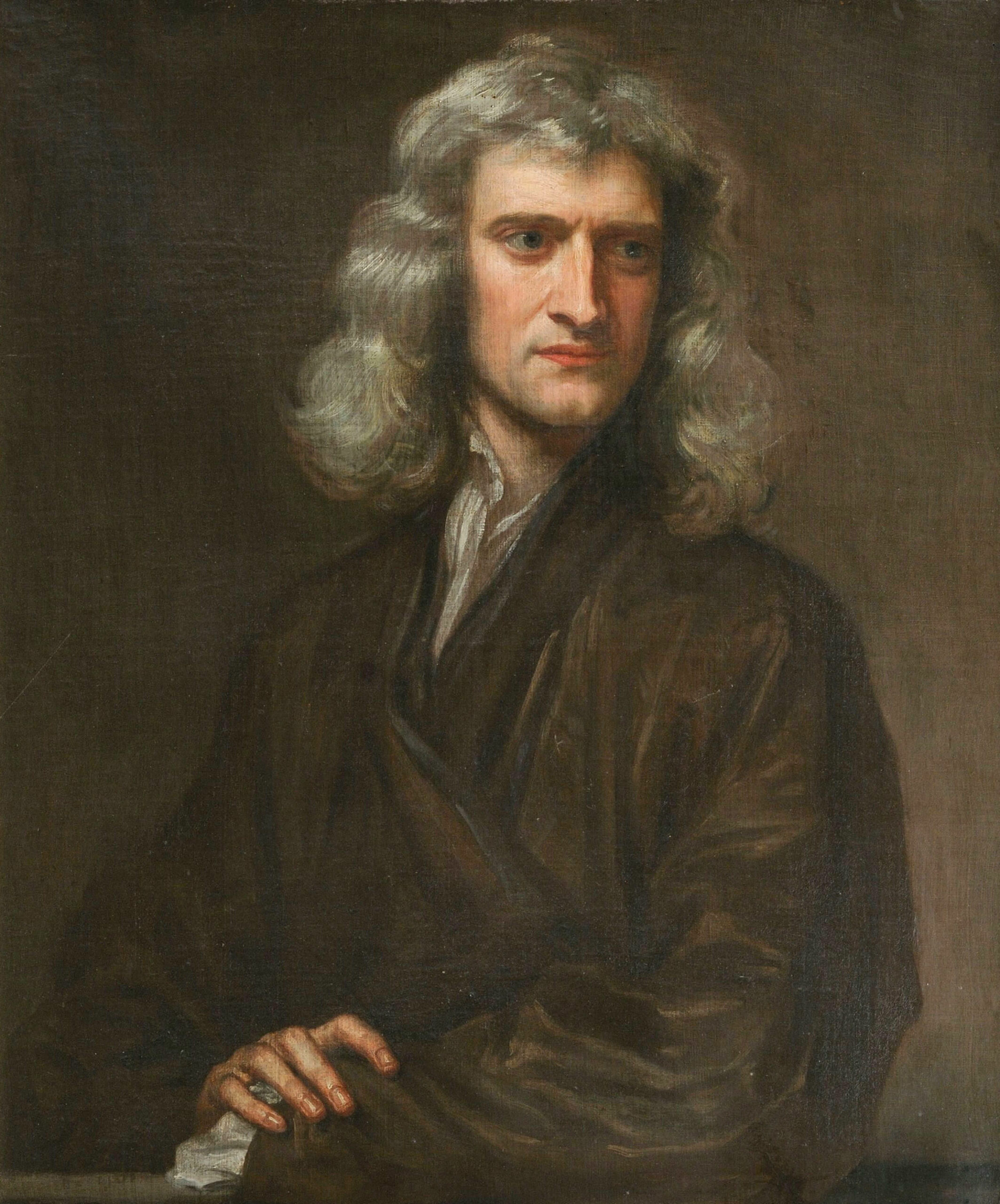
Introduction
Isaac Newton, one of the most influential scientists in history, revolutionized the way we understand the natural world. Born on January 4, 1643, in Woolsthorpe, Lincolnshire, England (though some sources state December 25, 1642, due to calendar differences), Newton’s discoveries laid the groundwork for classical mechanics, optics, and mathematics. His work not only shaped the scientific revolution of the 17th century but continues to influence modern science today. This article delves into Newton’s life, his groundbreaking contributions to science, and the historical context that shaped his thinking.
Early Life and Education
Isaac Newton was born into a world of political and religious turmoil in England. His father died before his birth, and his mother, Hannah Ayscough, remarried when Newton was three years old, leaving him in the care of his maternal grandmother. Newton’s childhood was marked by loneliness and a sense of abandonment, experiences that may have fueled his later obsession with his work.
At the age of 12, Newton was sent to King’s School in Grantham, where he lodged with a local apothecary named Clark. It was here that Newton’s interest in science began to flourish. He would spend hours in Clark’s laboratory, experimenting with chemicals and inventing mechanical devices, including a water clock and a sundial. These early experiences with experimentation and observation would later become central to his scientific method.
Despite his modest beginnings, Newton’s academic potential was evident, and in 1661, he enrolled at Trinity College, Cambridge. At Cambridge, Newton initially studied the works of Aristotle, but he soon became fascinated by the ideas of contemporary scientists like Galileo, Descartes, and Kepler. His studies at Cambridge were interrupted by the outbreak of the Great Plague in 1665, forcing the university to close temporarily. Newton returned to his family home in Woolsthorpe, where he would spend the next two years in what is often referred to as his “annus mirabilis” or “year of wonders.”
Annus Mirabilis: The Year of Wonders
The period from 1665 to 1667 was arguably the most productive in Newton’s life. During his time in Woolsthorpe, Newton made significant discoveries in calculus, optics, and the laws of motion and gravity. These breakthroughs would later form the foundation of his most famous work, the Philosophiæ Naturalis Principia Mathematica (Mathematical Principles of Natural Philosophy), commonly known as the Principia.
One of the most famous anecdotes about Newton’s life is the story of the falling apple. According to legend, Newton was sitting in his garden when he observed an apple fall from a tree. This event supposedly led him to ponder the forces that govern motion both on Earth and in the heavens, eventually leading to his formulation of the law of universal gravitation. While the exact details of this story are likely embellished, there is evidence that Newton himself recounted a version of it to his biographer, William Stukeley.
During this period, Newton also developed the foundations of calculus, a branch of mathematics that would become essential for understanding change and motion. Although Newton initially kept his discoveries to himself, the later publication of his methods would ignite a bitter dispute with the German mathematician Gottfried Wilhelm Leibniz over the invention of calculus. This controversy, known as the calculus priority dispute, would persist for years, with both men claiming credit for the discovery.
Return to Cambridge and Academic Career
In 1667, Newton returned to Cambridge, where he quickly completed his master’s degree. His work during the “annus mirabilis” had already set him apart as a rising star in the scientific community, and in 1669, he was appointed the Lucasian Professor of Mathematics at Cambridge, a position he would hold for the next 27 years.
As Lucasian Professor, Newton focused much of his research on optics. He conducted experiments with prisms and demonstrated that white light is composed of a spectrum of colors, each corresponding to a different wavelength of light. This discovery challenged the prevailing theory of light, which held that white light was a pure and fundamental entity. Newton’s work in optics culminated in the publication of Opticks in 1704, a groundbreaking treatise that laid the foundation for the modern understanding of light and color.
In addition to his work in optics, Newton continued to develop his theories of motion and gravity. His lectures at Cambridge and correspondence with other scientists, including Robert Hooke and Edmond Halley, helped refine his ideas. Halley, in particular, played a crucial role in encouraging Newton to publish his work on gravitation, which would eventually lead to the publication of the Principia in 1687.
The Principia and the Laws of Motion
The publication of the Principia in 1687 is widely regarded as one of the most significant events in the history of science. In this monumental work, Newton formulated the three laws of motion, which describe the relationship between the forces acting on an object and its motion in response to those forces. These laws provided a unified framework for understanding the motion of objects both on Earth and in the heavens, effectively laying the groundwork for classical mechanics.
The Principia also introduced Newton’s law of universal gravitation, which states that every mass in the universe attracts every other mass with a force that is proportional to the product of their masses and inversely proportional to the square of the distance between them. This law explained not only the motion of falling objects on Earth but also the orbits of planets and moons, providing a comprehensive explanation for the motions of celestial bodies.
Newton’s Principia was not only a scientific triumph but also a philosophical one. It represented a shift from the Aristotelian view of the cosmos, which had dominated Western thought for centuries, to a new, mechanistic view of the universe. In Newton’s universe, the motion of objects was governed by natural laws that could be understood and described mathematically, without the need for supernatural explanations.
Later Life and Public Service
In the latter part of his life, Newton’s focus shifted from academic research to public service and administration. In 1696, he was appointed Warden of the Royal Mint, a position that required him to oversee the production of England’s currency. Newton took this role seriously, implementing reforms to combat counterfeiting and ensuring the integrity of the nation’s coinage. His work at the Mint was highly regarded, and in 1699, he was promoted to Master of the Mint, a position he held until his death.
Newton also served as a Member of Parliament for Cambridge University, though his contributions to political life were minimal. He was more interested in his duties at the Mint and his ongoing scientific inquiries. In 1705, he was knighted by Queen Anne, becoming Sir Isaac Newton, in recognition of his contributions to science and public service.
Throughout his later years, Newton remained active in the scientific community, serving as President of the Royal Society from 1703 until his death in 1727. Under his leadership, the Royal Society became the leading scientific institution in Britain, promoting research and the exchange of ideas among scientists.
Despite his many accomplishments, Newton’s later years were not without challenges. He became increasingly reclusive and paranoid, particularly in his disputes with other scientists, including the ongoing conflict with Leibniz over calculus. Newton’s health also began to decline, and he suffered from various ailments, including kidney stones and digestive issues.
Legacy and Influence
Isaac Newton’s legacy is vast and enduring. His contributions to physics, mathematics, and astronomy laid the foundation for much of modern science. The laws of motion and universal gravitation he formulated are still taught in physics classes around the world, and his development of calculus is a fundamental tool in mathematics, engineering, and the physical sciences.
Newton’s work also had a profound impact on the philosophy of science. His emphasis on empirical observation and mathematical description as the basis for understanding the natural world helped establish the scientific method as the standard for scientific inquiry. Newton’s mechanistic view of the universe, in which the behavior of objects is governed by natural laws, influenced not only science but also philosophy, economics, and other fields.
In addition to his scientific achievements, Newton’s personal qualities—his perseverance, intellectual rigor, and unrelenting curiosity—serve as an inspiration to scientists and thinkers. His ability to question established ideas and explore new avenues of thought, even in the face of skepticism, exemplifies the spirit of scientific inquiry.
Newton’s influence extends beyond the scientific community. His work has become a part of popular culture, symbolizing the power of human intellect and the quest for knowledge. The story of the falling apple, whether true or apocryphal, has become an iconic image of scientific discovery, representing the moment when a great mind grasps a fundamental truth about the universe.
Conclusion
Isaac Newton’s contributions to science are unparalleled. From his formulation of the laws of motion and universal gravitation to his pioneering work in optics and mathematics, Newton transformed our understanding of the natural world. His legacy continues to shape the course of scientific inquiry, influencing generations of scientists and thinkers.
Newton’s life, marked by personal challenges and intellectual triumphs, serves as a testament to the power of curiosity and perseverance. His work not only changed the way we see the world but also laid the foundation for the modern scientific method, establishing principles that continue to guide scientific research today.
As we reflect on Newton’s life and achievements, it is clear that his influence will endure for centuries to come, inspiring future generations to explore, question, and discover the wonders of the universe.


