
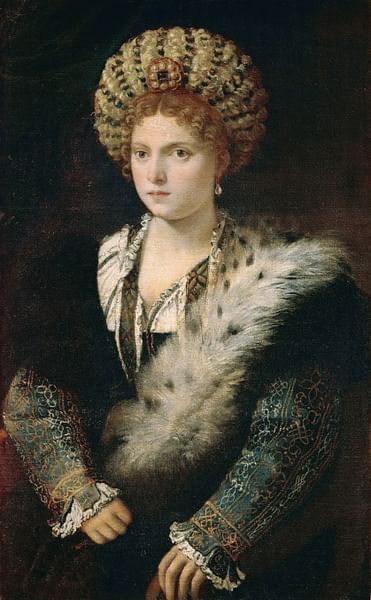
Isabella d’Este is a figure whose name echoes through the annals of history, particularly in the context of the Italian Renaissance. Born on May 17, 1474, in Ferrara, Italy, Isabella was a product of the powerful Este family, with her father being Ercole I d’Este, Duke of Ferrara, and her mother, Eleonora d’Aragona, a daughter of the King of Naples, Ferdinand I. Her lineage alone positioned her as a key player in the intricate tapestry of Renaissance Italy, but it was her intellect, political acumen, and cultural patronage that cemented her place in history.
Early Life and Education
From an early age, Isabella exhibited an extraordinary intellect and a keen interest in the arts and humanities, nurtured by the finest tutors of the time. Her education was steeped in humanism, a reflection of the intellectual currents sweeping through Renaissance Italy. This educational foundation not only broadened her knowledge but also instilled in her a deep appreciation for art, literature, and music, all of which would become defining aspects of her life.
By the age of six, Isabella was already betrothed to Francesco II Gonzaga, a young member of the influential Gonzaga family of Mantua. This engagement was a strategic alliance aimed at strengthening the political ties between the Este and Gonzaga families. The marriage was eventually solemnized on February 12, 1490, when Isabella was just sixteen years old, marking the beginning of her role as the Marchioness of Mantua.
The Marchioness of Mantua: A Patron of the Arts
Upon her arrival in Mantua, Isabella quickly established herself as a key figure in the cultural life of the city. Her court became a vibrant hub for artists, musicians, and intellectuals, attracting some of the most renowned figures of the Renaissance. Among those who graced her court were luminaries like Leonardo da Vinci, Andrea Mantegna, and Ludovico Ariosto, to name but a few.
Isabella’s patronage was not just limited to hosting artists; she was deeply involved in the artistic process, often commissioning works and providing detailed guidance on their creation. Her personal collection included sculptures in both Roman and modern styles, and her taste in jewelry and fashion set trends across Europe. The “Studiolo” and “Grotta,” her private spaces, were decorated by some of the finest artists of the day, reflecting her impeccable taste and deep understanding of art.
Her influence extended beyond the arts into the realms of fashion and decorum. Isabella d’Este was considered a paragon of Renaissance style and elegance, earning her the title of the “First Lady of the Renaissance.” Her fashion sense was emulated by women across Europe, and her court became a model of refinement and sophistication.
Political Acumen and Leadership
Isabella d’Este’s role was not confined to the cultural sphere; she was also a shrewd political operator. Her diplomatic skills were particularly evident during the periods when her husband, Francesco II Gonzaga, was away, often engaged in military campaigns or held captive, as was the case during his imprisonment in Venice. During these times, Isabella effectively managed the affairs of Mantua, displaying a remarkable ability to navigate the complex political landscape of the time.
One of her most notable political achievements came after the death of her husband in 1519. Isabella assumed the role of regent for her son, Federico II Gonzaga, who was still a minor at the time. Her regency was marked by astute political maneuvering, including securing the elevation of Mantua from a marquisate to a duchy, a significant upgrade in status that enhanced the prestige of the Gonzaga family.
Isabella’s political savvy was also evident in her dealings with powerful figures of the time, such as Cesare Borgia. In one notable instance, she successfully negotiated the return of a Cupid statue created by Michelangelo, which had been stolen by Borgia during his conquest of Urbino. This episode highlights her tenacity and resourcefulness in protecting her family’s interests.
Later Years and Legacy
As Isabella grew older, her influence did not wane. Even after her son Federico assumed full control of Mantua, Isabella continued to play a significant role in the political and cultural life of the region. However, her relationship with Federico became strained, leading to her eventual departure from Mantua. She sought refuge in Rome, where she continued to exert her influence, despite the political turmoil that gripped the city.
In 1527, during the infamous Sack of Rome, Isabella demonstrated her characteristic courage and leadership. When the city was besieged, she provided shelter to over two thousand people within her palace, protecting them from the violence and chaos that engulfed the city. Her ability to negotiate with the occupying forces and prevent her palace from being looted is a testament to her diplomatic skills and indomitable spirit.
Isabella d’Este’s final years were spent resolving the issues left by her son’s rule and managing the family’s estates. She passed away on February 13, 1539, at the age of 64, leaving behind a legacy that continues to resonate in the annals of history. She was buried in the Church of San Francesco in Mantua, where her memory is preserved as one of the most formidable women of the Renaissance.
Isabella d’Este’s Impact on Renaissance Culture and Politics
Isabella d’Este’s life was a testament to the power of intellect, culture, and diplomacy in shaping the course of history. Her influence on Renaissance culture cannot be overstated; she was a central figure in the dissemination of Renaissance ideals across Europe. Through her patronage, she not only supported the arts but also helped to define the cultural standards of her time.
Moreover, Isabella’s political acumen and leadership during turbulent times underscore her significance as more than just a cultural icon. She was a key player in the complex political dynamics of Renaissance Italy, and her actions had a lasting impact on the fortunes of the Gonzaga family and the broader political landscape of the region.
In the context of modern historical analysis, Isabella d’Este is often celebrated as a proto-feminist figure, a woman who wielded considerable power in a male-dominated society. Her ability to navigate the treacherous waters of Renaissance politics, while also cultivating one of the most vibrant cultural courts in Europe, marks her as a figure of enduring importance.
Conclusion: The Enduring Legacy of Isabella d’Este
Isabella d’Este remains one of the most fascinating figures of the Italian Renaissance. Her life, marked by her roles as a patron of the arts, a political leader, and a cultural trendsetter, continues to inspire admiration and scholarly interest. The legacy she left behind is one of elegance, intellect, and resilience, qualities that ensured her place in history as the “First Lady” of the Renaissance.
In understanding Isabella d’Este, we gain insight not only into the life of an extraordinary woman but also into the broader cultural and political currents that shaped the Renaissance. Her story is a reminder of the impact that a single individual can have on the course of history, and her legacy continues to be a source of inspiration for those who study the Renaissance and the history of powerful women.


