
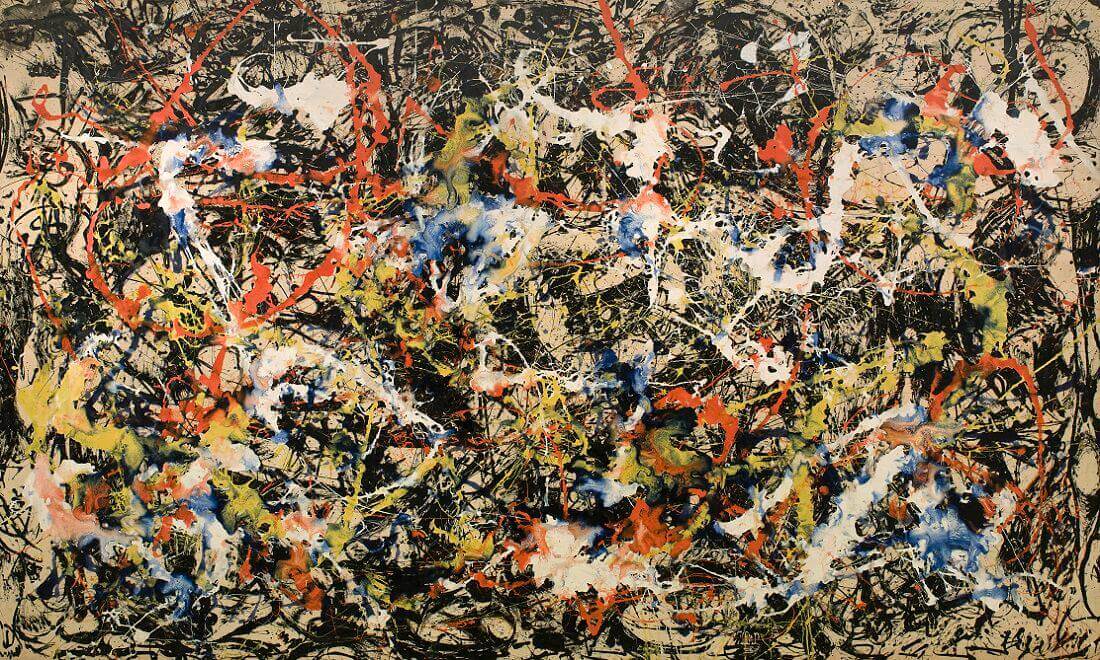
Jackson Pollock, born on January 28, 1912, in Cody, Wyoming, was an American painter who became one of the most influential figures in the modern art movement, particularly known for his role in the abstract expressionist movement. Pollock’s innovative techniques and unique approach to painting, characterized by his “action painting” and “dripping” methods, revolutionized the art world and cemented his place as a pivotal figure in 20th-century art. This article explores the life, fame, and significant highlights of Jackson Pollock’s career, offering insights into his artistic journey and the historical context that shaped his work.
Early Life and Background
Jackson Pollock was born into a large, working-class family of Scottish-Irish descent. He was the youngest of five sons, and his early life was marked by frequent relocations as his family moved across Arizona and California. Growing up in a rural setting, Pollock’s childhood was shaped by the hardships of life in a farming family, which instilled in him a sense of resilience but also contributed to the restlessness that would characterize his later life.
From a young age, Pollock exhibited a rebellious streak and struggled with authority. By the time he was a teenager, he had already developed a dependence on alcohol, a habit that would plague him throughout his life. His academic career was troubled; he was expelled from the Riverside High School in 1929 due to his unruly behavior and later from the Los Angeles High School in 1930. Despite his difficulties in traditional education, Pollock showed an early interest in art, which led him to pursue formal training.
Artistic Training and Early Influences
In 1930, Pollock moved to New York City, where he enrolled in the Art Students League under the tutelage of Thomas Hart Benton, a leading figure in the American Regionalist movement. Benton’s influence on Pollock was significant, particularly in the early stages of his career. Benton’s emphasis on rhythmic composition and dynamic movement in painting left a lasting impression on Pollock, even though Pollock would eventually break away from Benton’s figurative style.
During the 1930s, Pollock also became involved in the Works Progress Administration (WPA) Federal Art Project, which provided employment for artists during the Great Depression. This period allowed Pollock to develop his skills while gaining exposure to various artistic influences, including the Mexican muralists José Clemente Orozco and David Alfaro Siqueiros. Siqueiros, in particular, introduced Pollock to experimental techniques, including the use of industrial materials and unconventional methods of applying paint, which would later become central to Pollock’s practice.
Pollock’s early work was deeply rooted in the American Scene, reflecting social realism and the struggles of the working class. However, as the 1940s progressed, his style began to shift dramatically, influenced by the burgeoning abstract expressionist movement and the psychoanalytic ideas that were gaining popularity in New York’s intellectual circles.
The Rise of Abstract Expressionism
The 1940s were a transformative decade for Pollock. He began to move away from representational art and towards abstraction, influenced by the works of European modernists such as Pablo Picasso and Joan Miró, as well as the teachings of Carl Jung, whose theories on the unconscious mind resonated deeply with Pollock.
In 1942, Pollock participated in the landmark exhibition “Art of This Century,” organized by the influential art dealer Peggy Guggenheim. Guggenheim became a crucial figure in Pollock’s career, providing him with financial support and a platform to showcase his work. In 1943, she offered Pollock a contract and hosted his first solo exhibition at her gallery, which was a pivotal moment in his career.
Pollock’s work during this period reflected a growing interest in Native American art and rituals, which he had encountered during his youth in the West. This influence is evident in his early drip paintings, where he began to develop a unique style of applying paint to canvas. These works marked the beginning of what would become known as “action painting,” a term coined by the art critic Harold Rosenberg to describe Pollock’s dynamic and physical approach to painting.
Action Painting and the Drip Technique
By the mid-1940s, Pollock had fully embraced the technique that would make him famous: the drip painting. This method involved laying a canvas on the floor and dripping, pouring, or splattering paint onto it from above, using sticks, trowels, or even his hands. This approach allowed Pollock to work from all angles, moving around the canvas and engaging with it in a visceral and performative way. He described his process as being “in” the painting, emphasizing the physicality of his work.
The drip technique was revolutionary in its departure from traditional methods of painting. It rejected the use of easels, brushes, and meticulous planning in favor of spontaneity, movement, and the exploration of chance. Pollock’s canvases from this period are characterized by their chaotic yet controlled compositions, with layers of paint creating intricate webs of lines, drips, and splatters.
Pollock’s most famous works, such as No. 5, 1948 and Autumn Rhythm (Number 30), epitomize this technique. These paintings, often large in scale, exude a sense of energy and immediacy that captivated both critics and the public. They were seen as a radical break from the past, embodying the postwar spirit of innovation and experimentation.
Fame and Critical Reception
Pollock’s rise to fame in the late 1940s and early 1950s was meteoric. His work was celebrated as a breakthrough in modern art, and he became a leading figure in the abstract expressionist movement. The critical acclaim was accompanied by a surge in his popularity, and Pollock quickly became a symbol of American artistic innovation.
However, Pollock’s success was also accompanied by personal struggles. Despite periods of sobriety, his battle with alcoholism persisted, and he was often tormented by feelings of self-doubt and insecurity. The pressure of his newfound fame, coupled with his volatile personality, made him increasingly erratic and unpredictable.
Pollock’s fame was further cemented by a 1949 feature in Life magazine, which famously asked, “Is he the greatest living painter in the United States?” This exposure brought Pollock into the mainstream, but it also heightened the scrutiny of his work. Some critics praised his paintings as groundbreaking, while others dismissed them as chaotic and meaningless.
The Decline and Final Years
By the early 1950s, Pollock’s work began to shift again. He moved away from the drip technique and experimented with darker, more somber compositions that incorporated elements of figuration. These works were less well-received than his earlier abstractions, and Pollock struggled to regain the critical acclaim he had once enjoyed.
Pollock’s personal life continued to deteriorate as his alcoholism worsened. His marriage to fellow artist Lee Krasner, who had been a stabilizing influence, became increasingly strained as Pollock’s behavior grew more erratic. Despite her efforts to help him, Pollock’s self-destructive tendencies led to a deepening depression.
On August 11, 1956, Jackson Pollock died in a tragic car accident near his home in Long Island. He was driving under the influence of alcohol when he lost control of his car, crashing it and killing himself and a passenger. Pollock was only 44 years old at the time of his death.
Legacy and Influence
Despite his untimely death, Jackson Pollock’s influence on the art world remains profound. He is often credited with having fundamentally changed the way we think about painting and the role of the artist. Pollock’s emphasis on process over product, his exploration of the unconscious, and his rejection of traditional techniques all contributed to the development of modern art.
Pollock’s work has been the subject of numerous exhibitions, retrospectives, and scholarly studies. His paintings are held in major collections around the world, and they continue to fetch record prices at auction, a testament to his enduring impact on the art market.
The term “action painting” has become synonymous with Pollock, and his approach has inspired generations of artists who seek to break free from conventional methods of creation. Pollock’s work also played a crucial role in establishing New York City as the center of the art world in the postwar era, shifting the focus away from Europe.
In popular culture, Pollock’s life and work have been immortalized in films, documentaries, and biographies. The 2000 film Pollock, directed by and starring Ed Harris, brought renewed attention to Pollock’s legacy and introduced his story to a new generation.
Conclusion
Jackson Pollock’s journey from a troubled youth to one of the most celebrated artists of the 20th century is a story of innovation, struggle, and profound impact. His contributions to the abstract expressionist movement and his pioneering techniques continue to resonate in the art world today.
Pollock’s legacy is not only found in his groundbreaking paintings but also in the way he redefined what it means to be an artist. His life, marked by both extraordinary creativity and deep personal turmoil, serves as a reminder of the complex relationship between art and the artist. As we continue to explore and celebrate his work, Jackson Pollock remains a towering figure in the history of modern art.


