
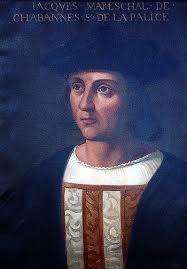
Jacques II de Chabannes de La Palice, often simply referred to as La Palice, is a historical figure whose name has become synonymous with the concept of the “lapalissade,” a term in French that denotes a truism or an obvious statement. Born around 1470 in the Château of La Palice in France, Jacques de La Palice was a nobleman, military leader, and marshal of France. His life, though steeped in military and political significance, is often overshadowed by the irony of how his legacy has been remembered—a legacy rooted in a misunderstood epitaph.
Early Life and Noble Origins
Jacques de La Palice was born into the Chabannes family, a noble house with a long and prestigious history. His father, Geoffroy de Chabannes, and his mother, Charlotte de Prie, were members of the French aristocracy, a class that held significant influence in the affairs of the nation. From a young age, Jacques was destined for a life of service to the French crown. At just 15 years old, he entered the court of King Charles VIII of France as an “enfant d’honneur,” a position that marked the beginning of his lifelong loyalty to the French monarchy.
His first taste of battle came in 1488 at the Battle of Saint-Aubin-du-Cormier, where the French forces, under the command of Charles VIII, clashed with Breton forces. This battle, which ended in a decisive French victory, was Jacques’ “baptism of fire” and set the stage for his future military career. The victory solidified the young nobleman’s position in the royal court and earned him the favor of the king.
Marriage and Italian Campaigns
In 1492, Jacques de La Palice married Marie de Montberon, the daughter of Eustache de Montberon, a royal advisor. This union further cemented his status within the French nobility and provided him with the means to pursue his military ambitions. His marriage coincided with a period of significant military activity in Europe, particularly in Italy, where the French crown sought to expand its influence.
Jacques de La Palice played a prominent role in the Italian Wars, a series of conflicts that would dominate European politics for several decades. He fought under the banners of both Charles VIII and his successor, Louis XII, participating in key battles such as the Battle of Fornovo in 1495. This battle, fought against the forces of the Holy League, was a pivotal moment in the Italian Wars and demonstrated La Palice’s tactical acumen.
Following the death of Charles VIII in 1498, Louis XII ascended to the French throne, and La Palice continued to serve loyally under the new king. His military career during this period was marked by his involvement in the French campaigns in Lombardy, where he fought against the forces of Ludovico Sforza, also known as Ludovico il Moro, the Duke of Milan. These campaigns further established La Palice as one of France’s most capable military leaders.
Rise to Prominence and Challenges
As La Palice’s reputation grew, so too did his responsibilities. In 1501, he was appointed Viceroy of Abruzzi, a region in southern Italy that was of strategic importance to the French crown. His tenure as viceroy, however, was not without challenges. He faced a formidable opponent in Consalvo de Cordova, a Spanish general who besieged Ruvo di Puglia, a key stronghold in the region. Despite his efforts, La Palice was defeated and captured by the Spanish forces. His imprisonment, though a setback, did not diminish his standing at the French court. He was eventually released in 1504, but the experience marked a low point in his otherwise illustrious career.
The year 1504 was also a year of personal tragedy for La Palice, as his wife Marie de Montberon passed away. This loss, combined with his military defeat, could have ended the career of a lesser man, but La Palice remained steadfast in his service to the French crown.
Service Under Louis XII and Francis I
La Palice’s fortunes began to turn around in 1507 when he participated in the French siege of Genoa. Despite suffering serious injuries, he demonstrated his resilience and leadership, earning the trust of Louis XII, who appointed him as the commander of French forces in Lombardy. In this role, La Palice found himself at the forefront of the conflict against the Republic of Venice during the War of the League of Cambrai.
His military successes during this period earned him the title of “Grand Master of France” in 1511, a position that placed him among the most powerful men in the kingdom. However, the tides of war were ever-changing, and in 1512, La Palice was sent to the Pyrenees to aid Jean d’Albret, the Duke of Navarre, in his struggle against Spanish forces. His efforts in the Pyrenees were marked by both success and hardship. He was captured by English forces during a skirmish in Artois, but he was later released following the Treaty of Noyon in 1516.
With the death of Louis XII in 1515, Francis I ascended to the French throne. The young and ambitious king recognized La Palice’s military prowess and appointed him as Marshal of France, one of the highest military honors in the kingdom. La Palice quickly proved his worth by leading French forces to a decisive victory at the Battle of Marignano in September 1515. This battle, fought against Swiss mercenaries, was a turning point in the Italian Wars and solidified Francis I’s control over Milan.
The Later Years and the Battle of Pavia
Following the victory at Marignano, La Palice continued to serve as one of France’s most trusted military leaders. He played a crucial role in the French campaigns in Italy, including the defense of Milan against the forces of Prospero Colonna, a Spanish general. However, not all of La Palice’s endeavors were successful. His attempt to recapture Milan during the Siege of Bicocca in 1522 ended in failure, a setback that highlighted the challenges France faced in maintaining its influence in Italy.
In the final years of his life, La Palice remained deeply involved in the military affairs of France. In 1524, he successfully liberated the French garrison at Fuenterrabia, a fortress on the Franco-Spanish border that had been besieged by Spanish forces. This victory, though significant, was overshadowed by the events that would unfold the following year.
The Battle of Pavia, fought on February 25, 1525, was one of the most significant and devastating battles of the Italian Wars. La Palice, along with Francis I, led the French forces against the Imperial army commanded by Fernando Francesco d’Avalos. The battle was a disaster for France. The French forces were decisively defeated, and Francis I was captured by the enemy. Jacques de La Palice was killed during the battle, a tragic end to a long and distinguished military career. His body was later interred at the Château de La Palice, where he had been born.
The Legacy of Jacques de La Palice
Jacques de La Palice’s legacy is a complex one. While his military achievements were significant, his name has become more widely associated with the concept of the “lapalissade,” a term that originated from a misunderstood epitaph. According to legend, after La Palice’s death, his soldiers composed a song in his honor that included the line, “S’il n’était pas mort, il ferait encore envie,” which translates to “If he were not dead, he would still be envied.” Over time, this line was misinterpreted and became “S’il n’était pas mort, il serait encore en vie,” or “If he were not dead, he would still be alive,” a statement of the obvious that gave rise to the term “lapalissade.”
This ironic twist of fate has overshadowed La Palice’s true contributions to French history. However, for those who study the life of Jacques de La Palice, he remains a figure of immense historical importance. His service to the French crown spanned some of the most turbulent years in European history, and his actions on the battlefield had a lasting impact on the course of the Italian Wars.
Historical Context and Influence
The life of Jacques de La Palice offers valuable insights into the broader historical context of the late 15th and early 16th centuries. This period, marked by the Italian Wars, was a time of significant political and military upheaval in Europe. The wars were characterized by the shifting alliances between France, Spain, the Holy Roman Empire, and various Italian states, each vying for dominance in the region.
La Palice’s career provides a lens through which to view these complex dynamics. His participation in key battles, such as Fornovo, Marignano, and Pavia, highlights the challenges faced by French forces as they sought to expand and maintain their influence in Italy. These conflicts were not just about territorial gains; they were also about the assertion of power and the defense of national interests in an increasingly competitive European landscape.
Moreover, La Palice’s life sheds light on the role of the French nobility in these conflicts. As a member of the Chabannes family, La Palice was part of a class that played a crucial role in the military and political affairs of the kingdom. His rise to the rank of Marshal of France reflects the importance of noble lineage and the connections that came with it. At the same time, his experiences underscore the risks and uncertainties that accompanied a life of military service.
Conclusion
Jacques de La Palice was more than just a soldier; he was a key figure in one of the most tumultuous periods in European history. His life, marked by military victories, personal losses, and an enduring commitment to the French crown, offers a window into the complexities of the Italian Wars and the broader geopolitical landscape of the time.
While his name may be most commonly associated with a misunderstood epitaph, the true legacy of Jacques de La Palice lies in his contributions to French military history. His service under three French kings, his participation in some of the most significant battles of the era, and his eventual death on the battlefield of Pavia all attest to a life lived in the service of his country.
Today, Jacques de La Palice is remembered both for his historical significance and the ironic twist of fate that turned his name into a byword for the obvious. His story is a reminder of the complexities of history and the ways in which the legacy of a person can be shaped by both their actions and the interpretations of those who come after them.


