
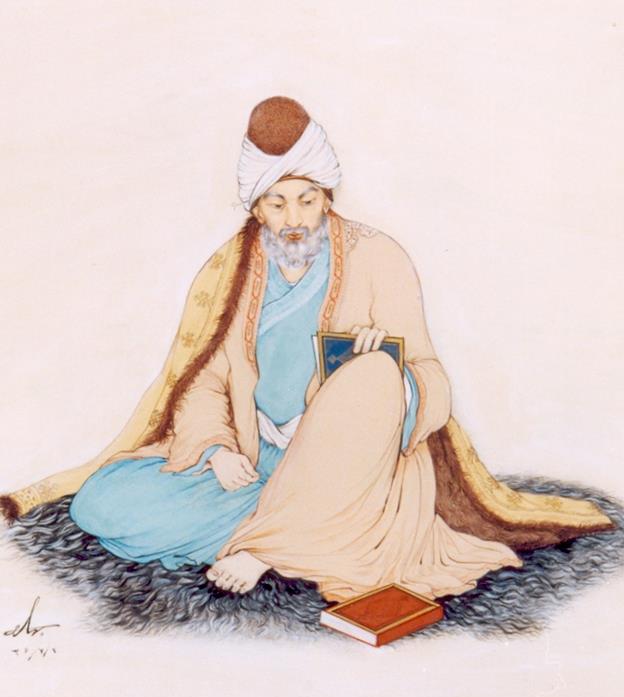
Jalal al-Din Rumi, often simply referred to as Rumi, is one of the most celebrated and revered poets in history. His influence extends beyond the boundaries of literature, touching the realms of spirituality, mysticism, and philosophy. Born on September 30, 1207, in what is now Afghanistan, Rumi’s life and works have left an indelible mark on Persian literature and Sufi thought. This article explores the life, fame, and enduring legacy of Rumi, providing detailed insights into his spiritual journey, literary contributions, and the historical context that shaped his philosophy.
Early Life and Background
Jalal al-Din Rumi was born in Balkh, a city located in the region of Khorasan, which is present-day Afghanistan. However, some sources suggest that he might have been born in Wakhsh, in modern-day Tajikistan. Rumi’s father, Baha ud-Din Walad, was a renowned jurist, mystic, and theologian, whose influence on Rumi was profound. Growing up in a household steeped in religious scholarship and mysticism, Rumi was exposed to the teachings of Islam from an early age.
In 1217, when Rumi was just ten years old, his family embarked on a pilgrimage to Mecca. This journey marked the beginning of a life defined by spiritual exploration and a deepening connection to the divine. The family’s travels continued as they fled the Mongol invasions, eventually settling in Konya, in present-day Turkey. This move was pivotal in Rumi’s life, as it placed him at the crossroads of various cultures and spiritual traditions.
Spiritual Apprenticeship and Scholarly Pursuits
Rumi’s early education was comprehensive, covering the Quran, Hadith, and Islamic jurisprudence, as well as the mystical teachings that would later define his work. His father, Baha ud-Din, played a crucial role in his education, not only as a parent but also as a spiritual guide. Following his father’s death, Rumi’s education continued under the tutelage of Sayyid Burhan al-Din Muhaqqiq, a prominent Islamic scholar and mystic. Sayyid Burhan al-Din became a father figure to Rumi, nurturing his intellectual and spiritual growth.
Rumi spent several years studying Islamic jurisprudence and theology in the cities of Aleppo and Damascus, which were major centers of learning at the time. These years of study deepened his understanding of Islamic law and spirituality, preparing him for the role of a spiritual leader and teacher. It was during this period that Rumi began to attract a following of students and disciples who were drawn to his profound insights and charismatic personality.
The Turning Point: Meeting Shams-i Tabriz
The most significant event in Rumi’s life came in 1244, when he met Shams-i Tabriz, a wandering dervish and mystic. This encounter transformed Rumi’s life and set him on a path of intense spiritual exploration. Shams-i Tabriz was an enigmatic figure whose teachings challenged Rumi to look beyond the conventional practices of Islam and delve into the deeper, mystical aspects of faith.
Shams became Rumi’s spiritual mentor, and their relationship was one of deep, transformative love and companionship. Shams introduced Rumi to the mystical practices of Sufism, emphasizing the importance of direct experience of God through love, rather than through strict adherence to religious doctrine. This period of intense spiritual communion led to a profound shift in Rumi’s outlook, inspiring him to compose some of his most famous works.
The relationship between Rumi and Shams was not without controversy. Shams’s influence on Rumi was so profound that it alienated some of Rumi’s followers and even members of his family. The mysterious disappearance of Shams, which remains a subject of speculation, plunged Rumi into deep sorrow. This grief, however, became the catalyst for an outpouring of creativity that would define Rumi’s legacy.
Literary Contributions and Poetic Mastery
Rumi’s literary output following Shams’s disappearance was nothing short of extraordinary. He began composing poetry that expressed the depths of his spiritual experiences and his longing for union with the divine. His poetry, much of which was inspired by his relationship with Shams, became a vehicle for conveying complex spiritual ideas in a language that was accessible and profoundly moving.
Rumi’s most famous work, the “Divan-i Shams-i Tabriz” (The Collected Poems of Shams of Tabriz), is a collection of lyric poetry that reflects his spiritual transformation. Comprising thousands of verses, the “Divan” is characterized by its passionate expressions of love, both human and divine. The poems in this collection are infused with Sufi themes of love, mysticism, and the pursuit of spiritual enlightenment.
Another monumental work by Rumi is the “Masnavi-yi Manavi” (Spiritual Couplets), a six-volume poem that has often been referred to as the “Persian Quran.” The “Masnavi” is a didactic work that explores a wide range of spiritual and ethical themes, offering guidance to those on the Sufi path. Through stories, parables, and metaphors, Rumi addresses the nature of the soul, the relationship between the individual and the divine, and the importance of love as the driving force of the universe.
The “Masnavi” has been translated into numerous languages and continues to be studied and revered by scholars and spiritual seekers around the world. Its influence extends beyond the Muslim world, resonating with people of diverse cultural and religious backgrounds. Rumi’s ability to convey universal truths through his poetry has earned him a place among the greatest poets in history.
Historical Context and Sufi Influence
To fully appreciate Rumi’s work, it is essential to understand the historical and cultural context in which he lived. The 13th century was a time of great upheaval in the Islamic world, marked by the Mongol invasions that devastated much of Central Asia and the Middle East. These invasions disrupted traditional power structures and led to the displacement of countless people, including Rumi and his family.
Amidst this chaos, Sufism, the mystical branch of Islam, offered a path of inner peace and spiritual fulfillment. Sufism emphasized the importance of direct experience of God, often through practices such as meditation, music, and dance. Rumi’s association with Sufism, particularly through his relationship with Shams-i Tabriz, profoundly influenced his work and his approach to spirituality.
Rumi’s poetry is steeped in the themes of Sufism, particularly the idea of love as a force that transcends the material world. For Rumi, love was not merely an emotion but a cosmic principle that governs the universe. His poems often explore the relationship between the lover and the Beloved, using this metaphor to illustrate the soul’s longing for union with God.
The influence of Sufism on Rumi’s work is also evident in the practices of the Mevlevi order, also known as the Whirling Dervishes, which was founded by Rumi’s followers after his death. The Mevlevi order incorporates dance and music into their rituals, using these art forms as a means of reaching spiritual ecstasy. The whirling dance, in particular, symbolizes the soul’s journey towards God, with the dervishes spinning in a state of meditative trance.
Legacy and Modern Relevance
Jalal al-Din Rumi’s impact on literature and spirituality has only grown over the centuries. His works have been translated into countless languages, and his poetry continues to resonate with readers around the world. In the West, Rumi has become one of the best-selling poets, with his works inspiring a wide range of artists, writers, and thinkers.
Rumi’s appeal lies in the universal themes that pervade his work—love, longing, and the quest for spiritual truth. His ability to articulate the human experience in a way that transcends cultural and religious boundaries has made him a timeless figure. In a world often divided by ideology and belief, Rumi’s message of love and unity remains as relevant today as it was in the 13th century.
Rumi’s influence extends beyond literature; it has permeated various aspects of popular culture. His poetry has been quoted by public figures, used in films, and set to music, bringing his message to new audiences. The Mevlevi order, with its iconic whirling dance, continues to perform around the world, keeping Rumi’s spiritual legacy alive.
Conclusion
Jalal al-Din Rumi’s life and work embody the essence of Sufi mysticism and the power of poetry to convey profound spiritual truths. From his early life in Khorasan to his later years in Konya, Rumi’s journey was one of constant exploration and deepening faith. His encounters with spiritual figures like Shams-i Tabriz and Ibn Arabi shaped his worldview and inspired a body of work that continues to enlighten and inspire.
Rumi’s legacy is a testament to the enduring power of love and the human spirit’s capacity for transcendence. His poetry speaks to the soul, inviting readers to embark on their own spiritual journeys and to seek the divine within themselves. As the world continues to discover and celebrate Rumi’s work, his message of unity, love, and spiritual awakening remains as vital as ever.


