
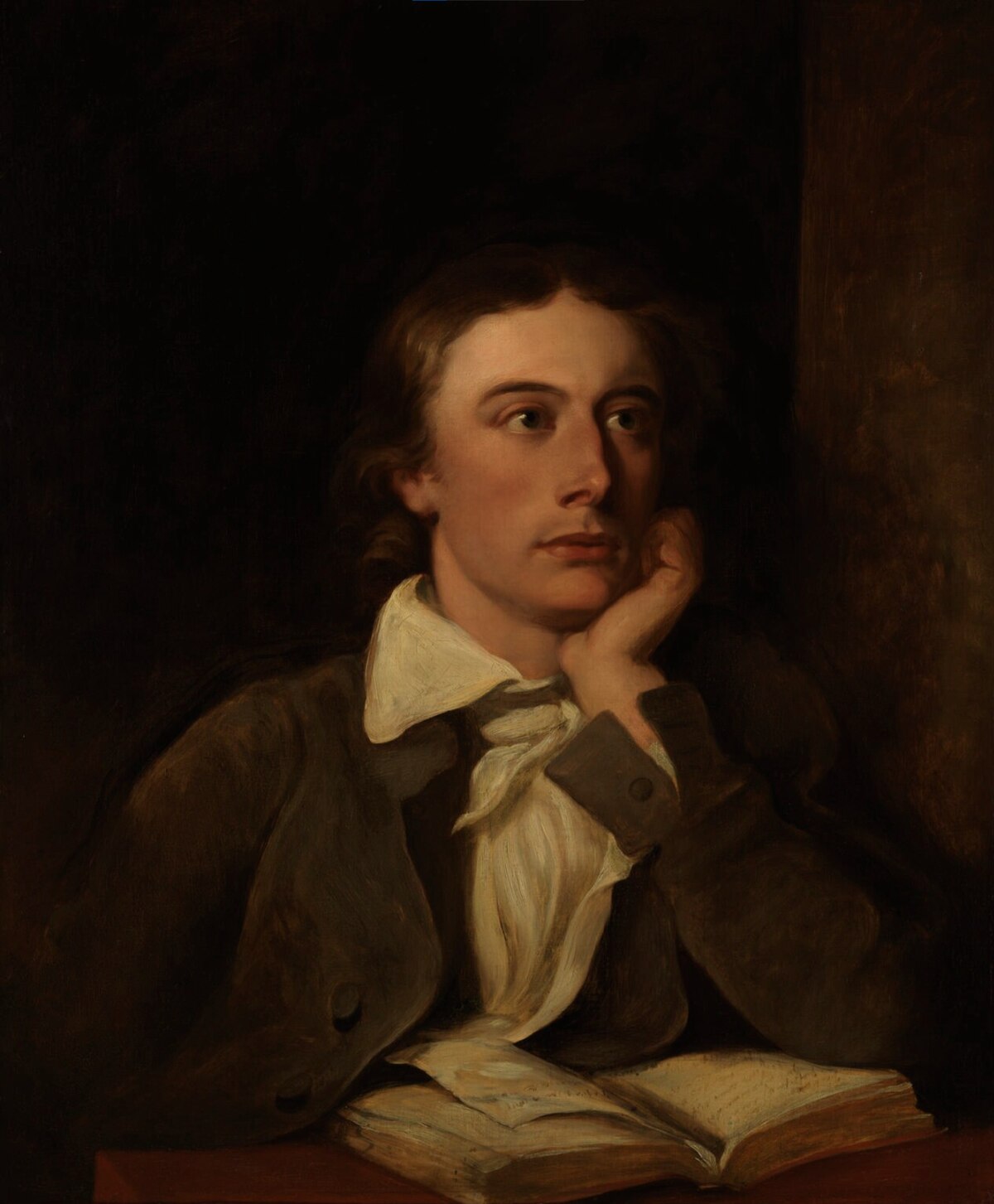
John Keats, born on October 31, 1795, in London, England, is one of the most celebrated poets of the Romantic era. Despite his short life, his poetic legacy has left an indelible mark on English literature. Keats’ works, renowned for their emotional depth, vivid imagery, and exploration of beauty, have continued to inspire readers and writers alike for over two centuries.
Early Life and Background
John Keats was born into a modest family in the London suburb of Moorgate. His father, Thomas Keats, managed a livery stable owned by his wife’s father, and his mother, Frances Jennings Keats, was known for her lively spirit and beauty. John was the eldest of five children, and his early years were marked by both familial warmth and a series of profound losses.
Tragedy struck early in Keats’ life when his father died in 1804 after falling from a horse. This event plunged the family into financial instability, and just a few years later, in 1810, Keats’ mother succumbed to tuberculosis. These losses had a profound impact on Keats, instilling in him a deep sensitivity to the fragility of life—a theme that would later permeate his poetry.
After his mother’s death, Keats and his siblings were placed under the guardianship of their grandmother, who in turn appointed Richard Abbey as their trustee. Abbey was a pragmatic and somewhat unscrupulous man who made decisions for the Keats children that were often more in his interest than theirs. Despite the challenges, Keats received a solid education at the Reverend Clarke’s school in Enfield, where he developed a passion for reading and a close friendship with Charles Cowden Clarke, the headmaster’s son.
Medical Studies and Literary Awakening
In 1811, Keats left school and was apprenticed to a surgeon-apothecary named Thomas Hammond. This apprenticeship marked the beginning of his formal medical training, a career path that his guardian Abbey strongly encouraged. However, Keats’ true passion lay in literature, a passion that blossomed during his time at Enfield, where he was introduced to classical literature and poetry.
While pursuing his medical studies at Guy’s Hospital in London, Keats continued to write poetry. In 1816, he passed his apothecary’s examination, allowing him to practice as a surgeon. Despite showing promise in the medical field, Keats found himself increasingly drawn to the literary world. His first published poem, “O Solitude,” appeared in The Examiner, a liberal magazine edited by Leigh Hunt, who would become a significant influence and mentor in Keats’ literary career.
Hunt was a central figure in the Romantic movement and introduced Keats to a circle of influential writers, including Percy Bysshe Shelley and William Hazlitt. Hunt also encouraged Keats’ writing and helped him publish his first collection of poems in 1817, simply titled Poems. Although the collection received little attention, it marked the beginning of Keats’ dedication to poetry.
Literary Career and Major Works
Keats’ early poetry was heavily influenced by the works of classical and Renaissance writers, as well as by contemporary Romantics like William Wordsworth. However, it was during 1817 and 1818 that Keats began to develop his unique voice, marked by a deep appreciation for beauty and a poignant awareness of life’s transience.
In 1818, Keats published Endymion, a lengthy narrative poem based on the Greek myth of the same name. The poem begins with the famous line, “A thing of beauty is a joy forever,” encapsulating Keats’ belief in the enduring power of beauty. However, Endymion was met with harsh criticism, particularly from the conservative literary magazines Blackwood’s Edinburgh Magazine and The Quarterly Review. The critics derided Keats’ work as overly ambitious and flawed, with one infamous review from Blackwood’s suggesting that Keats should return to his medical studies and abandon poetry.
The negative reviews deeply affected Keats, but they did not deter him from writing. In fact, the criticism seemed to galvanize him, leading to a period of intense creativity. During the spring and summer of 1819, Keats composed some of his most famous works, including his six great odes: Ode to a Nightingale, Ode on a Grecian Urn, Ode on Melancholy, Ode to Psyche, Ode to Indolence, and To Autumn.
These odes are widely regarded as masterpieces of English literature, each exploring complex themes such as beauty, mortality, and the relationship between the ideal and the real. In Ode to a Nightingale, for instance, Keats meditates on the fleeting nature of happiness and the inevitability of death, using the song of the nightingale as a symbol of transcendence and immortality. Similarly, in Ode on a Grecian Urn, Keats reflects on the timelessness of art, famously concluding that “Beauty is truth, truth beauty.”
To Autumn, often considered Keats’ most perfect poem, celebrates the richness and maturity of the autumn season, while also subtly acknowledging the impending decline that follows. The poem is a testament to Keats’ ability to find beauty in all stages of life, even as he faced his own mortality.
Personal Life and Tragic Love
Keats’ personal life during this period was marked by both joy and sorrow. In 1818, he met Fanny Brawne, a young woman who would become the great love of his life. Their relationship was passionate but fraught with difficulties, not least because of Keats’ deteriorating health and precarious financial situation.
By 1819, Keats was suffering from the first symptoms of tuberculosis, the same disease that had claimed his mother and brother. Despite his declining health, Keats continued to write, but his relationship with Fanny became increasingly strained as he struggled with feelings of inadequacy and despair. The couple became unofficially engaged, but Keats’ illness made it clear that marriage was unlikely.
In early 1820, Keats suffered a severe hemorrhage, a clear sign that his tuberculosis was advancing rapidly. His doctors advised him to move to a warmer climate in the hope that it might prolong his life. In September 1820, Keats left England for Italy, accompanied by his close friend, the artist Joseph Severn.
Final Years and Death in Rome
Keats arrived in Rome in November 1820, but his health continued to decline. He took up residence in a small apartment at 26 Piazza di Spagna, near the Spanish Steps, where he spent the last months of his life. Despite the efforts of Severn and his doctors, Keats’ condition worsened, and he became increasingly aware that he was nearing the end of his life.
Keats’ letters from this period reveal his profound sense of despair and hopelessness. In a letter to his friend Charles Brown, written on November 30, 1820, Keats expressed his belief that his “real life” had already ended and that he was merely living in a “posthumous existence.” He was plagued by thoughts of his unfulfilled potential and the knowledge that he would never see Fanny again.
On February 23, 1821, John Keats passed away at the age of 25. His final words, spoken to Severn, were, “Severn—I—lift me up—I am dying—I shall die easy—don’t be frightened—thank God it has come.” Keats was buried in the Protestant Cemetery in Rome, a peaceful resting place that he had chosen for its beauty. At his request, his gravestone bears the inscription, “Here lies One Whose Name was writ in Water,” a poignant reflection of his fear that he would be forgotten.
Legacy and Posthumous Fame
Contrary to Keats’ fears, his name was not “writ in water.” Although he died in relative obscurity, his work soon gained recognition and admiration. The publication of his letters and the efforts of his friends and fellow poets, such as Shelley and Byron, helped to establish Keats’ reputation as one of the greatest poets of the Romantic era.
Keats’ poetry, with its rich imagery, emotional depth, and exploration of beauty and mortality, has continued to resonate with readers across generations. His work has influenced countless poets and writers, and his life story, marked by creativity, love, and tragedy, has become emblematic of the Romantic ideal.
Today, John Keats is remembered not only for the beauty of his verse but also for his unwavering dedication to his art, even in the face of illness and adversity. His poems remain a testament to the enduring power of beauty and the human spirit, and his influence can be seen in the works of later poets such as Tennyson, Yeats, and Eliot.
The house where Keats spent his final days in Rome is now a museum, the Keats-Shelley House, dedicated to his memory and that of his fellow Romantic poets. Visitors from around the world come to pay homage to the poet who, in his brief life, captured the essence of beauty and the transience of human existence with unparalleled grace and sensitivity.


