
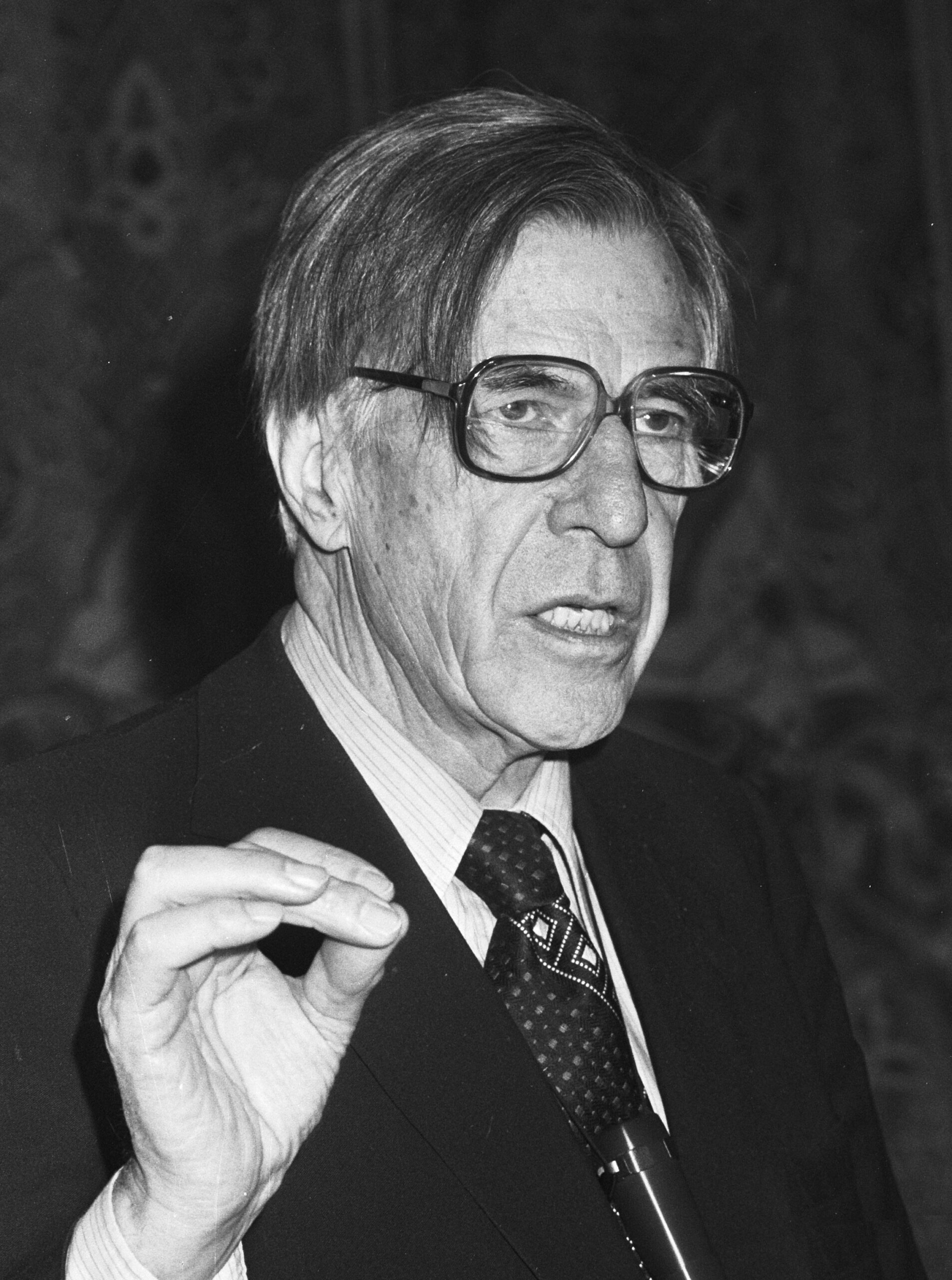
John Kenneth Galbraith stands as one of the most influential and distinguished economists of the 20th century. His life, spanning nearly a century, saw him deeply involved in the shaping of economic thought, public policy, and political discourse in the United States and beyond. This article provides an in-depth exploration of Galbraith’s life, from his early years in Canada to his rise as a key figure in American economic policy, and his enduring legacy in both academia and public life.
Early Life and Education
John Kenneth Galbraith was born on October 15, 1908, in Iona Station, Ontario, Canada. His upbringing in rural Canada imbued him with a practical understanding of the agricultural economy, which would later influence his economic theories. Galbraith pursued his early education at the Ontario Agricultural College, a part of the University of Toronto, where he earned a degree in agricultural economics.
Galbraith’s academic prowess led him to the United States, where he enrolled at the University of California, Berkeley. There, he earned a Master of Science in 1931 and later a Ph.D. in 1934. His doctoral thesis focused on the economics of agricultural production, a topic that resonated with his rural upbringing and laid the foundation for his future work.
Early Career and Academic Contributions
After completing his education, Galbraith began his academic career, holding teaching positions at several prestigious universities, including the University of California, Princeton University, and eventually Harvard University. It was at Harvard where Galbraith would make his most significant contributions to economic thought.
Galbraith’s early work was heavily influenced by the economic conditions of the Great Depression and the New Deal policies of President Franklin D. Roosevelt. He became a strong advocate of Keynesian economics, which emphasized the role of government intervention in stabilizing the economy. This alignment with Keynesian thought positioned Galbraith as a prominent voice in the academic and policy circles of his time.
Public Service and Political Involvement
John Kenneth Galbraith’s academic achievements soon led to opportunities in public service. During World War II, he was appointed as the Deputy Head of the Office of Price Administration, where he was responsible for controlling prices and preventing inflation during the war effort. His effectiveness in this role earned him the nickname “Supercommissioner of Prices,” highlighting his influence in managing the wartime economy.
Galbraith’s political engagement deepened when he became an advisor to several Democratic presidents, beginning with Franklin D. Roosevelt and later including John F. Kennedy, Lyndon B. Johnson, and Bill Clinton. His close association with the Kennedy administration was particularly notable, as he served as the U.S. Ambassador to India from 1961 to 1963. In this role, Galbraith played a crucial part in shaping U.S.-India relations during a critical period of the Cold War.
The Affluent Society and Economic Philosophy
Galbraith’s fame as an economist was cemented with the publication of his groundbreaking book, “The Affluent Society,” in 1958. In this work, Galbraith critiqued the prevailing economic thought that prioritized production and consumption above all else. He argued that while the United States had achieved unparalleled wealth in terms of consumer goods, it had neglected public services and infrastructure, leading to a society that was materially rich but socially impoverished.
“The Affluent Society” introduced the concept of “private affluence and public squalor,” highlighting the disparity between the wealth of individuals and the underfunded state of public goods such as education, healthcare, and infrastructure. Galbraith’s critique was both timely and prescient, as it resonated with the growing concerns of the 1960s regarding inequality and social justice.
The book forced policymakers and the public to reconsider the goals of economic growth, questioning whether the pursuit of material wealth alone was sufficient for a healthy and equitable society. “The Affluent Society” remains a seminal work in the field of economics, influencing generations of economists and policymakers.
Later Works and Continued Influence
Galbraith continued to write prolifically throughout his career, producing a series of influential books that expanded on his ideas and addressed new economic challenges. His 1967 book, “The New Industrial State,” argued that large corporations had become so powerful that they could shape both markets and government policies, leading to a distortion of the free market system. Galbraith warned that this concentration of power could undermine democracy and called for greater public control over economic life.
In 1977, Galbraith published “The Age of Uncertainty,” which was also adapted into a television series. This work explored the economic and social changes of the 20th century, focusing on the challenges posed by rapid technological advancement and the increasing complexity of global markets. Galbraith’s ability to communicate complex economic ideas to a broad audience made him a unique figure in the field, as he was able to bridge the gap between academia and the general public.
Galbraith’s later works continued to explore the themes of power, inequality, and the role of government in managing the economy. His 1983 book, “The Anatomy of Power,” examined the different forms of power in society and how they influence economic and political outcomes. This work underscored Galbraith’s belief that economic analysis could not be separated from the study of power and its impact on social relations.
Legacy and Impact
John Kenneth Galbraith’s impact on economics and public policy is difficult to overstate. His work challenged the orthodoxies of his time and offered a new vision of economics that prioritized social welfare and public goods. Galbraith’s critiques of consumerism, corporate power, and economic inequality remain relevant today, as policymakers continue to grapple with these issues in the 21st century.
In addition to his contributions to economic thought, Galbraith’s legacy includes his role as a public intellectual who engaged with the pressing issues of his time. He was a frequent commentator on economic and political matters, writing for major publications and appearing on television to discuss the issues of the day. His ability to communicate complex ideas in a clear and accessible manner made him a beloved figure among both scholars and the general public.
Galbraith’s influence extended beyond the academic and policy spheres. He was awarded more than fifty honorary degrees from universities around the world and was a member of numerous academic societies. His contributions to economics were recognized with the Presidential Medal of Freedom, one of the highest civilian honors in the United States.
Personal Life and Final Years
John Kenneth Galbraith’s personal life was as rich and varied as his professional career. He married Catherine Merriam Atwater in 1937, and the couple had four sons. Galbraith was known for his wit, charm, and towering intellect, qualities that made him a popular figure in both academic and social circles.
Despite his many achievements, Galbraith remained modest about his contributions, often deflecting praise with humor. He continued to write and speak on economic issues well into his later years, remaining active in public life until shortly before his death.
Galbraith passed away on April 29, 2006, at the age of 97, in Cambridge, Massachusetts. His death marked the end of an era in economics, as he was one of the last great public intellectuals who had a direct hand in shaping the policies and debates of the 20th century.
Conclusion
John Kenneth Galbraith’s life and work are a testament to the power of ideas and the importance of questioning the status quo. His critiques of consumerism, corporate power, and economic inequality challenged the dominant economic paradigms of his time and offered a new vision of economics that emphasized social welfare and the public good.
Galbraith’s legacy continues to influence economists, policymakers, and thinkers around the world. His work remains relevant in the 21st century, as the issues he addressed—inequality, the role of government, and the power of corporations—continue to shape the global economy.
As we reflect on Galbraith’s life and contributions, it is clear that he was more than just an economist; he was a visionary who used his intellect and influence to advocate for a more just and equitable society. His work serves as a reminder that economics is not just about numbers and markets, but about people and the quality of life in society. John Kenneth Galbraith will be remembered as one of the most important economic thinkers of the 20th century, and his ideas will continue to inspire future generations.


