
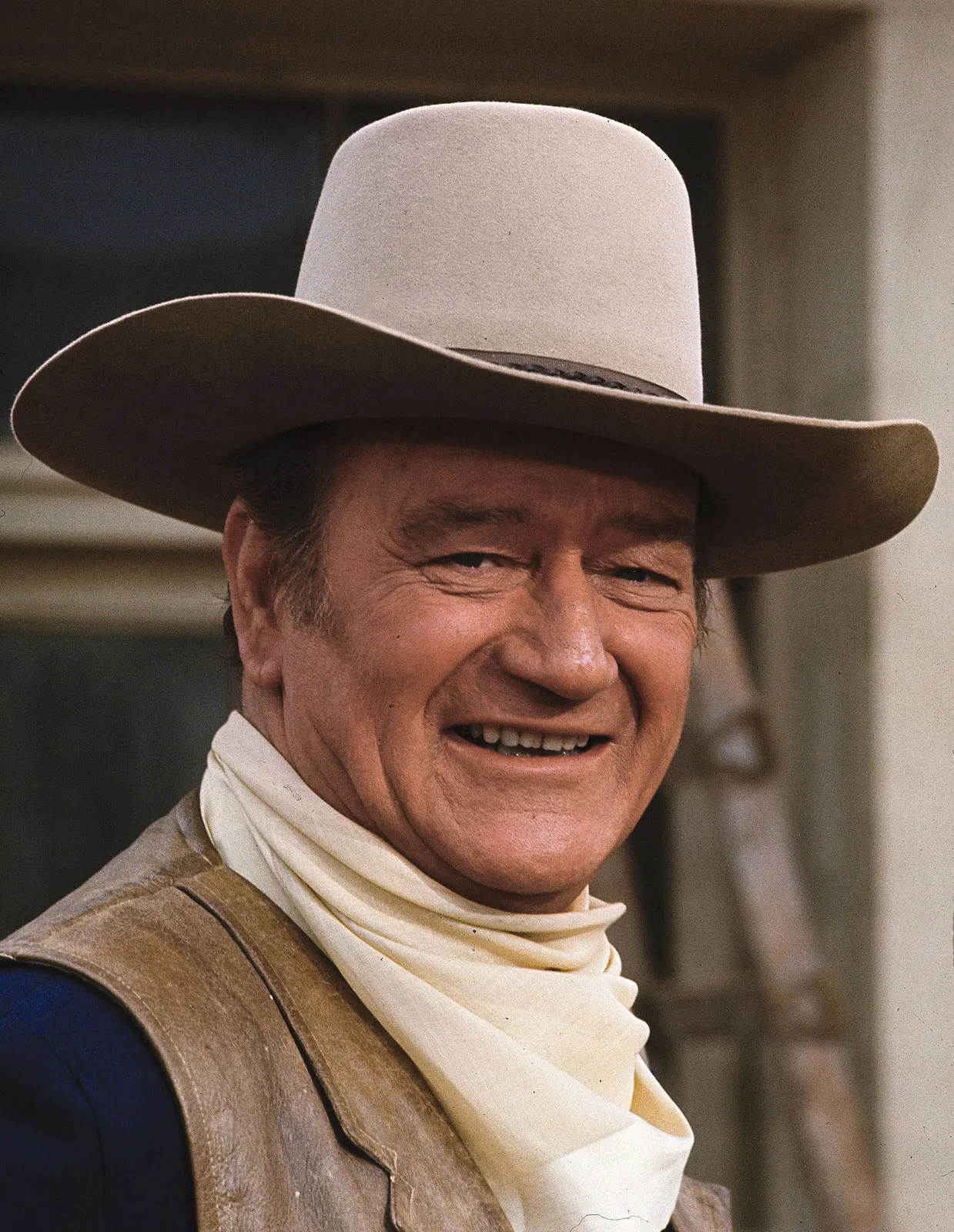
John Wayne, born Marion Michael Morrison on May 26, 1907, in Winterset, Iowa, is one of the most iconic figures in American cinema. Known as “The Duke,” Wayne became synonymous with the Western genre and American ideals of rugged individualism, honor, and patriotism. Over a career spanning more than five decades, he starred in over 250 films, leaving an indelible mark on Hollywood and American culture. Wayne’s legacy as a symbol of American masculinity and his embodiment of the frontier spirit have made him a lasting cultural icon.
Early Life and Introduction to Acting
John Wayne was born into a modest family in Winterset, Iowa, but moved to Southern California during his childhood. Growing up in the rural environment of California, Wayne was exposed to the tough life of cowboys and ranchers, an experience that would later inform many of his film roles. His early life was marked by a strong work ethic and an interest in sports, particularly football. Wayne was a capable student and an accomplished athlete, earning a scholarship to the University of Southern California (USC) in 1925, where he played on the football team.
Wayne’s path to Hollywood began almost by accident. After a shoulder injury ended his football career, he started working as a prop boy and extra on film sets. This behind-the-scenes work sparked his interest in acting, and he soon began appearing in small roles in low-budget Westerns. His athletic build, strong presence, and work ethic quickly caught the attention of directors and producers.
In 1930, director Raoul Walsh gave Wayne his first leading role in the film The Big Trail. Although the film was a box office disappointment, it was a significant step in Wayne’s career, setting the stage for his future as a leading man in Hollywood.
Breakthrough with Stagecoach and Rise to Fame
John Wayne’s career breakthrough came in 1939 with the release of Stagecoach, directed by John Ford. This film is often credited with revitalizing the Western genre and establishing Wayne as a major star. In Stagecoach, Wayne played the Ringo Kid, a character that embodied the virtues of courage, honor, and resilience—traits that would become synonymous with Wayne’s screen persona.
Stagecoach was both a critical and commercial success, and it marked the beginning of a long and fruitful collaboration between Wayne and Ford. The duo would go on to make numerous classic films together, including The Searchers (1956), The Man Who Shot Liberty Valance (1962), and The Quiet Man (1952). These films not only solidified Wayne’s reputation as a leading actor but also helped define the Western as a uniquely American genre.
Wayne’s performance in Stagecoach showcased his ability to portray a complex character with both toughness and vulnerability. This film was instrumental in establishing his image as the quintessential American hero, a role he would continue to play throughout his career.
The Icon of American Westerns
Throughout the 1940s and 1950s, John Wayne became the face of the Western genre, starring in a series of films that celebrated the mythology of the American West. His characters were often strong, silent types who adhered to a strict moral code, embodying the virtues of loyalty, bravery, and self-reliance. Films like Red River (1948), She Wore a Yellow Ribbon (1949), and Rio Bravo (1959) further entrenched his status as the archetypal cowboy.
Wayne’s portrayal of Western heroes resonated with audiences during a time when America was grappling with the uncertainties of World War II and the Cold War. His characters provided a sense of stability and moral clarity in an increasingly complex world. Wayne’s influence extended beyond the screen; he became a symbol of American patriotism, and his films often reflected the values and ideals of the time.
In 1949, Wayne received his first Academy Award nomination for his role in Sands of Iwo Jima, a film that highlighted his ability to portray military figures with the same authenticity and gravitas he brought to his Western roles. This film, along with his other war films, such as The Longest Day (1962) and They Were Expendable (1945), showcased his versatility and solidified his reputation as a leading man capable of carrying a wide range of films.
Personal Life and Political Involvement
Off-screen, John Wayne’s life was as complex and colorful as the characters he portrayed. He was known for his strong, often controversial, political views. A staunch conservative and ardent anti-communist, Wayne was heavily involved in politics, particularly during the height of the Red Scare in the 1940s and 1950s. He was a founding member of the Motion Picture Alliance for the Preservation of American Ideals, an organization that sought to combat communist influence in Hollywood.
Wayne’s political beliefs were often reflected in his choice of film roles and his public statements. His directorial debut, The Alamo (1960), was a passion project that depicted the legendary battle as a symbol of American heroism and sacrifice. The film was both a commercial success and a reflection of Wayne’s deeply held beliefs about American history and values.
In 1968, Wayne starred in The Green Berets, a film that supported U.S. involvement in the Vietnam War. The movie was one of the few Hollywood films to take a pro-Vietnam War stance, and it was met with mixed reviews. Despite the controversy, Wayne remained unapologetic in his support of the war and his broader political views.
Wayne’s personal life was also marked by a series of marriages and relationships. He was married three times and had seven children. Despite his tough on-screen persona, those who knew him described Wayne as a man with a tender heart, particularly when it came to his family and close friends.
Later Career and Legacy
As John Wayne entered the later stages of his career, he continued to take on roles that reinforced his status as a symbol of American masculinity and heroism. In 1969, Wayne won the Academy Award for Best Actor for his performance in True Grit, where he portrayed Rooster Cogburn, a rough-and-tumble U.S. Marshal. This role, which combined elements of humor, toughness, and vulnerability, was one of Wayne’s most celebrated performances and is often considered the pinnacle of his career.
Wayne continued to work throughout the 1970s, starring in films like The Cowboys (1972), Cahill U.S. Marshal (1973), and The Shootist (1976). The Shootist, which was Wayne’s final film, is particularly poignant as it tells the story of an aging gunfighter battling cancer, a reflection of Wayne’s own struggle with the disease at the time.
Despite facing health challenges, including a battle with lung cancer in the 1960s, Wayne remained a towering figure in Hollywood until his death. He passed away on June 11, 1979, at the age of 72, after a long battle with stomach cancer. His death marked the end of an era in Hollywood, but his legacy as an American icon continues to endure.
Cultural Impact and Enduring Legacy
John Wayne’s impact on American culture is profound and far-reaching. He is often cited as the embodiment of the “American Dream,” a self-made man who rose to the pinnacle of Hollywood stardom through hard work, determination, and an unwavering belief in his values. Wayne’s films continue to be celebrated for their portrayal of American ideals, and his influence can be seen in the work of countless actors, directors, and filmmakers who followed in his footsteps.
Wayne’s legacy extends beyond the silver screen. He is commemorated through various awards, honors, and memorials, including the John Wayne Cancer Foundation, which was established by his family to fund cancer research and education. His larger-than-life persona has been immortalized in countless books, documentaries, and retrospectives that examine his contributions to cinema and his impact on American society.
Even decades after his death, John Wayne remains a symbol of the rugged, independent spirit that is often associated with the American West. His portrayal of strong, principled characters continues to resonate with audiences, and his films are still regarded as classics of American cinema.
Conclusion
John Wayne was more than just a movie star; he was a cultural icon who represented the best of what America aspired to be. His performances in Westerns and war films created a lasting image of the American hero—tough, honorable, and unwavering in his commitment to justice and freedom. Wayne’s influence on the film industry and his role in shaping American identity are undeniable, making him one of the most significant figures in the history of cinema.
As we reflect on John Wayne’s life and career, it is clear that his legacy will continue to endure for generations to come. His films remain a testament to his talent, his dedication to his craft, and his belief in the values that define the American experience. John Wayne will forever be remembered as the quintessential American icon, a man whose life and work have left an indelible mark on Hollywood and the world.


