
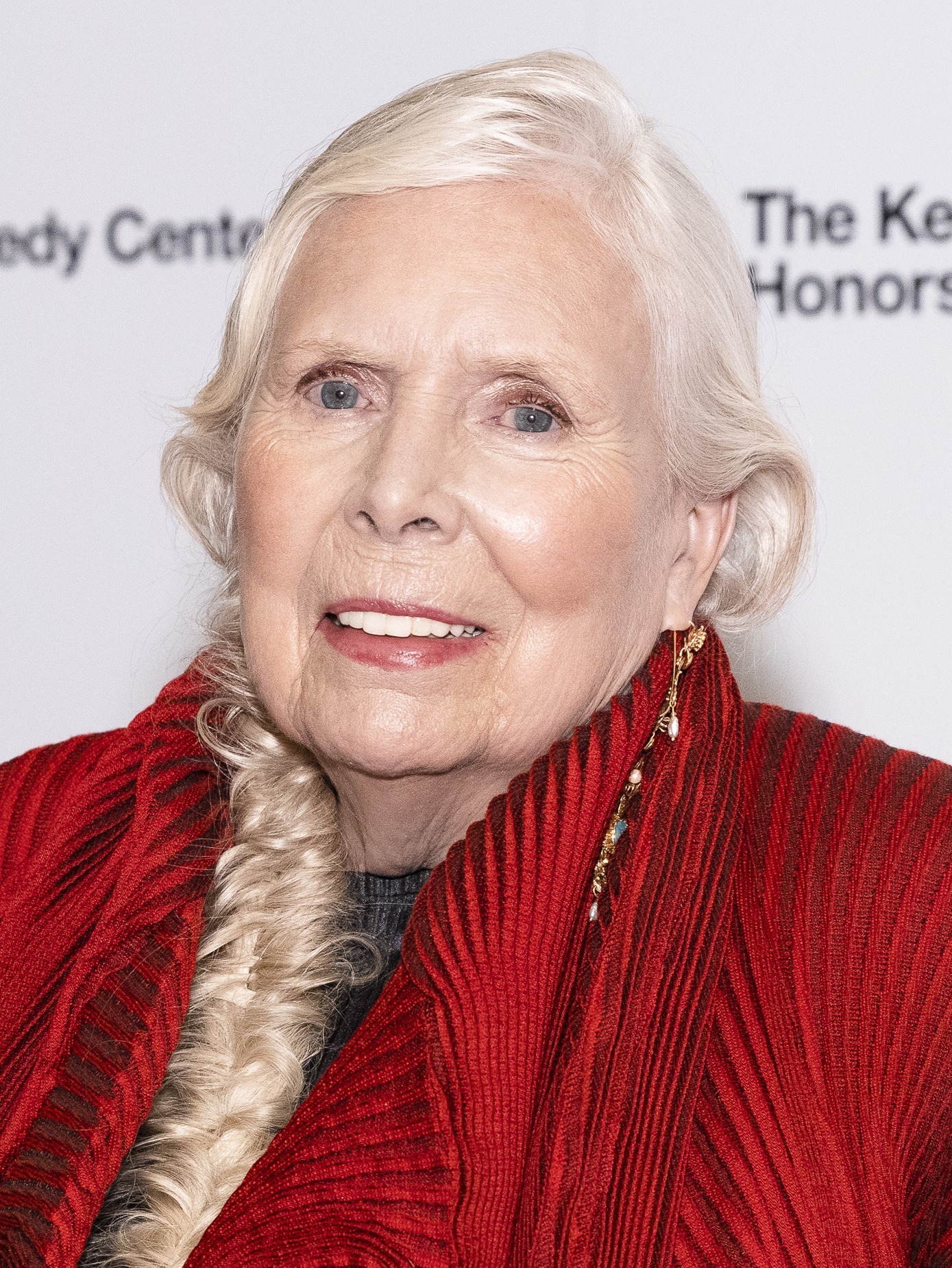
Joni Mitchell, born Roberta Joan Anderson on November 7, 1943, in Fort Macleod, Alberta, Canada, is one of the most influential singer-songwriters and musicians of the 20th century. Renowned for her poetic lyrics, intricate melodies, and innovative use of harmony, Mitchell’s work has left an indelible mark on the music industry. Her journey from a small town in Canada to becoming an iconic figure in folk, rock, and jazz is a testament to her artistic vision and resilience.
Early Life and Musical Beginnings
Joni Mitchell was born into a middle-class family, the daughter of Myrtle, a schoolteacher, and William Anderson, a Royal Canadian Air Force flight lieutenant. Her family moved frequently during her childhood, eventually settling in Saskatoon, Saskatchewan, a place that Mitchell often refers to as her hometown. Growing up in the prairies of Canada deeply influenced her artistic sensibilities, evident in the vivid imagery and themes of nature that pervade her work.
Mitchell’s early life was marked by challenges, including a bout with polio at the age of nine, which left her hospitalized for weeks. During this time, she developed a deep love for music and the arts, initially through painting and later through poetry and songwriting. Despite her initial interest in piano, she abandoned formal lessons because her teacher discouraged her from composing her own music. Undeterred, she picked up the ukulele and began performing in local venues, laying the foundation for her future career.
Her passion for music continued through her teenage years, and after high school, she attended the Alberta College of Art in Calgary. However, she found the academic environment uninspiring and left to pursue her dream of becoming a folk singer. This decision marked the beginning of her journey into the world of music.
The Move to Toronto and Early Career Struggles
In the mid-1960s, Joni Mitchell moved to Toronto, determined to establish herself as a folk musician. Toronto, with its burgeoning folk scene, offered a fertile ground for her to hone her craft. However, her early years were not easy. Mitchell struggled to find steady work as a musician due to the requirements of union membership, which she could not afford at the time. To make ends meet, she took a job as a sales clerk in a department store, all the while performing in local coffeehouses and clubs.
In 1964, Mitchell faced another personal challenge when she became pregnant and gave birth to a daughter. Unable to support her child, she made the heart-wrenching decision to place her daughter for adoption—a decision that would haunt her and later inspire some of her most poignant songs. Around this time, she met Chuck Mitchell, a fellow musician, whom she married in 1965. The couple moved to Detroit, where they performed as a folk duo. However, the marriage was short-lived, and they divorced in 1967.
After the breakup, Mitchell moved to New York City, where she decided to pursue a solo career. Her time in New York proved to be a turning point. Mitchell’s songwriting talents began to gain recognition among her peers, including established artists like Judy Collins, Dave Van Ronk, and Buffy Sainte-Marie. It was during this period that she adopted the stage name Joni Mitchell, a name that would soon become synonymous with lyrical brilliance and musical innovation.
Breakthrough Success and the 1960s Folk Scene
Joni Mitchell’s big break came when she was discovered by David Crosby of Crosby, Stills, Nash & Young. Impressed by her unique voice and songwriting, Crosby helped Mitchell secure a recording contract with Reprise Records. In 1968, she released her debut album, Song to a Seagull, produced by Crosby. The album, with its acoustic sound and introspective lyrics, was a critical success and established Mitchell as a significant new voice in the folk music scene.
Mitchell’s second album, Clouds (1969), solidified her reputation as a songwriter. Featuring hits like “Both Sides, Now” and “Chelsea Morning,” Clouds earned Mitchell her first Grammy Award for Best Folk Performance. The success of this album allowed her to move to Los Angeles, where she became part of the burgeoning Laurel Canyon music scene, a community of artists that included Crosby, Graham Nash, and Jackson Browne.
During this period, Mitchell released her third album, Ladies of the Canyon (1970), which included some of her most famous songs, such as “Big Yellow Taxi” and “Woodstock.” The album’s success further propelled her into the spotlight, and Mitchell quickly became one of the leading figures in the folk and rock music scenes.
The Evolution of Joni Mitchell’s Sound in the 1970s
The 1970s marked a period of significant artistic growth for Joni Mitchell. Her music began to evolve beyond the folk genre, incorporating elements of jazz, pop, and rock. This experimentation with different musical styles was evident in her 1971 album Blue, which is often hailed as one of the greatest albums of all time. Blue is a deeply personal record, reflecting Mitchell’s emotional state following the end of a relationship. Songs like “River” and “A Case of You” showcased her ability to convey raw emotion through her lyrics and melodies.
Following Blue, Mitchell continued to push the boundaries of her music. Her 1972 album, For the Roses, featured more complex arrangements and orchestration, blending folk with pop and jazz influences. This trend continued with Court and Spark (1974), which became her best-selling album and included the hit single “Help Me.” The album marked a shift towards a more mainstream sound, incorporating elements of pop and jazz that appealed to a broader audience.
Mitchell’s experimentation reached new heights with the release of The Hissing of Summer Lawns (1975), which was met with mixed reviews but has since been recognized as a groundbreaking work. The album featured intricate arrangements and complex lyrics that explored themes of gender, power, and identity. Despite the initial lukewarm reception, The Hissing of Summer Lawns has come to be seen as one of Mitchell’s most innovative works.
Her next albums, Hejira (1976) and Don Juan’s Reckless Daughter (1977), continued her exploration of jazz and world music, incorporating experimental sounds and structures. Don Juan’s Reckless Daughter was a double album, showcasing Mitchell’s willingness to take risks and defy industry expectations. Although not commercially successful, these albums solidified her reputation as an artist who was unafraid to challenge herself and her audience.
The 1980s: Experimentation and Reinvention
The 1980s were a decade of significant change for Joni Mitchell, both personally and professionally. Her music during this period reflected her growing interest in electronic sounds and production techniques. In 1982, she released Wild Things Run Fast, an album that marked a departure from her previous work and embraced a more pop-oriented sound. The album was a commercial success, but it also alienated some of her longtime fans who preferred her earlier, more acoustic work.
Mitchell continued to experiment with new sounds on her 1985 album Dog Eat Dog, which featured heavy use of synthesizers and drum machines. Produced by British musician Thomas Dolby, the album addressed contemporary social and political issues, showcasing Mitchell’s ability to adapt to changing musical landscapes while remaining true to her lyrical style.
Her 1988 album Chalk Mark in a Rain Storm further explored electronic and experimental music, featuring collaborations with artists like Peter Gabriel and Billy Idol. The album was well-received by critics but did not achieve the same level of commercial success as her earlier work. Despite this, Mitchell’s willingness to push the boundaries of her music and explore new genres kept her at the forefront of the music industry.
Resurgence in the 1990s and 2000s
The 1990s saw a resurgence of interest in Joni Mitchell’s work, as a new generation of artists and fans discovered her music. In 1991, she released Night Ride Home, an album that returned to a more acoustic sound and was praised by critics for its introspective lyrics and sophisticated arrangements. The album marked the beginning of a renewed appreciation for Mitchell’s artistry, with many critics recognizing her influence on contemporary music.
In 1994, Mitchell released Turbulent Indigo, an album that dealt with themes of love, loss, and societal issues. The album was acclaimed by critics and won Mitchell a Grammy Award for Best Pop Album. The cover of Turbulent Indigo featured a self-portrait of Mitchell in the style of Vincent van Gogh, reflecting her deep connection to visual art, which had always been a parallel passion alongside her music.
During this period, Mitchell also received numerous accolades, including induction into the Rock and Roll Hall of Fame in 1997. She was the first Canadian woman to receive this honor, cementing her legacy as one of the most influential artists of her generation.
In 2000, Mitchell released Both Sides Now, an album of orchestral jazz standards, along with re-recordings of some of her earlier songs. The album was a critical success and showcased Mitchell’s versatility as a musician. However, she soon announced her retirement from music, expressing frustration with the music industry and a desire to focus on her painting.
Despite her retirement, Mitchell continued to release archival material and compilations, including The Beginning of Survival (2004) and Songs of a Prairie Girl (2005). These releases further solidified her status as a pioneering artist who had left an indelible mark on the music industry.
The Later Years: Health Struggles and Legacy
In 2015, Joni Mitchell suffered a brain aneurysm, which left her temporarily unable to speak or walk. However, she made a remarkable recovery and returned to public life, although she remained largely out of the spotlight. Despite her health challenges, Mitchell’s influence on the music world continued to grow, with many contemporary artists citing her as a major inspiration.
In 2022, Mitchell made a surprise return to the stage at the Newport Folk Festival, performing for the first time in over 20 years. The performance was a triumphant moment for Mitchell and her fans, reaffirming her place as one of the greatest artists of all time.
Conclusion: The Enduring Legacy of Joni Mitchell
Joni Mitchell’s life and career are a testament to her incredible talent, resilience, and dedication to her craft. From her early days as a struggling folk singer in Toronto to her status as a global music icon, Mitchell has continually pushed the boundaries of what is possible in music and art. Her work has inspired generations of musicians, and her influence can be seen in the work of countless contemporary artists.
Mitchell’s ability to blend deeply personal lyrics with innovative musical compositions has earned her a place among the most important figures in the history of popular music. Her legacy is one of artistic integrity, fearless experimentation, and a deep connection to the human experience.
As she continues to be celebrated by fans and fellow musicians alike, Joni Mitchell’s music remains as relevant and powerful today as it was when she first burst onto the scene over five decades ago. Her contributions to the world of music and art will undoubtedly continue to resonate for many years to come.


